
FundCount
FundCount brings portfolio, partnership, and general ledger accounting together for investment analysis and reporting.
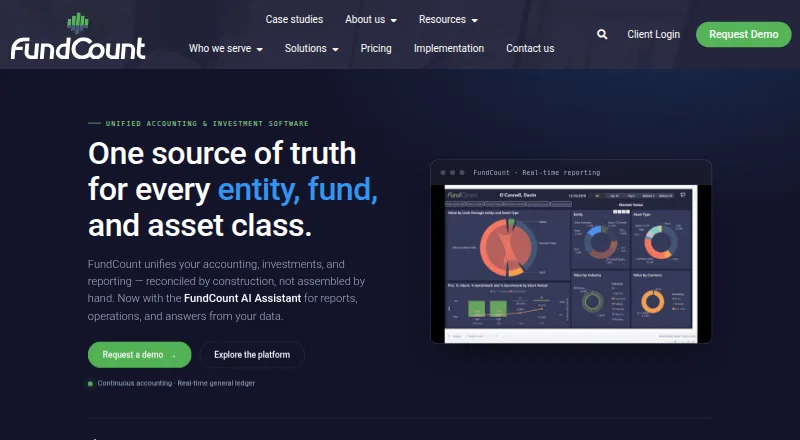
What FundCount is
FundCount brings portfolio, partnership, and general ledger accounting together for investment analysis and reporting. Its portfolio accounting covers listed securities, fixed income, OTC derivatives, private equity, real estate, and other alternatives. Partnership tools handle capital accounts, allocations, waterfalls, fees, and profit splits. Users can create reports ranging from tables and charts to complex visualizations; client community members can also access sample reports through the Report Encyclopedia. FundCount imports Excel, CSV, text, and XML data and connects with banks, brokers, and custodians. It supports on-site, public or private cloud, and fully managed SaaS deployment, and can run in a browser without locally installed plug-ins. The investor portal offers permissioned access, document delivery, and multi-factor authentication. There is no free plan or trial; prospective customers can request a guided proof of concept using their own data and reports.
Good
- Combines portfolio, partnership, and general ledger accounting
- Covers listed securities and alternative investments
- Imports Excel, CSV, text, and XML data
- Investor portal includes multi-factor authentication
Watch out
- No free plan or trial
Who it suits
FundCount is aimed at family offices, fund administrators, hedge funds, and private equity firms. Its accounting and reporting features suit organizations handling multiple asset classes or partnership structures.
Verdict
FundCount combines investment accounting, data importing, and reporting across a range of asset classes. Consider the starting price and additional fees when assessing whether its capabilities fit your organization.
Plans and prices
From FundCount's own pricing page, checked 28 Sep 2026.
| Plan | Price | What it gives you |
|---|---|---|
| Single Family Office / Asset Owner | $35,899 a year | Any asset class · Automated data feeds · Full financials on demand · Starting from $35,899 / year; + digital transformation & hosting fees |
| Multi-Family Office | $26,950 a year | Customized family reporting · US tax reporting: K-1, 1065, Schedule D, 1099 · Starting from $26,950 / year; + digital transformation & hosting fees |
| Fund Admin Incubator | $14,450 a year | Up to 5 funds · US$50M AUA per fund · 1 user · Starting from $14,450 / year; $6,450 per additional fund · + digital transformation & hosting fees |
| Shadow Hedge Fund | $35,899 a year | For funds serviced by an administrator · On-site or single-client secure cloud · Starting from $35,899 / year; + digital transformation & hosting fees |
| FundCount Sandbox | $499 a month | experienced investment-systems users · try before buying · per month |
| High-Net-Worth Individual | $4,000 a year | up to $30M · up to 3 users · 100+ reports · accounts payable · self-starter training · 1 user per year |
| Average entry license | $25,000 a year | customer support · maintenance releases and upgrades · annual subscription |
| Asset Management starting price | $35,899 a year | digital-transformation and hosting fees apply · per year |
| Fund Administration | Priced on request | integrated investment, partnership and general-ledger accounting · white-labeled reports · client self-service |
| Private Equity | Priced on request | fundraising and deal flow · equity, loan and hybrid structures · waterfall calculations |
| Family Office | Priced on request | multi-family-office aggregation · automated feeds · reconciliations · full financials |
| Asset Management | Priced on request | all asset classes · partnership accounting · on-premises, private cloud or SaaS |
| Hedge Fund | Priced on request | secure single-client cloud or on-premises · light implementation |
The facts
Each one read from FundCount's own pages, with the date it was checked.
What it does
- AI document intelligence
- Its AI assistant extracts information from alternative-investment statements and can post the results into the books.checked 15 Oct 2026
- API
- The infrastructure diagram shows a REST API for imports, exports, custom reports, audit management, backups and other integrations.checked 15 Oct 2026
- API workflow limit
- FundCount’s API guidance says available fields, refresh timing, credentials, failures, duplicates and source-format changes must be validated for each connection.checked 15 Oct 2026
- Architecture
- The product uses a three-tier database-server, application-server and client architecture, and the FAQ says it is written in pure Java.checked 15 Oct 2026
- Architecture and access
- The FAQ describes a Java three-tier architecture and says the software can run through a web browser without locally installed plug-ins.checked 28 Sep 2026
- Audience
- FundCount says it serves family offices, fund administrators, hedge funds, and private equity firms.checked 28 Sep 2026
- Data aggregation
- FundCount advertises more than 50 native custodian and broker connectors plus Bloomberg and Refinitiv pricing and foreign-exchange feeds.checked 15 Oct 2026
- Data integrations
- FundCount says it has interfaces with dozens of banks, brokers, and custodians and imports data through its ETL Importer, including Excel, CSV, text, and XML formats.checked 28 Sep 2026
- Deployment
- FundCount can run on premises, in a private or public cloud, or as a fully managed single-tenant SaaS environment.checked 15 Oct 2026
- Documentation
- The implementation page says the customer knowledge base contains more than 1,000 articles and FundCount Academy provides e-learning and webinars.checked 15 Oct 2026
- General ledger
- FundCount provides a real-time, multi-entity and multi-currency ledger with journals, intercompany accounting and consolidations.checked 15 Oct 2026
- Investor portal
- The investor portal offers permissioned access, document delivery, multifactor authentication and activity controls.checked 15 Oct 2026
- Legal name
- Crunchbase identifies the legal name as FundCount Group Ltd. and lists Alex Ivanov as CEO and founder.checked 15 Oct 2026
- Licence
- An independent software directory classifies FundCount licensing as proprietary and lists cloud-hosted, on-premises, web, Windows and Linux deployment.checked 15 Oct 2026
- Limit: asset fit
- A Capterra reviewer says FundCount is better suited to liquid strategies than non-liquid funds.checked 15 Oct 2026
- Limit: extra fees
- A Capterra review notes that some functionality carries an additional fee.checked 15 Oct 2026
- Limit: learning curve
- A Capterra reviewer reports a learning curve even though training materials are available.checked 15 Oct 2026
Where it runs
- Browser access
- Users can access FundCount through Chrome or another modern browser without installing software, while the optional thin client needs about 1 GB RAM.checked 15 Oct 2026
The company
- Company facts
- LinkedIn lists FundCount as privately held, founded in 1999, headquartered in Christ Church, Barbados, with 51–200 employees and offices in Boston, Toronto, Singapore and Dubai.checked 15 Oct 2026
- Company scale
- FundCount’s home page says the platform covers more than $100 billion in assets, operates in 25 countries and has more than 27 years of expertise.checked 15 Oct 2026
- Founded
- 1999checked 23 Sep 2026
- Headquarters
- Barbadoschecked 23 Sep 2026
Money
- Free plan
- Nochecked 21 Sep 2026
- Limit: price
- A Capterra reviewer says the product can be expensive for some companies, while GetApp reports a starting annual price above $21,000.checked 15 Oct 2026
The full review of FundCount
FundCount is an investment accounting and reporting platform that brings portfolio, partnership, and general ledger accounting together. It is best suited to family offices, fund administrators, hedge funds, and private equity firms with varied assets and reporting needs. Its breadth is compelling, but high starting prices and additional fees make it a poor fit for buyers seeking lightweight or low-cost software.
Overview
FundCount covers listed securities, fixed income, OTC derivatives, private equity, real estate, and other alternatives. Its combination of portfolio accounting, partnership accounting, and general ledger functions can give organizations a shared basis for analysis and reporting across those holdings. Partnership tools address capital accounts, allocations, waterfalls, fees, and profit splits, making the product relevant to firms managing investor-level economics as well as investments.
Data can be brought in through interfaces with banks, brokers, and custodians, or through an ETL importer that accepts Excel, CSV, text, and XML. Named sources include Bloomberg and Refinitiv for prices and corporate actions, and Pershing, BNY, and Goldman for custodian and prime-broker feeds. That range should help reduce manual consolidation for organizations whose providers are covered, though the fit still depends on their specific data sources.
Reporting spans tables, charts, and complex visualizations. The Report Encyclopedia gives client community members hundreds of samples to draw on. Security controls include period locks, user permissions, and audit trails; the investor portal adds permissioned access, document delivery, and multi-factor authentication. FundCount identifies itself as SOC 2 Type II and AICPA examined.
Key features
- Multi-asset accounting: The portfolio engine covers public and private assets, while partnership accounting handles allocations, fees, and profit splits. This is a strong match for organizations with both investment and partnership-accounting complexity.
- Importing and integrations: Dozens of bank, broker, and custodian interfaces, plus file-based importing, support consolidated workflows. Buyers should confirm that their counterparties and feed requirements are covered.
- Reporting and investor access: Flexible report formats and a sample library support varied reporting demands; the permissioned portal supports document delivery with multi-factor authentication.
- Deployment and access: FundCount offers on-site, public- or private-cloud, and fully managed SaaS deployment. Its Java three-tier architecture runs through a browser without locally installed plug-ins.
- Guided proof of concept: Prospective customers can work with FundCount in guided sessions using their own data and reports, a useful way to assess fit before committing.
Pricing
FundCount is paid software with no free plan or free trial. Published starting prices run from $14,450/yr to $38,389/yr, and every plan below carries additional digital transformation and hosting fees. The proof of concept is guided access, not a free trial.
- Fund Admin Incubator — Starting from $14,450 / year: Includes up to 5 funds, US$50M AUA per fund, and 1 user; each additional fund costs $6,450. This is the entry point for a small fund administration operation, but the fund, asset, and seat limits are material constraints.
- Multi-Family Office — Starting from $26,950 / year: Includes customized family reporting and US tax reporting for K-1, 1065, Schedule D, and 1099. It suits firms needing family-specific outputs and those tax forms, at a lower starting price than the single-family plan.
- Fund Administration — Starting from $26,950 / year: Combines investment, partnership, and general ledger accounting with white-labeled reports and look-through reporting. It is aimed at administrators needing investor-facing branded outputs and consolidated visibility.
- Single Family Office / Asset Owner — Starting from $35,899 / year: Covers any asset class, automated data feeds, and full financials on demand. It is the broader family-office option for owners with diverse holdings and a need for automated feeds.
- Hedge Fund — Starting from $35,899 / year: Intended for funds not serviced by an administrator, with NAV by fund, class, side pocket, partner, or series.
- Shadow Hedge Fund — Starting from $35,899 / year: For funds serviced by an administrator, with on-site or single-client secure cloud deployment. The distinction from the Hedge Fund plan is the administrator relationship and deployment choice.
- Asset Management — Starting from $35,899 / year: Includes multi-entity reporting and on-site, public- or private-cloud, or fully managed SaaS deployment.
- Private Equity — Starting from $38,389 / year: Supports equity, loan, convertible, and hybrid structures, plus waterfall calculations. Its higher starting price is targeted at firms needing those private-equity-specific structures.
Each price is a starting point, not a complete total, because digital transformation and hosting fees are additional. Organizations should also weigh the Incubator's one-user cap and per-fund charge against their expected scale.
Platforms
FundCount supports API, Linux, macOS, self-hosted, web, and Windows environments. Its deployment options accommodate organizations that want on-site or cloud hosting, while browser access avoids a locally installed plug-in requirement.
Who it's for
FundCount is most compelling for family offices, fund administrators, hedge funds, asset managers, and private equity firms that need accounting across multiple asset types and detailed reporting. The breadth of accounting and deployment choices can justify the investment for organizations with complex operations. Smaller teams with limited requirements may find the annual starting prices, added fees, or the Incubator's caps hard to justify.
Pros and cons
- Pro: Portfolio, partnership, and general ledger accounting sit on one platform, reducing the need to separate those functions across tools.
- Pro: Broad asset coverage, data imports, and named market and custodian feeds serve organizations consolidating varied holdings.
- Pro: Deployment options range from on-site to fully managed SaaS, with browser access that does not require local plug-ins.
- Con: Starting prices are substantial, and digital transformation and hosting fees are additional, raising the total cost beyond the headline figures.
- Con: The lowest-priced Incubator plan is limited to 5 funds, US$50M AUA per fund, and 1 user; additional funds cost $6,450 each.
- Con: There is no free plan or free trial, so prospective buyers need a guided proof of concept to evaluate the software with their own data.
Alternatives
For a different investment-accounting shortlist, see Investment Accounting Software; for broader family-office options, see Family Office Software; and for portfolio-focused tools, see Portfolio Management Software.
- Enfusion is worth considering if iOS access matters; its Enfusion by Clearwater plan is available by demo request with no commitment or contract required.
- FIS Data Integrity Manager is a paid, web-based alternative.
- Juniper Square is a paid option with Android, iOS, API, and web platforms.
- WealthSpectrum is a paid alternative with Android, iOS, API, web, and self-hosted platforms.
- Allvue Investment Management offers a web-based portfolio management plan, with pricing handled through a demo request.
- Dynamo CRM & Deal Management is a paid alternative with mobile and web platforms; ballpark pricing is available through a demo request.
- AnyVault is another paid, web-based option.
- AtlasFive is designed for staffed family offices with $500M+ of wealth, and pricing typically starts in the six figures annually according to deployment scope.
Verdict
FundCount is a strong choice for established investment organizations that need multi-asset accounting, partnership workflows, and flexible reporting in one system. Its broad accounting coverage and deployment options are the main reasons to choose it; the substantial starting prices, extra fees, and narrow entry-plan limits are reasons smaller or simpler operations should look elsewhere.
Getting started
- Visit https://fundcount.com/.
- Choose a plan for your organization type.
- Arrange a guided proof-of-concept session using your own data and reports.
- Select on-site, public or private cloud, or fully managed SaaS deployment.
Limits worth knowing
Fund Admin Incubator starts at $14,450 per year and covers up to five funds, US$50M AUA per fund, and one user; each additional fund costs $6,450. All listed plans add digital transformation and hosting fees.
Questions
How much does FundCount cost?
Digital transformation and hosting fees are additional.
Is there a free plan or trial?
There is no free plan or free trial. FundCount offers guided proof-of-concept sessions where prospective customers can use their own data and reports.
Which platforms does FundCount support?
Its platforms include API, Linux, macOS, self-hosted, web, and Windows. The software can run through a browser without locally installed plug-ins.
What kinds of organizations does it serve?
FundCount says it serves family offices, fund administrators, hedge funds, and private equity firms.
Where is FundCount based, and when was it founded?
Its headquarters are in Barbados, and it was founded in 1999.
What deployment options are available?
FundCount can be deployed on-site, in public or private cloud, or as fully managed SaaS.
Alternatives to FundCount
- 1
Dynamo CRM & Deal Management
AndroidiOSWebAPI7.3From $1 a year - 2

Enfusion
iOSWebLinuxmacOS6.8 - 3
Orion Portfolio Accounting
AndroidiOSWebAPI6.8From $13,000 a year - 4

Juniper Square
AndroidiOSWebAPI6.6 - 5

Asset Vantage
AndroidiOSWeb6.5 - 6
FinFolio
AndroidiOSWebAPI6.5