ARES
ARES is a free, open-source framework for evaluating retrieval-augmented generation systems, including custom RAG models and configuration comparisons.
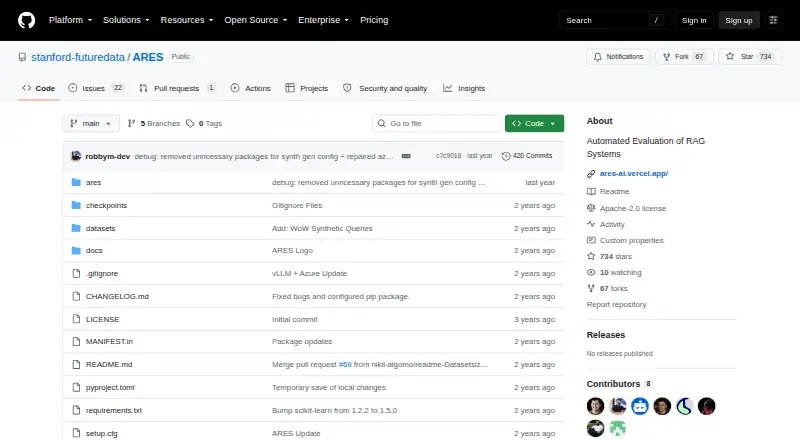
What ARES is
ARES is a free, open-source framework for evaluating retrieval-augmented generation systems, including custom RAG models and configuration comparisons. It measures context relevance, answer faithfulness, and answer relevance. The method creates synthetic training data, fine-tunes lightweight language models as judges, and applies prediction-powered inference with human-annotated examples to produce confidence intervals. Evaluations require an in-domain prompts dataset and an unlabeled evaluation set; a labeled set is optional because machine labels can be used. Documentation recommends at least 50 annotated query, document, and answer examples for human preference validation, with several hundred ideal. ARES can retrieve KILT and SuperGLUE datasets. Examples use OpenAI and TogetherAI API keys, while vLLM supports local and offline execution. Installation uses pip or a local repository clone. ARES is self-hosted on Linux under Apache-2.0. Local execution needs a GPU and over about 100 GB of disk space; an A100 is cited as a working example.
Good
- Evaluates three RAG quality dimensions
- Model-agnostic evaluation framework
- Prediction-powered confidence intervals
- Supports OpenAI, TogetherAI, and vLLM
- Offline local execution is available
Watch out
- Local execution needs a GPU
- Requires over about 100 GB disk space
- Needs prompts and an evaluation set
- Recommended human validation set has at least 50 examples
Who it suits
It suits teams evaluating RAG quality, custom retrieval systems, or competing RAG configurations. It is appropriate for users able to provide evaluation datasets and self-host the required compute.
Verdict
ARES provides a self-hosted, open-source approach to measuring RAG relevance and faithfulness with confidence estimates. Dataset preparation and substantial local hardware requirements shape its practical use.
The facts
Each one read from ARES's own pages, with the date it was checked.
What it does
- Annotation guidance
- The README recommends at least 50 annotated query, document, and answer examples for the human preference validation set, with several hundred ideal.checked 4 Oct 2026
- Compute requirements
- For execution without the OpenAI API, the README lists over about 100 GB of available disk space and a GPU, and says an A100 should work.checked 9 Oct 2026
- Custom systems
- ARES is model-agnostic and can evaluate queries and answers generated by custom RAG models.checked 4 Oct 2026
- Data requirements
- ARES requires an in-domain prompts dataset and an unlabeled evaluation set; a labeled evaluation set is optional because PPI can create one using machine labels.checked 4 Oct 2026
- Dataset example
- The README says the optional full Natural Questions dataset is 37.3 GB.checked 9 Oct 2026
- Datasets
- ARES can retrieve KILT datasets including nq, hotpotqa, wow, and fever, and SuperGLUE datasets including record, rte, boolq, and multirc.checked 4 Oct 2026
- Evaluation criteria
- ARES assesses context relevance, answer faithfulness, and answer relevance.checked 9 Oct 2026
- Evaluation method
- ARES combines synthetic data generation, fine-tuned classifiers, and Prediction-Powered Inference to estimate evaluation results with statistical confidence.checked 9 Oct 2026
- Evaluation metrics
- ARES evaluates context relevance, answer faithfulness, and answer relevance.checked 4 Oct 2026
- Hardware requirements
- The README says local execution needs over about 100 GB of available disk space and a GPU, and names an A100 as a working example.checked 4 Oct 2026
- Input requirements
- The README says evaluation uses a human preference validation set, few-shot examples, and a larger set of unlabeled query-document-answer triples; it recommends at least 50 validation examples.checked 9 Oct 2026
- Install
- The documentation provides installation through `pip install ares-ai` or by cloning the GitHub repository and installing it locally.checked 4 Oct 2026
- Installation
- The README gives `pip install ares-ai` as the installation command.checked 9 Oct 2026
- Intended users
- The project documentation describes ARES as a tool for evaluating RAG systems and comparing different RAG configurations.checked 9 Oct 2026
- License
- The GitHub repository identifies its license as Apache-2.0.checked 9 Oct 2026
- Local execution
- ARES supports running models locally with vLLM, which the README says can enable offline operation and enhanced privacy.checked 9 Oct 2026
- Method
- ARES generates synthetic training data, fine-tunes lightweight language models as judges, and uses prediction-powered inference with human-annotated examples to produce confidence intervals.checked 4 Oct 2026
- Model integrations
- The README gives examples using OpenAI and TogetherAI API keys and shows local model execution with vLLM.checked 4 Oct 2026
- Model support
- ARES describes itself as model-agnostic and shows examples using OpenAI, Together AI, and vLLM-hosted models.checked 9 Oct 2026
- Offline use
- ARES says vLLM enables local model execution and offline operation.checked 4 Oct 2026
- Purpose
- ARES is an automated framework for evaluating retrieval-augmented generation (RAG) systems.checked 9 Oct 2026
- Support
- The README invites users with questions to contact [email protected] or [email protected].checked 9 Oct 2026
Alternatives to ARES
- 1

DeepEval
Free planOpen sourceWebAPILinuxmacOS8.3From $200 a month - 2

Promptfoo
Free planOpen sourceWebAPILinuxmacOS7.8Free plan - 3

Braintrust
Free planWebAPISelf-hosted7.7From $249 a month - 4

Giskard
Free planOpen sourceWebAPILinuxSelf-hosted7.6Free plan - 5
TruLens
Free planOpen sourceAPISelf-hosted7.2Free plan - 6

Arena (formerly Chatbot Arena)
Free planOpen sourceWebAPISelf-hosted7.1Free plan