Ardour
Ardour is an open-source workstation for recording, editing, mixing, and mastering audio and MIDI projects on Linux, macOS, and Windows.
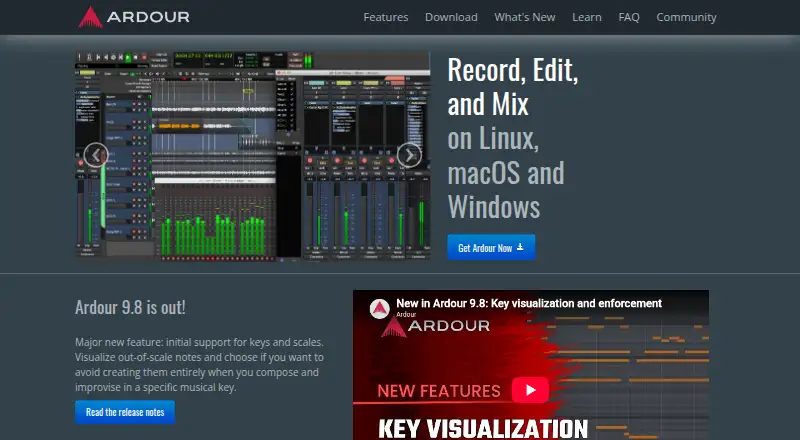
What Ardour is
Ardour is an open-source workstation for recording, editing, mixing, and mastering audio and MIDI projects on Linux, macOS, and Windows. It supports any number of tracks and busses, unlimited undo and redo, and flexible signal routing between sources. Plugin formats include AudioUnit, LV2, VST2/VST3, and LADSPA; plugins can use sample-accurate automation and MIDI Learn. For MIDI synchronization, Ardour supports MIDI timecode, MIDI Machine Control, MIDI clock, and JACK transport sync. Its video timeline can import one video, show a thumbnail view, synchronize audio, and export video. Users can also search the Freesound database and import audio or MIDI. Ardour is licensed under GNU GPL v2, and users may copy, share, and modify it without paying. Optional subscriptions support development and include unlimited updates while active. Monthly subscription options are $1 a month, $4 a month, $10 a month, and $50 a month; an annual subscription is $120 a year. Support includes documentation, tutorials, bug tracking, email, forums, IRC, Matrix, and social channels.
Good
- Runs on Linux, macOS, and Windows.
- Supports any number of tracks and busses.
- Includes unlimited undo and redo.
- Supports AudioUnit, LV2, VST2/VST3, and LADSPA plugins.
- Can synchronize audio to an imported video.
Watch out
- Video timeline imports one video.
- Updates are unlimited only while subscribed.
- Annual subscription costs $120 a year.
- Monthly options range up to $50 a month.
Who it suits
Ardour suits people working on audio and MIDI projects who want a workstation that can be used, copied, and modified without payment. Its video timeline and broad plugin and synchronization support may also suit projects that combine audio with video or external MIDI workflows.
Verdict
Ardour offers extensive audio and MIDI editing in an open-source package that can be used without payment. Subscriptions are optional, but unlimited subscriber updates last only while a subscription remains active.
Plans and prices
From Ardour's own pricing page, checked 27 Sep 2026.
| Plan | Price | What it gives you |
|---|---|---|
| Developing World | $1 a month | Subscription supports Ardour development and includes unlimited updates while subscribed. · Supports Ardour development · Unlimited updates while subscribed · billed monthly |
| Low Cost | $4 a month | Subscription supports Ardour development and includes unlimited updates while subscribed. · Supports Ardour development · Unlimited updates while subscribed · billed monthly |
| Standard | $10 a month | Subscription supports Ardour development and includes unlimited updates while subscribed. · Supports Ardour development · Unlimited updates while subscribed · billed monthly |
| Institutional | $50 a month | Subscription supports Ardour development and includes unlimited updates while subscribed. · Supports Ardour development · Unlimited updates while subscribed · billed monthly |
| Annual subscription | $120 a year | A 1 year subscription will likely span 2 major releases. · billed annually at US$120 |
The facts
Each one read from Ardour's own pages, with the date it was checked.
What it does
- Audio MIDI Workflows
- Ardour supports recording, editing, mixing, and mastering audio and MIDI projects.checked 27 Sep 2026
- Development Funding
- Subscriptions fund feature development, bug fixes, documentation, equipment, and developer meetings.checked 27 Sep 2026
- MIDI sequencing
- Yeschecked 21 Sep 2026
- MIDI Synchronization
- Ardour supports MIDI timecode, MIDI Machine Control, MIDI clock, and JACK transport sync.checked 27 Sep 2026
- Multitrack editing
- Yeschecked 21 Sep 2026
- Open Source
- Ardour is an open-source collaborative project licensed under the GNU Public License v2.checked 27 Sep 2026
- Paid from
- 1checked 21 Sep 2026
- Plugin Automation
- Plugins support full sample-accurate automation and MIDI Learn control.checked 27 Sep 2026
- Plugin Formats
- Supported plugin formats include AudioUnit, LV2, VST2/VST3, and LADSPA.checked 27 Sep 2026
- Signal Routing
- Connections can be one-to-many, many-to-one, or many-to-many.checked 27 Sep 2026
- Subscriber Updates
- Subscribers receive unlimited updates while they remain subscribers.checked 27 Sep 2026
- Support Channels
- Support includes documentation, tutorials, bug tracking, email, forums, IRC, Matrix, and social channels.checked 27 Sep 2026
- Third-party plugins
- Yeschecked 21 Sep 2026
- Tracks And Busses
- Ardour supports any number of tracks and busses.checked 27 Sep 2026
- Undo Redo
- The editor provides unlimited undo and redo.checked 27 Sep 2026
- Video synchronization
- Yeschecked 21 Sep 2026
- Video Synchronization
- Audio regions can be locked to video and moved at video-frame granularity.checked 27 Sep 2026
Money
- Free plan
- Yeschecked 21 Sep 2026
- Freesound Access
- Users can import audio or MIDI from the Freesound database and search it within Ardour.checked 27 Sep 2026
- Free Use
- Users are not obligated to pay and may copy, share, and modify Ardour.checked 27 Sep 2026
- Payment Billing
- Subscriptions are managed through PayPal, with one retry if a monthly payment fails.checked 27 Sep 2026
The company
- Headquarters
- Galisteo, New Mexico, United Stateschecked 28 Sep 2026
Where it runs
- Supported platforms
- Linux, macOS, Windowschecked 21 Sep 2026
- Supported Platforms
- Ardour runs on Linux, macOS, and Windows.checked 27 Sep 2026
The full review of Ardour
Overview
Ardour is an open-source digital audio workstation for recording, editing, mixing and mastering audio and MIDI. It suits producers who want a flexible desktop workspace across Linux, macOS or Windows, particularly those comfortable choosing how much to contribute to ongoing development.
Its broad track, routing and plugin support make it a capable fit for complex projects; the trade-off is that subscriber updates are unlimited only for as long as the subscription stays active.
Key features
Ardour handles the full audio and MIDI workflow, with no stated cap on tracks or busses and unlimited undo and redo. That flexibility matters for layered arrangements and evolving mixes, while the breadth of supported workflows makes it relevant beyond straightforward audio editing.
- Routing and plugins: Signals can be routed one-to-many, many-to-one or many-to-many. AudioUnit, LV2, VST2/VST3 and LADSPA support gives users several plugin ecosystems to work with; sample-accurate automation and MIDI Learn allow precise control.
- MIDI and synchronization: MIDI sequencing is supported, along with MIDI timecode, MIDI Machine Control, MIDI clock and JACK transport sync. That range helps when coordinating projects with other MIDI-capable equipment or software.
- Video: Ardour can import one video, show a thumbnail timeline, synchronize audio and export video. This is useful for scoring or aligning sound to picture, but the one-video import limit makes it a narrower video workflow than a dedicated video editor.
- Freesound: Users can search the Freesound database from within Ardour and import audio or MIDI from it, keeping those source materials close to the project workflow.
Pricing
Ardour is free to use, copy, share and modify under the GNU Public License v2. Payment is optional: subscriptions fund development, bug fixes, documentation, equipment and developer meetings. Every paid tier described includes unlimited updates while subscribed, rather than a permanent entitlement to future updates.
- Free plan: Best for anyone who wants to use Ardour without paying. There is no required subscription, though free use does not include the subscriber update commitment.
- Developing World: $1 a month, billed monthly. A low-cost way to support development while receiving updates for the active subscription.
- Low Cost: $4 a month, billed monthly. It carries the same stated subscription benefits at a higher contribution level.
- Standard: $10 a month, billed monthly. Suitable for subscribers choosing a larger monthly contribution; the stated update terms are unchanged.
- Institutional: $50 a month, billed monthly. This tier is framed for institutional support, with the same stated subscription benefits.
- Annual subscription: $120 a year, billed annually. It may span two major releases, but ongoing unlimited updates still depend on remaining subscribed.
Subscriptions are managed through PayPal. If a monthly payment fails, there is one retry, a term worth considering for anyone relying on uninterrupted subscriber updates.
Platforms
Ardour runs on Linux, macOS and Windows, so it can suit desktop workflows across the three major platforms. It is not positioned here as a mobile app.
Who it's for
Choose Ardour if you need a substantial audio-and-MIDI workstation with flexible routing, broad plugin format support and video synchronization, and value the freedom to use and modify open-source software. It also makes sense for users who want to support continued development at a contribution level they choose.
Look elsewhere if your priority is a mobile-first editor, or if you need video workflows that go beyond importing one video into an audio timeline.
Pros and cons
- Pros: No-cost use with permission to copy, share and modify; unlimited tracks and busses; unlimited undo and redo; wide plugin format support with sample-accurate automation.
- Cons: Unlimited updates are tied to an active subscription; video work is limited to importing one video; monthly billing has only one retry after a failed payment.
Alternatives
For a broader comparison, explore Digital Audio Workstations, Audio Editing Software, Game Audio Editors or Game Music Software.
- Pro Tools is a freemium option on macOS and Windows; its Intro plan is described as free for casual creators and caps audio, instrument and MIDI tracks at eight each.
- REAPER is a paid alternative for Linux, macOS and Windows. Its discounted license is $60 a month, with eligibility tied to personal use or qualifying commercial use under USD 20,000 yearly gross revenue.
- Nuendo is a paid macOS and Windows alternative, with full-version and crossgrade plans.
- Audacity is a free, open-source editor for Android, iOS, Linux, macOS and Windows; choose it when a free audio editor is a better fit than Ardour's full workstation scope.
- Sequoia is a paid Windows option with monthly, annual and perpetual licensing.
- Harrison Mixbus is a paid alternative across Linux, macOS and Windows, with a console-inspired DAW and Harrison processing on every channel.
- WavePad is a freemium editor for Android, iOS, macOS and Windows, with annual Standard and Master's editions.
- SAWStudio is a paid Windows workstation offered in Full and 64-bit versions.
Verdict
Ardour is a strong choice for producers who want a cross-platform, open-source workstation with extensive audio and MIDI capabilities and no mandatory payment. Its clearest reason to look elsewhere is the subscription-bound update access, alongside the single-video limit for picture work.
Alternatives to Ardour
- 1
WavePad
Free planAndroidiOSmacOSWindows8.8From $39.95 a year - 2
n-Track Studio
Free planAndroidiOSLinuxmacOS8.7From $109 a year - 3
Zenbeats
Free planAndroidiOSmacOSWindows8.5From $2.99 a month - 4

Koala Sampler
Free planAndroidiOSLinuxmacOS8.4$2.99 one-time - 5
Pro Tools
Free planmacOSWindows8.3Free plan - 6

Soundtrap
Free planAndroidiOSWebLinux8.3Free plan