Apastra
Apastra is a file-based PromptOps framework and skill pack for versioning prompts and evaluating agent instructions.
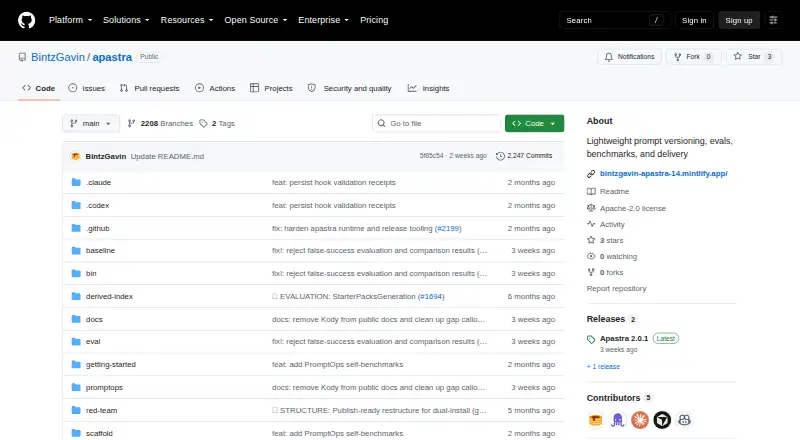
What Apastra is
Apastra is a file-based PromptOps framework and skill pack for versioning prompts and evaluating agent instructions. Prompt specifications are YAML files with stable IDs, variable schemas, and output contracts that can be versioned in Git. Its regression checks compare evaluation results against baselines to help teams catch quality changes before shipping. Apastra validates evaluation evidence and recalculates scorecard means, while a user-controlled adapter runs the model calls. The project does not include a production provider adapter, so users need to supply an executable harness. It can run locally without a hosted service, telemetry sink, hidden database, or CI infrastructure. Optional GitHub Actions workflows support regression gating, promotion, and immutable releases; named compatible IDE agents include Claude, Cursor, Amp, and Codex. Installation is documented through Git clone or npm, with setup actions controlled by opt-in flags. Optional request logging is disabled by default, stores full request bodies locally, and offers configurable rolling retention. Apastra is free and open source under Apache-2.0; model and API usage may incur costs when evaluations run.
Good
- Version prompt specs in Git with stable IDs and schemas
- Compare evaluation results against baselines
- Works locally without hosted services or CI
- Optional GitHub Actions workflows support release controls
- Request logging is off by default
Watch out
- No production provider adapter is included
- Users must bring an executable harness
- Model or API usage may incur costs
Who it suits
Apastra suits developers, platform teams, and agents that need versioned prompt specifications and evaluation checks. It is especially relevant to users who can provide their own executable model-call harness.
Verdict
Apastra brings prompt versioning and regression evaluation into a file-based workflow. Its main constraint is that model calls require a user-supplied harness; the framework itself is free and open source.
Plans and prices
From Apastra's own pricing page, checked 4 Oct 2001.
| Plan | Price | What it gives you |
|---|---|---|
| Apastra | Free | Apache-2.0 · local-first framework · model/API usage may incur costs when evaluations run |
The facts
Each one read from Apastra's own pages, with the date it was checked.
What it does
- Agent compatibility
- The docs name Claude, Cursor, Amp, and Codex as IDE agents that can run Apastra workflows.checked 4 Oct 2001
- Install options
- The README documents installation by Git clone or npm, with setup actions controlled by opt-in flags.checked 4 Oct 2001
- Integrations
- The docs describe optional GitHub Actions workflows for regression gating, promotion, and immutable releases.checked 4 Oct 2001
- License
- The project is licensed under Apache-2.0.checked 4 Oct 2001
- Local-first design
- Apastra says it can run without a hosted service, telemetry sink, hidden database, or CI infrastructure.checked 4 Oct 2001
- Logging retention
- The request-logging setup offers a rolling retention policy of seven days or 250 MB, which users can change.checked 4 Oct 2001
- Model adapter limit
- The README says Apastra does not yet ship a production provider adapter, so users bring their own executable harness.checked 4 Oct 2001
- Prompt versioning
- Prompt specs are YAML files with stable IDs, variable schemas, and output contracts that can be versioned in Git.checked 4 Oct 2001
- Regression checks
- Apastra compares evaluation results with baselines to help catch quality regressions before shipping.checked 4 Oct 2001
- Request logging
- Optional provider request logging stores complete request bodies locally; it is disabled by default and does not persist authentication headers or upload logs.checked 4 Oct 2001
- What it does
- Apastra is a file-based PromptOps framework and skill pack for versioning prompts and evaluating agent instructions.checked 4 Oct 2001
- Who it is for
- The getting-started guide identifies developers, platform teams, and agents as its audience.checked 4 Oct 2001
Where it runs
- Evaluation approach
- Apastra validates evaluation evidence and recomputes scorecard means, while a user-controlled adapter executes the model calls.checked 4 Oct 2001
Alternatives to Apastra
- 1
Vellum
Free planOpen sourceAndroidiOSWebAPI8.7From $30 a month - 2

Langfuse
Free planOpen sourceWebAPILinuxSelf-hosted8.1From $29 a month - 3
PromptHelm
Free planAndroidiOSWebAPI8.0From $39 a month - 4

Agenta
Free planOpen sourceWebAPISelf-hosted7.9From $29 a month - 5

Promptfoo
Free planOpen sourceWebAPILinuxmacOS7.8Free plan - 6

Braintrust
Free planWebAPISelf-hosted7.6From $249 a month