
Amazon MQ
Amazon MQ is a managed message broker service for Apache ActiveMQ and RabbitMQ.
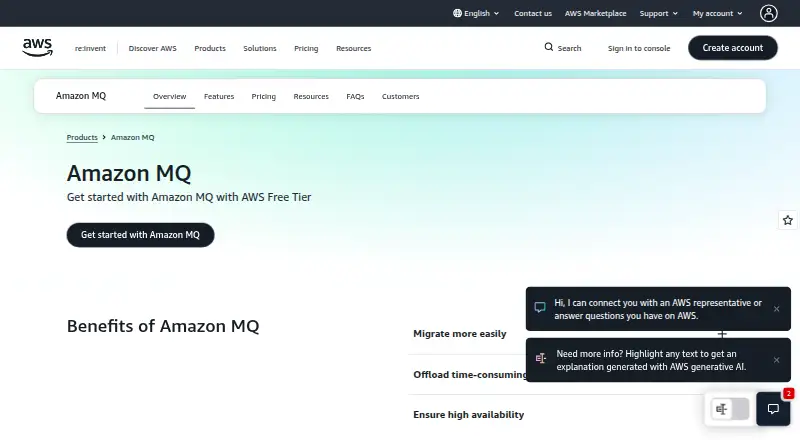
What Amazon MQ is
Amazon MQ is a managed message broker service for Apache ActiveMQ and RabbitMQ. It handles broker provisioning, setup, upgrades, ongoing operation, and failure recovery, so applications can move existing brokers to the service using standard messaging protocols without rewriting messaging code. Brokers can be launched through the AWS Management Console, CloudFormation, the CLI, or API calls. Deployment options include a single instance, replicated cluster, and active/standby, with availability and durability features across Availability Zones.
ActiveMQ supports protocols such as JMS, AMQP, STOMP, OpenWire, WebSocket, and MQTT, with clients for Java, Node.js, Go, Python, Ruby, and C++. RabbitMQ supports classic, classic mirrored, and quorum queues; quorum queues require RabbitMQ 3.13 or newer. Amazon MQ integrates with CloudWatch for broker and queue metrics and CloudTrail for API-call records, and AWS Lambda can poll a broker. Data at rest is encrypted with AWS KMS, while broker connections use TLS. The service has an AWS Free Tier option for eligible new customers for six months after account creation; pay-as-you-go broker usage is billed hourly and storage monthly, with standard data transfer fees potentially applying.
Good
- Supports migration without rewriting messaging code
- Offers single-instance, cluster, and active/standby modes
- Integrates broker metrics with CloudWatch
- Supports several ActiveMQ protocols and client languages
Watch out
- Paid usage includes standard AWS data transfer fees
- RabbitMQ quorum queues require version 3.13 or newer
- Free Tier is limited to eligible new customers
Who it suits
Amazon MQ suits teams moving existing ActiveMQ or RabbitMQ applications to a managed broker without changing messaging code. It also fits AWS workloads that need broker metrics, private networking, or multiple deployment modes.
Verdict
Amazon MQ combines managed broker operations with migration support for ActiveMQ and RabbitMQ applications. Review deployment, storage, and data-transfer charges against the workload before choosing it.
Plans and prices
From Amazon MQ's own pricing page, checked 8 Oct 2026.
| Plan | Price | What it gives you |
|---|---|---|
| AWS Free Tier | Free | Up to $200 in credits · credits must be used within 12 months of account creation · Eligible new AWS customers can choose a free plan available for 6 months after account creation; AWS Free Tier credits can be applied to eligible Amazon MQ usage. |
| Pay-as-you-go | — | No minimum fees or upfront commitments · standard data transfer fees may apply · Broker usage is billed hourly at one-second resolution; storage is billed monthly. Fees vary by instance size, deployment type, and storage. |
The facts
Each one read from Amazon MQ's own pages, with the date it was checked.
What it does
- Access controls
- Amazon MQ supports IAM controls for service actions; broker authentication methods include LDAP for ActiveMQ and OAuth 2.0, IAM, LDAP, HTTP, and mutual TLS options for RabbitMQ.checked 8 Oct 2026
- Availability
- Amazon MQ offers single-instance, replicated cluster, and active/standby deployment modes, with availability and durability features across Availability Zones.checked 8 Oct 2026
- AWS integrations
- Amazon MQ integrates with CloudWatch for broker and queue metrics and supports using AWS Lambda functions to poll a broker.checked 8 Oct 2026
- Intended workloads
- AWS describes Amazon MQ use cases including low-latency event messaging, migration from on premises, and communication between cloud-native applications and components.checked 8 Oct 2026
- Limits
- Amazon MQ charges standard AWS data transfer fees, and traffic forwarded between brokers across Availability Zones in the same Region is charged at $0.01/GB in each direction.checked 8 Oct 2026
- Management
- Amazon MQ can be launched through the AWS Management Console, CloudFormation, the CLI, or API calls, and manages provisioning, setup, upgrades, and failure recovery.checked 8 Oct 2026
- Migration
- Applications can migrate existing message brokers to Amazon MQ using industry-standard messaging protocols without rewriting messaging code.checked 8 Oct 2026
- Monitoring and audit
- Amazon MQ sends broker and queue metrics to CloudWatch every minute and integrates with CloudTrail to record API calls related to brokers and configurations.checked 8 Oct 2026
- Private networking
- Amazon MQ brokers can be isolated in an Amazon VPC, and RabbitMQ brokers can connect across VPCs and AWS accounts using private networking.checked 8 Oct 2026
- Protocols and clients
- ActiveMQ supports JMS, NMS, AMQP, STOMP, OpenWire, WebSocket, and MQTT, with clients including Java, Node.js, Go, Python, Ruby, and C++.checked 8 Oct 2026
- RabbitMQ queues
- Amazon MQ for RabbitMQ supports classic, classic mirrored, and quorum queues; quorum queues are supported on RabbitMQ 3.13 and above.checked 8 Oct 2026
- Security
- Amazon MQ encrypts data at rest with AWS KMS and uses TLS for connections between brokers; the documentation says TLS 1.3 is not available for RabbitMQ brokers.checked 8 Oct 2026
- What it does
- Amazon MQ is a managed message broker service for Apache ActiveMQ and RabbitMQ that handles broker setup, operation, and maintenance.checked 8 Oct 2026
The company
- Maker history
- Amazon Web Services says it launched in 2006; Amazon's investor FAQ says the company was incorporated in 1994 and its principal corporate offices are in Seattle, Washington.checked 8 Oct 2026
Alternatives to Amazon MQ
- 1

EMQX
Free planOpen sourceWebAPILinuxmacOS8.1From $234 a month - 2

RabbitMQ
Free planOpen sourceWebAPILinuxmacOS7.8Free plan - 3

CloudAMQP
Free planWebAPILinuxmacOS7.6From $19 a month - 4

Apache ActiveMQ
Free planOpen sourceWebAPILinuxmacOS7.5Free plan - 5
Apache RocketMQ
Free planOpen sourceAPILinuxmacOSSelf-hosted7.5Free plan - 6
Faye
Free planOpen sourceWebAPILinuxmacOS7.5Free plan