
Amazon Interactive Video Service
Amazon Interactive Video Service (IVS) is a managed service for delivering live video with either low latency or real-time streaming.
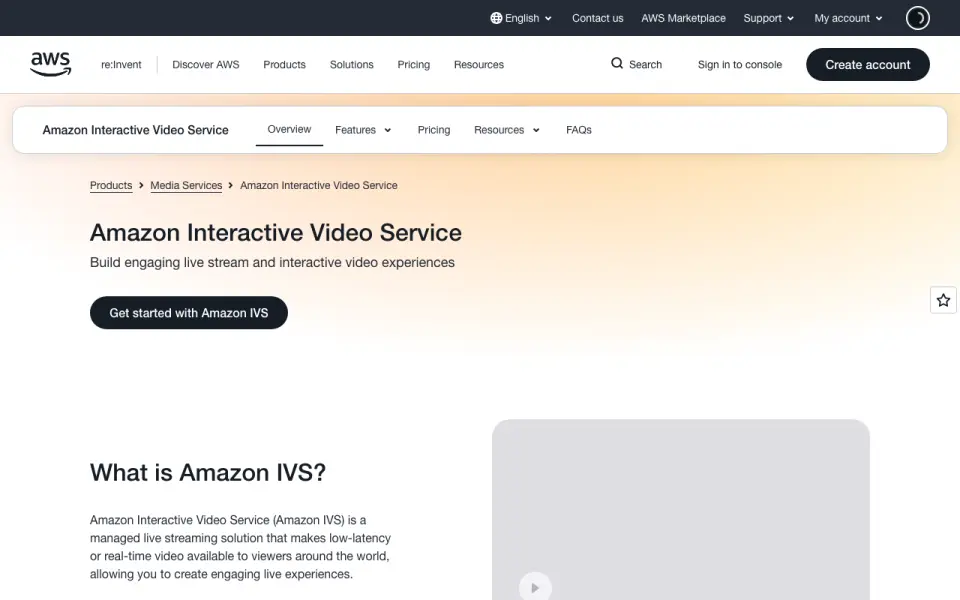
What Amazon Interactive Video Service is
Amazon Interactive Video Service (IVS) is a managed service for delivering live video with either low latency or real-time streaming. AWS lists real-time latency below 300 milliseconds and low-latency streaming at 3–5 seconds. Real-time streams use RTMPS or WHIP input and WebRTC output; low-latency streams use RTMPS or SRT input and HLS output. Applications can use chat and timed metadata APIs for features such as polls, graphics, and synchronized elements. A stage allows multiple hosts to exchange audio and video in real time, and that feed can be broadcast to an IVS channel. Standard and advanced channels can transcode video into multiple resolutions and bitrates. IVS can record streams to customer-owned Amazon S3 storage for archiving and on-demand playback; recordings can also be used with AWS Elemental MediaConvert. AWS says channels can serve millions of concurrent viewers. Broadcast and player SDKs support web, iOS, and Android.
Good
- Offers real-time and low-latency streaming modes.
- Chat and timed metadata APIs support interactive features.
- Stages let multiple hosts exchange audio and video.
- SDKs support web, iOS, and Android.
Watch out
- Recorded video uses customer-owned storage.
- Input limits vary by channel type and resolution.
- Security responsibilities are shared with customers.
Who it suits
IVS suits developers building live video applications that need real-time or low-latency delivery, interactive features, or multi-host stages. It also fits workflows that record streams to Amazon S3 for later playback.
Verdict
IVS provides distinct streaming modes, interaction APIs, and recording options for live-video applications. Choose the mode and channel type with their latency and input limits in mind.
Plans and prices
From Amazon Interactive Video Service's own pricing page, checked 20 Sep 2026.
| Plan | Price | What it gives you |
|---|---|---|
| Advanced SD channel input | $0.50 a month | Low-latency streaming video input · Pay-as-you-go |
| Advanced HD channel input | $0.85 a month | Low-latency streaming video input · Pay-as-you-go |
| Real-Time Streaming participant hours | $0.07 a month | 10,000 participant hours per month · North America, first 10,000 participant hours per month |
| Free Tier | Free | 5 basic-channel input hours · 100 audio-only/SD output hours · 20 participant-hours · 5 server-side composition hours · 13,500 messages sent · 270,000 messages delivered · Monthly for first 12 months for new AWS customers |
| Basic channel input | Priced on request | Basic channel · maximum input 1.5 Mbps at 480p or 3.5 Mbps at 720p/1080p · Per hour of video input |
| Advanced SD input | Priced on request | Advanced SD channel · Per hour of video input |
| Standard Multitrack input | Priced on request | Standard channel with Multitrack Video · Per hour of video input |
| Advanced HD input | Priced on request | Advanced HD channel · Per hour of video input |
| Standard channel input | Priced on request | Standard channel · input metered to the nearest minute · Per hour of video input |
| Pay-as-you-go | — | Standard channel input: $2.00/hour ($0.50/hour with Multitrack Video) · Advanced HD: $0.85/hour · Advanced SD: $0.50/hour · Basic: $0.20/hour · Other usage rates vary · Usage-based; charged for video input and output, participant hours, chat messages, and optional encoding, with rates varying by service, resolution, region, and usage tier. |
The facts
Each one read from Amazon Interactive Video Service's own pages, with the date it was checked.
What it does
- Adaptive bitrate
- Standard and advanced channels create multiple renditions so playback can adapt to device and network conditions.checked 14 Oct 2026
- Adaptive playback
- For standard or advanced channels, IVS can transcode incoming video into multiple resolutions and bitrates for different devices and network conditions.checked 30 Sep 2026
- API and documentation
- AWS publishes Low-Latency, Real-Time and Chat user guides plus control-plane and data-plane API references and SDK documentation for Android, iOS, web and JavaScript.checked 14 Oct 2026
- Broadcast SDKs
- Broadcast SDKs let iOS, Android and browser applications publish live video using cameras, microphones, screens or custom sources.checked 14 Oct 2026
- Collaboration
- A stage lets multiple hosts exchange audio and video in real time and can be broadcast to an IVS channel for a larger audience.checked 30 Sep 2026
- Collaborative stages
- Stage resources combine audio and video from multiple hosts and can be broadcast to a larger low-latency channel audience.checked 14 Oct 2026
- Developer resources
- AWS provides user guides and API references for real-time streaming, low-latency streaming, and the chat feature, along with AWS re:Post resources.checked 30 Sep 2026
- Encryption limitation
- IVS playback uses HTTPS and ingest can use RTMPS, but AWS states streams are not end-to-end encrypted internally and IVS does not provide DRM or stream-content encryption.checked 14 Oct 2026
- Interactive features
- The service provides chat APIs and timed metadata APIs that applications can use for chat rooms, polls, graphics, and synchronized elements.checked 30 Sep 2026
- Latency
- AWS lists real-time streaming latency as under 300 milliseconds and low-latency streaming as 3–5 seconds.checked 30 Sep 2026
- Latency modes
- The feature comparison lists real-time latency below 300 milliseconds and low-latency streaming at about 3–5 seconds.checked 14 Oct 2026
- Launch news
- AWS announced general availability of Amazon IVS on July 15, 2020, describing Twitch-based technology, sub-three-second latency and pay-as-you-go input/output billing.checked 14 Oct 2026
- Licence
- The Web Broadcast SDK page states Amazon copyright and AWS Customer Agreement terms; it is not presented as open-source software, although bundled libraries have separate Apache-2.0, BSD or MIT licenses.checked 14 Oct 2026
- Mobile requirements
- The Player SDK supports Android 6.0 and later and iOS 14 or later.checked 14 Oct 2026
- Network requirements
- Broadcasting requires accessible IVS_LOW_LATENCY subnets globally, regardless of the selected AWS control-plane region.checked 14 Oct 2026
- Notable update
- On September 10, 2025 AWS announced PrivateLink interface VPC endpoints for private RTMP(S) ingest from VPC or on-premises networks in selected regions.checked 14 Oct 2026
- Outage history
- StatusGator reports monitoring Amazon IVS since March 2015 and collecting more than 2,214 outage records.checked 14 Oct 2026
The company
- Company size and founding
- AWS's LinkedIn page lists Seattle headquarters, 10,001-plus employees and a 2006 founding year.checked 14 Oct 2026
- Founded
- 2006checked 28 Sep 2026
- Legal entity and owner
- AWS legal pages identify Amazon Web Services, Inc. at 410 Terry Avenue North in Seattle and describe it as wholly owned by Amazon.com, Inc.checked 14 Oct 2026
- Maker
- Amazon Web Services says it launched in 2006 and is part of Amazon.checked 30 Sep 2026
Money
- Free plan
- Nochecked 20 Sep 2026
- Limit: cost complaints
- Reddit users reported unexpectedly high test bills and said IVS streaming costs prompted consideration of building or using another stack.checked 14 Oct 2026
Where it runs
- Limit: browser and interactivity gaps
- An Ex Machina review reported higher and variable latency on iOS Safari, lack of low-latency support in some third-party players, and one-way metadata without built-in poll result handling.checked 14 Oct 2026
Alternatives to Amazon Interactive Video Service
- 1

Restream
Free planAndroidiOSWebAPI9.1From $19 a month - 2
mimoLive
Free planiOSWebAPImacOS8.7From $70 a month - 3

BoxCast
AndroidiOSWebAPI8.6From $8.25 a month - 4
OneStream Live
Free planAndroidiOSWebExtension8.5From $15 a month - 5

StreamYard On-Air
Free planiOSWebExtension8.5From $35.99 a month - 6

PRISM Live Studio
Free planAndroidiOSmacOSWindows8.4From $79.99 a year