
Amazon CloudFront
Amazon CloudFront is a content delivery network for serving data, video, applications, and APIs around the world.
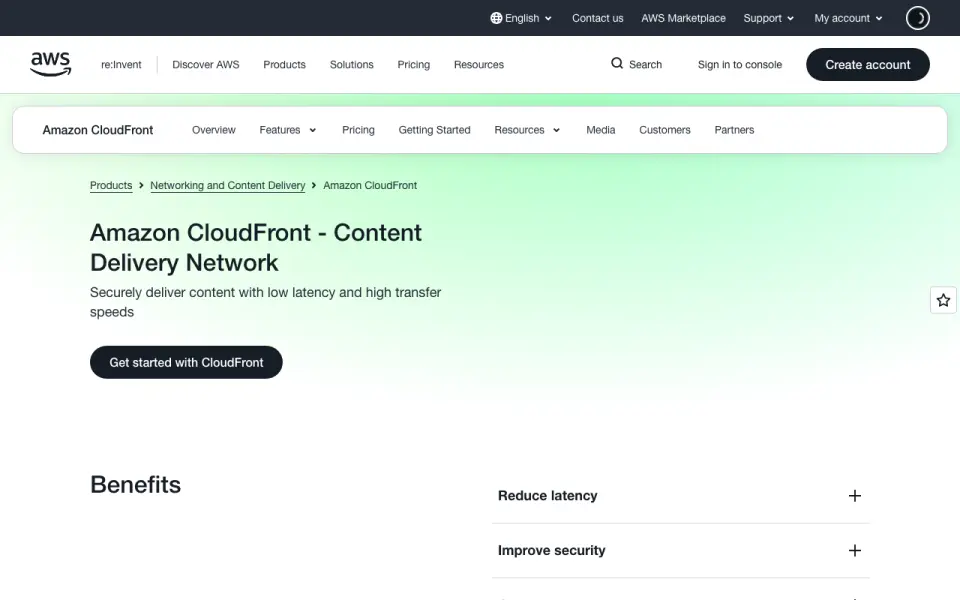
What Amazon CloudFront is
Amazon CloudFront is a content delivery network for serving data, video, applications, and APIs around the world. It uses 750+ globally distributed Points of Presence, with automated network mapping and intelligent routing, to deliver content with low latency and high transfer speeds. It works with Amazon S3, Amazon EC2, Elastic Load Balancing, and custom HTTP origins. Developers can customize edge behavior with CloudFront Functions and AWS Lambda@Edge, and configure distributions through its API, AWS CloudFormation, CodeDeploy, CodeCommit, or AWS SDKs. Use cases include websites, dynamic content, APIs, live and on-demand video, software distribution, game patches, and IoT updates. Security options include HTTPS/TLS, signed URLs and cookies, token authentication, geographic restrictions, and limiting S3 origin access to CloudFront. It integrates with AWS Shield, AWS WAF, and Amazon Route 53 for protection against network and application attacks, including DDoS. CloudWatch metrics and logs delivered to S3 or Kinesis Data Streams provide monitoring options.
Good
- 750+ globally dispersed Points of Presence
- Works with common AWS and custom HTTP origins
- Supports edge functions and Lambda@Edge
- Free plan includes 1M requests and 100GB transfer
- Offers HTTPS/TLS and multiple access controls
Watch out
- Flat-rate plans cannot be combined with other offers or discounts
Who it suits
CloudFront suits teams delivering websites, APIs, video, software, game patches, or IoT updates through a global network. Its edge customization, access controls, logging, and infrastructure-as-code options may suit teams managing detailed delivery and security requirements.
Verdict
CloudFront combines global content delivery with edge customization, security controls, and monitoring options. Its free plan provides a starting point, while listed paid plans specify per-distribution prices and transfer allowances.
Plans and prices
From Amazon CloudFront's own pricing page, checked 30 Sep 2026.
| Plan | Price | What it gives you |
|---|---|---|
| Free | Free | 1M requests · 100GB data transfer · 5 WAF rules · 5GB included S3 storage · no overage charges · $0/month per distribution |
| Pro | $15 a month | 10M requests · 50TB data transfer · 25 WAF rules · 50GB included S3 storage · no overage charges · $15/month per distribution |
| Business | $200 a month | 125M requests · 50TB data transfer · 50 WAF rules · 1TB included S3 storage · no overage charges · $200/month per distribution |
| Premium | $1,000 a month | 500M requests · 50TB data transfer · 75 WAF rules · 5TB included S3 storage · no overage charges · $1,000/month per distribution |
| Custom pricing | Priced on request | No limit on requests · No limit on data transfer · No limit on WAF rules · Custom |
The facts
Each one read from Amazon CloudFront's own pages, with the date it was checked.
What it does
- Compliance
- AWS states that CloudFront infrastructure and processes are designed to comply with PCI-DSS Level 1, HIPAA, ISO 9001, ISO/IEC 27001, 27017, and 27018, SOC 1, 2, and 3, and FedRAMP Moderate.checked 30 Sep 2026
- Content and origins
- CloudFront works with Amazon S3, Amazon EC2, Elastic Load Balancing, and custom HTTP origins.checked 30 Sep 2026
- Edge compute
- CloudFront supports edge customization through CloudFront Functions and AWS Lambda@Edge.checked 30 Sep 2026
- Encryption and access
- CloudFront supports HTTPS/TLS, signed URLs and cookies, token authentication, geographic restrictions, and restricting S3 origin access to CloudFront.checked 30 Sep 2026
- Global delivery
- CloudFront delivers content through a network of 750+ globally dispersed Points of Presence with automated network mapping and intelligent routing.checked 30 Sep 2026
- Infrastructure as code
- CloudFront distributions can be configured and deployed with its API, AWS CloudFormation, CodeDeploy, CodeCommit, and AWS SDKs.checked 30 Sep 2026
- Monitoring
- CloudFront publishes operational metrics to Amazon CloudWatch and can deliver standard logs to Amazon S3 and real-time logs to Amazon Kinesis Data Streams.checked 30 Sep 2026
- Origin shield
- Yeschecked 24 Sep 2026
- Security
- CloudFront integrates with AWS Shield, AWS WAF, and Amazon Route 53 for layered protection against network and application layer attacks, including DDoS.checked 30 Sep 2026
- Use cases
- AWS describes CloudFront use cases including websites, dynamic content and APIs, live and on-demand video, and distributing software, game patches, and IoT updates.checked 30 Sep 2026
- What it does
- Amazon CloudFront is a content delivery network that securely delivers data, videos, applications, and APIs globally with low latency and high transfer speeds.checked 30 Sep 2026
Money
- Free plan
- Yeschecked 24 Sep 2026
- Plan limits
- The pricing page lists a 50TB data-transfer allowance for the Pro, Business, and Premium plans, and says Premium can be configured up to 600TB for a new flat-rate price.checked 30 Sep 2026
- Plan restriction
- AWS says CloudFront flat-rate plans may not be combined with other offers, promotions, or discounts.checked 30 Sep 2026
The full review of Amazon CloudFront
Amazon CloudFront is a content delivery network for serving websites, APIs, video, and software from a global edge network. It suits teams building on AWS or needing configurable delivery and security controls. Its breadth is compelling, but the flat-rate plans require careful matching to each distribution’s request and storage allowances.
Overview
CloudFront delivers data, video, applications, and APIs through more than 750 globally dispersed points of presence, using automated network mapping and intelligent routing to reduce latency and increase transfer speeds. It supports Amazon S3, Amazon EC2, Elastic Load Balancing, and custom HTTP origins, so it can serve both AWS-hosted workloads and content from other HTTP sources.
Use cases span websites, dynamic content and APIs, live and on-demand video, and distribution of software, game patches, and IoT updates. Origin Shield is supported, and image optimization and video delivery are included among its capabilities. The scope is a strength for organizations that want one delivery layer across varied content; smaller projects may not need its range of AWS integrations and controls.
Key features
Edge control and security
CloudFront Functions and AWS Lambda@Edge let teams customize behavior at the edge. HTTPS/TLS, signed URLs and cookies, token authentication, geographic restrictions, and controls that restrict S3 origin access to CloudFront provide ways to protect content and limit access. Integration with AWS Shield, AWS WAF, and Amazon Route 53 adds defenses against network- and application-layer attacks, including DDoS. This is a strong fit for teams that need delivery and access controls together, though using the surrounding AWS services means managing a broader AWS setup.
AWS states that its infrastructure and processes are designed to comply with PCI-DSS Level 1, HIPAA, ISO 9001, ISO/IEC 27001, 27017, and 27018, SOC 1, 2, and 3, and FedRAMP Moderate. These standards matter to organizations with compliance obligations, but do not remove the need to assess their own implementation.
Monitoring and deployment
CloudFront sends operational metrics to Amazon CloudWatch, can deliver standard logs to Amazon S3, and supports real-time logs through Amazon Kinesis Data Streams. Distributions can be configured and deployed through the API, AWS CloudFormation, CodeDeploy, CodeCommit, and AWS SDKs. Those options favor teams already automating AWS infrastructure; they are less compelling for users seeking a delivery service without that operational ecosystem.
Pricing
CloudFront uses a freemium model, with per-distribution flat-rate plans and no overage charges on the listed tiers. Each plan bundles request, transfer, WAF-rule, and S3-storage allowances, so the right tier depends on more than traffic alone.
| Plan | Price | Included allowances |
|---|---|---|
| Free | free; billed $0/month per distribution | 1M requests, 100GB data transfer, 5 WAF rules, and 5GB included S3 storage |
| Pro | $15 a month; billed $15/month per distribution | 10M requests, 50TB data transfer, 25 WAF rules, and 50GB included S3 storage |
| Business | $200 a month; billed $200/month per distribution | 125M requests, 50TB data transfer, 50 WAF rules, and 1TB included S3 storage |
| Premium | $1,000 a month; billed $1,000/month per distribution | 500M requests, 50TB data transfer, 75 WAF rules, and 5TB included S3 storage |
| Custom pricing | Custom | No limit on requests, data transfer, or WAF rules |
Free is a useful starting point for a small distribution, with 1M requests and 100GB of transfer, but its 5 WAF rules and 5GB of included S3 storage are tight for growing workloads. Pro raises the request allowance to 10M and transfer to 50TB for $15 a month, while retaining only 50GB of S3 storage. Business and Premium keep the same 50TB transfer allowance but increase requests and storage substantially, making their higher prices most relevant to workloads that need those larger quotas: 125M requests and 1TB on Business, or 500M and 5TB on Premium. All four tiers state no overage charges.
Premium can be configured up to 600TB for a new flat-rate price. Flat-rate plans may not be combined with other offers, promotions, or discounts. Custom pricing suits needs beyond the listed request, transfer, or WAF limits.
Platforms
CloudFront is available on web and through an API. This suits both teams managing distributions through a web interface and those integrating or automating delivery programmatically.
Who it's for
CloudFront is a natural choice for AWS-oriented teams delivering content globally across websites, APIs, video, or software, especially when edge customization, access controls, monitoring, and infrastructure-as-code matter. Teams with modest needs can start on Free, while higher request or storage requirements point toward Business or Premium. Readers who only need a straightforward CDN and do not need CloudFront’s AWS-linked controls may prefer a narrower alternative.
Pros and cons
- Pro: More than 750 points of presence and intelligent routing give global delivery broad reach across varied content types.
- Pro: Edge functions, access controls, and integrations with AWS Shield and WAF combine delivery customization with security options.
- Pro: Free includes 1M requests and 100GB transfer per distribution, with no overage charges.
- Con: Flat-rate allowances differ sharply by tier; Free’s 100GB transfer and 5GB S3 storage can constrain a growing project.
- Con: Pro, Business, and Premium all include 50TB transfer, so moving up primarily buys more requests, WAF rules, and S3 storage rather than more transfer.
- Con: Flat-rate plans cannot be combined with other offers, promotions, or discounts.
Alternatives
Browse CDN Software to compare more delivery options.
- Cloudflare CDN is worth considering for personal or hobby projects: its Free plan includes a CDN, unmetered DDoS protection, and universal SSL; its Pro plan is $20 a month, billed annually.
- Gcore CDN may fit web-focused users seeking a PAYG plan with 1 TB/month of included traffic and 10k/month image optimization; its listed price is free, and prices do not include VAT.
- Azion Content Delivery is another option for personal projects and experimentation, with a free Hobby plan that includes 10 workloads and 1 TB/month of data transfer, subject to usage and resource limits.
- CacheFly offers a free developer account with 100 GB and one domain; its $299 a month Adoption plan includes 3 domains, 5 origins, and 10 TB/month.
- Akamai CDN is an alternative for readers seeking a custom-configured content delivery service through sales.
- Alibaba Cloud CDN offers pay-as-you-go billing by data transfer or peak bandwidth, with outbound traffic billed from CDN points of presence.
- CDNetworks CDN offers a free trial with no commitment or credit card required.
- Uploadcare is an alternative for file handling, with a Free plan capped at 1,000 operations/month, 5 GB traffic/month, 1 GB storage, and 500 MB max file size for personal use.
Verdict
Choose Amazon CloudFront if your team needs global delivery across multiple content types and values edge customization, security controls, and automation within an AWS-centered setup. Its free tier makes a measured start possible, and higher tiers provide substantial request and storage allowances. Look elsewhere if a simpler CDN or a plan structured around different needs better suits your project.
Alternatives to Amazon CloudFront
- 1

Cloudflare CDN
Free planWebAPI8.2From $20 a month - 2
Azion Content Delivery
Free planWebAPILinuxmacOS8.2From $25 a month - 3
Uploadcare
Free planAndroidiOSWebAPI8.1From $66 a month - 4

ImageKit
Free planAndroidiOSAPI7.9From $9 a month - 5
Cloudinary
Free planWebAPIExtension7.8Free plan - 6

Gcore CDN
Free planWeb7.7€0.01 usage-based