Alloy Planning
Alloy Planning is a web-based forecasting and planning solution built for consumer goods brands.
What Alloy Planning is
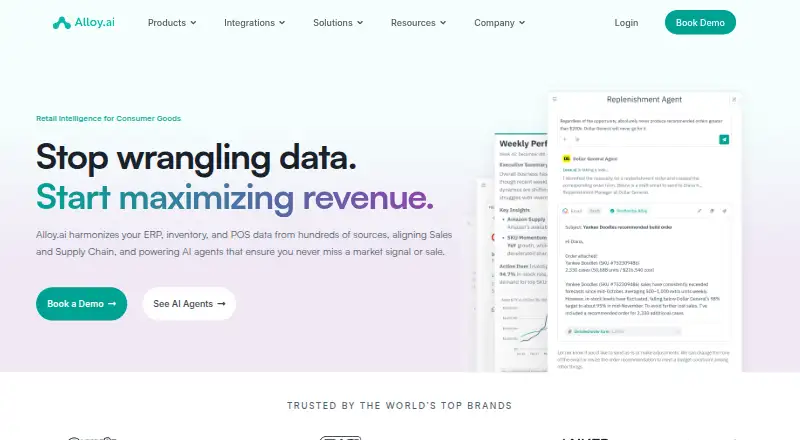
Alloy Planning is a web-based forecasting and planning solution built for consumer goods brands. It uses harmonized retail point-of-sale and channel inventory data to reflect demand shifts down to retailer and SKU level. The platform automatically updates point-of-sale, channel inventory, and shipment data, then alerts users to areas needing attention. Sales and supply chain teams can plan and track performance together, using demand projections, sales forecasts, marketing promotions, and capacity forecasts to develop consensus demand and inventory plans. Alloy.ai says its broader platform combines commerce and inventory information and normalizes data from retailers, ecommerce platforms, distributors, 3PLs, and ERPs. It models product movement across manufacturing, warehouses, and retail locations. Additional tools include an AI analyst for natural-language questions, a reporting agent, and an agent that prepares store-level stockout recovery orders for approval. Listed demand-planning integrations include SAP IBP, Anaplan, Kinaxis, and Logility; customers can ask about other integrations. Alloy.ai says customer data is encrypted at rest and in transit, and that it maintains SOC 2 Type II for Security and is GDPR compliant. Pricing is available on request.
Good
- Forecasts demand to retailer and SKU level.
- Automatically updates sales, inventory, and shipment data.
- Supports consensus demand and inventory planning.
- Lists SAP IBP, Anaplan, Kinaxis, and Logility integrations.
Watch out
- Pricing is available on request.
- The listed platform is web only.
- Prospective customers must request a demo.
Who it suits
Alloy Planning suits consumer goods brands whose sales and supply chain teams need retailer- and SKU-level forecasts. It is presented as a planning tool for responding to demand changes and managing inventory.
Verdict
Alloy Planning centers consumer goods forecasting on point-of-sale and channel inventory data, with shared planning and alerts for areas needing attention. Pricing and a demo are handled through Alloy.ai.
The facts
Each one read from Alloy Planning's own pages, with the date it was checked.
What it does
- Access controls
- Alloy.ai supports single sign-on through SAML.checked 4 Oct 2026
- AI analysis
- Lens is an on-demand AI analyst that answers natural-language questions and explains performance through multidimensional analysis.checked 4 Oct 2026
- Availability
- Alloy.ai directs prospective customers to book a demo; after a request, a sales representative will email within 24 hours to schedule an introductory call.checked 4 Oct 2026
- Compliance
- Alloy.ai says it maintains SOC 2 Type II for Security and is GDPR compliant, and describes its approach to CCPA data protection and compliance.checked 4 Oct 2026
- Custom integrations
- Alloy.ai invites customers to contact it to discuss building an integration if their demand planning software is not listed.checked 4 Oct 2026
- Data collection
- The platform automates data extraction from APIs, retailer portals, and flat files.checked 4 Oct 2026
- Data normalization
- Its SKU-Location Inference Model maps partner identifiers to internal SKUs, converts units of measure, and harmonizes metrics, calendars, and currencies.checked 4 Oct 2026
- Data sources
- Alloy.ai says it has 450+ pre-built integrations for retailers, ecommerce platforms, distributors, 3PLs, and ERPs.checked 4 Oct 2026
- Forecasting
- It uses harmonized retail point-of-sale and channel inventory data to reflect demand shifts down to retailer and SKU level.checked 4 Oct 2026
- Integrations
- Alloy.ai lists Snowflake, BigQuery, Databricks, Redshift, and Azure Data Lake as warehouse destinations, plus Tableau, Power BI, Looker, Kinaxis, Anaplan, and SAP IBP as downstream tools.checked 4 Oct 2026
- Purpose
- Alloy.ai is built to help consumer goods brands sell more products, save time, and solve supply chain challenges.checked 4 Oct 2026
- Replenishment agent
- The Replenishment Agent detects store-level stockouts and prepares recovery orders for approval.checked 4 Oct 2026
- Reporting agent
- The Performance Reporting Agent synthesizes data into executive narratives and custom visualizations.checked 4 Oct 2026
- Security
- Alloy.ai says it encrypts customer data at rest and in transit, stores it in Google Cloud Platform, and uses TLS 1.2 for transit and service requests.checked 4 Oct 2026
- S&OP
- Alloy Planning feeds consensus demand and inventory plans based on point-of-sale demand projections, sales forecasts, marketing promotions, and capacity forecasts.checked 4 Oct 2026
- Supply chain visibility
- The platform models product movement across manufacturing, warehouses, and retail locations, with visibility across network tiers.checked 4 Oct 2026
- Support
- Alloy.ai directs users to contact its support team for product questions and provides security contact [email protected] for security concerns.checked 4 Oct 2026
- What it does
- Alloy Planning is a point-of-sale-driven forecasting and planning solution for consumer goods companies.checked 4 Oct 2026
The company
- Data ownership
- Alloy.ai says customers retain exclusive ownership of raw signals and AI-generated insights and that it does not use proprietary customer data to train third-party or general AI models.checked 4 Oct 2026
- Headquarters
- San Francisco, California, United Stateschecked 28 Sep 2026
Where it runs
- Data platform
- The platform combines commerce and inventory data into a unified source of truth for Sales and Supply Chain teams.checked 4 Oct 2026
Money
- Demand planning integrations
- The site lists SAP IBP, Anaplan, Kinaxis, and Logility as popular demand planning integrations.checked 4 Oct 2026
- Planner workflow
- The platform automatically harmonizes and updates retail point-of-sale, channel inventory, and shipment data, and alerts users to areas needing attention.checked 4 Oct 2026
- Planning collaboration
- Teams can plan and track performance against plan in one place to respond to changes and reduce stockouts and excess inventory costs.checked 4 Oct 2026
The full review of Alloy Planning
Alloy Planning is a web-based forecasting and planning system designed specifically for consumer goods brands. It is best suited to sales and supply-chain teams that depend on retailer sell-through and channel inventory, rather than companies seeking a broad, self-serve planning app. Its retail-level data model is a strong differentiator, while custom pricing and a demo-led buying process make it a considered enterprise purchase.
Overview
Alloy Planning brings commerce and inventory information into a shared source of truth for Sales and Supply Chain teams. The platform is built around point-of-sale demand, channel inventory and shipment data, with visibility into product movement from manufacturing through warehouses and retail locations. That focus gives consumer brands a more operational view than a forecast based solely on shipments.
Alloy.ai says its platform connects to more than 450 pre-built sources, including retailers, ecommerce platforms, distributors, 3PLs and ERPs. It extracts data from APIs, retailer portals and flat files, then applies a SKU-Location Inference Model to map partner identifiers, convert units, and align metrics, calendars and currencies. For organizations dealing with inconsistent partner data, this normalization can remove substantial manual preparation before planning begins.
Key features
Forecasts use harmonized retail point-of-sale and channel inventory signals down to retailer and SKU level. Demand sensing, hierarchical forecasting and scenario planning let teams react to changes at a useful operating granularity instead of managing only an aggregate demand number. The sku_location forecast granularity is particularly relevant when store-level availability and sell-through determine replenishment decisions.
Shared planning lets teams build plans and measure performance against them in one workspace. Point-of-sale, inventory and shipment feeds are automatically updated, and alerts identify areas that need attention. That exception-oriented workflow can help teams respond to stockouts and reduce excess-inventory costs, although its value depends on having reliable retail and channel data to begin with.
For S&OP, Alloy Planning combines point-of-sale projections with sales forecasts, marketing promotions and capacity forecasts to support consensus demand and inventory plans. It lists SAP IBP, Anaplan, Kinaxis and Logility among its demand-planning integrations, and Alloy.ai will discuss a custom integration when a customer's system is not covered.
The wider data platform offers warehouse destinations including Snowflake, BigQuery, Databricks, Redshift and Azure Data Lake, with downstream connections to Tableau, Power BI, Looker, Kinaxis, Anaplan and SAP IBP. Lens acts as an on-demand AI analyst for natural-language questions and multidimensional performance explanations. A Replenishment Agent detects store-level stockouts and prepares recovery orders for approval, while the Performance Reporting Agent turns data into executive narratives and custom visualizations. These agents are practical extensions for teams that want analysis and exception handling close to the planning data, not replacements for planner approval.
Alloy.ai says customer data is encrypted at rest and in transit, stored on Google Cloud Platform, and protected with TLS 1.2 for transit and service requests. It maintains SOC 2 Type II for Security, is GDPR compliant, describes CCPA protections, and supports SAML single sign-on. Customers retain ownership of raw signals and AI-generated insights; Alloy.ai says it does not use proprietary customer data to train third-party or general AI models.
Pricing
Alloy Planning uses paid, custom pricing. Prospective customers are directed to book a demo, after which a sales representative emails within 24 hours to arrange an introductory call. There is no self-serve tier or published seat, quota, trial-length or renewal term to compare, so smaller teams should expect a sales-led evaluation rather than an immediate low-cost start.
Platforms
Alloy Planning runs on the web, making it suitable for distributed teams that can work through a browser. Its integrations and warehouse destinations extend data access into existing analytics and planning environments.
Who it's for
Choose Alloy Planning when you are a consumer goods brand coordinating sales, supply, promotions and inventory around retailer-level demand. It is a strong fit for organizations with many retail data feeds, complex SKU-location planning and a need to connect S&OP with current sell-through. It is less suitable for non-consumer-goods operations, teams without channel data, or buyers who require transparent pricing and instant deployment.
Pros and cons
- Pros: Retailer- and SKU-level forecasts use point-of-sale and channel inventory rather than shipment history alone.
- Pros: Automated extraction and normalization across 450-plus integrations can reduce the work of reconciling partner data.
- Pros: Demand sensing, scenarios and hierarchical forecasts support responsive planning, while alerts and replenishment workflows focus attention on exceptions.
- Pros: SAML, SOC 2 Type II, GDPR compliance and stated data-ownership protections address common enterprise governance requirements.
- Cons: Pricing is by request and purchase starts with a demo, making budget comparison and self-serve adoption difficult.
- Cons: The product's value is concentrated in consumer-goods and retail-channel use cases; organizations without those signals may not benefit from its specialization.
Alternatives
frePPLe is the better starting point for buyers wanting a free, open-source edition, self-hosting or a cloud option with a six-scenario limit. NETVIBES suits teams seeking a paid platform that also offers a free plan and mobile access. OpsFactor is preferable when a Windows, self-hosted community edition with no license charge is the priority.
Infor Learning Management System is an alternative paid web and API product with a free trial. Blue Ridge Supply Chain Intelligence is another quote-based supply-chain option for buyers prepared to book a demo. Kepion provides a paid, web, API, self-hosted and Windows deployment choice. Logility DemandAI+ is a web-based paid alternative with pricing discussed through a walkthrough, while RELEX Demand Planning is another paid web option.
For a wider comparison of demand-planning tools, see Demand Planning Software.
Verdict
Alloy Planning is a compelling choice for consumer goods brands that need retailer-level demand sensing, unified channel data and collaborative S&OP in one web platform. Its strongest reason to choose it is the combination of granular retail forecasting, automated data harmonization and action-oriented agents. Look elsewhere if you need published pricing, a free tier or a general-purpose planner outside retail-focused consumer goods.
Alternatives to Alloy Planning
- 1

frePPLe
Free planWebAPILinuxSelf-hosted7.2Free plan - 2

Forecast Pro
APILinuxSelf-hostedWindows7.0From $199 a month - 3

Inventory Planner
Free planWebAPI7.0Free plan - 4

Prediko
WebAPI7.0From $49 a month - 5

Flowlity
WebAPI6.9From €249 a month - 6
Anaplan
AndroidiOSWebAPI6.5