Aleph
Aleph is AI-native financial planning and analysis software that connects data, strategy, and spreadsheets through a web platform.
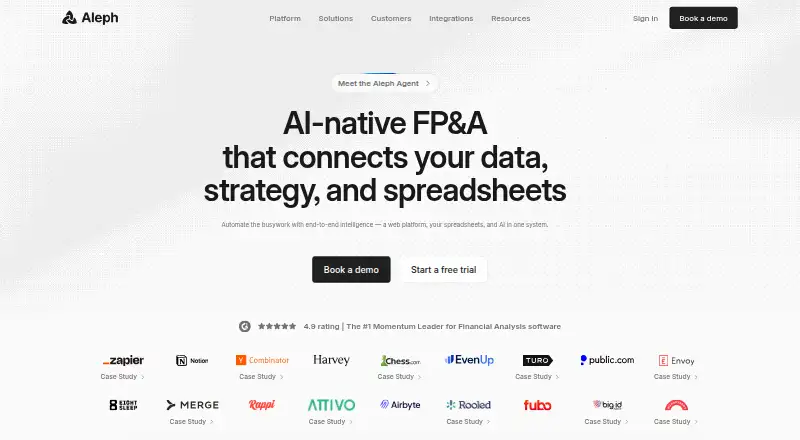
What Aleph is
Aleph is AI-native financial planning and analysis software that connects data, strategy, and spreadsheets through a web platform. Its workflows include financial reporting and close, collaborative budgeting, modeling and forecasting, headcount planning, and investor and board relations. More than 150 no-code connectors cover ERP, HRIS, CRM, and other systems, with API connections also supported. Excel and Google Sheets integrations can pull source data and push budgets, scenarios, or datasets; spreadsheet data can refresh on a schedule, and event triggers can automate work across sheets. Data tools include field mapping, combining tables, calculations, metrics, and SQL. Aleph's Scan tool analyzes changes and variances and produces AI-generated notes on factors, patterns, and root causes. Team and user permissions control access to sensitive data. The company, founded in 2020, offers a free full-access trial and a 30-minute demo using a prospective customer's data. Subscription pricing is quote-based and not published; there is no free plan, though a free trial is available.
Good
- Supports budgeting, forecasting, scenario modeling, and variance analysis.
- Offers more than 150 no-code connectors.
- Bidirectional Excel and Google Sheets integrations.
- Provides a free full-access trial and 30-minute demo.
- Lists SOC 1 Type II and SOC 2 Type II certification.
Watch out
- No free plan; only a free trial is listed.
- Subscription prices are quote-based and unpublished.
- Some integrations may take up to 48 hours to bring online.
Who it suits
Aleph suits finance teams that need budgeting, forecasting, reporting, workforce planning, or financial consolidation connected to spreadsheets and business systems. Prospective buyers can request a demo using their data and a free full-access trial.
Verdict
Aleph brings planning workflows, integrations, and spreadsheet automation into a web-based FP&A product. Its trial offers a way to evaluate it, but pricing requires a quote.
The facts
Each one read from Aleph's own pages, with the date it was checked.
What it does
- Access controls
- Google and Microsoft SSO are available by default; the security page also describes SAML support for providers such as Okta and SCIM directory sync.checked 8 Oct 2026
- AI analysis
- Aleph Scan analyzes changes and variances and generates notes identifying factors, patterns, and root causes.checked 8 Oct 2026
- Budgeting
- Yeschecked 22 Sep 2026
- Custom integrations
- Aleph says it can bring new integrations online in as little as 48 hours and supports connections through an API.checked 8 Oct 2026
- Data connectors
- Aleph advertises 150+ no-code connectors for syncing ERP, HRIS, CRM, and other business data.checked 8 Oct 2026
- Data transformation
- Aleph supports mapping fields, combining tables, running calculations, storing metrics, and SQL.checked 8 Oct 2026
- Demo
- Aleph offers a 30-minute demo using the prospective customer’s data.checked 7 Oct 2026
- Deployment option
- Aleph's security page says on-premise hosting is an option.checked 8 Oct 2026
- Encryption and hosting
- The security page says data is encrypted in transit and at rest and that Aleph is hosted on Google Cloud Platform.checked 8 Oct 2026
- Financial consolidation
- Yeschecked 22 Sep 2026
- Financial workflows
- The product supports financial reporting and close, collaborative budgeting, modeling and forecasting, headcount planning, and investor and board relations.checked 7 Oct 2026
- Forecasting
- Yeschecked 22 Sep 2026
- Integrations
- Listed integrations include NetSuite, QuickBooks, Xero, Salesforce, Stripe, Snowflake, BigQuery, Databricks, Google Sheets, and Excel.checked 8 Oct 2026
- Integration setup
- Aleph says it can have new integrations up and running in as little as 48 hours.checked 7 Oct 2026
- Named integrations
- The integrations page lists NetSuite, QuickBooks, Xero, BambooHR, Salesforce, Databricks, BigQuery, Google Sheets, Excel, Stripe, Snowflake, and other services.checked 7 Oct 2026
- Permissions
- Aleph says team and user permissions control who can access sensitive data.checked 7 Oct 2026
- Pricing availability
- The pages opened advertise a free trial and demo but do not state subscription prices.checked 7 Oct 2026
- Product
- Aleph is an AI-native FP&A platform connecting financial data, strategy, spreadsheets, and AI.checked 8 Oct 2026
- Scenario modeling
- Yeschecked 22 Sep 2026
- Security certifications
- Aleph says it is SOC 1 Type II and SOC 2 Type II certified, with continuous monitoring, annual audits, and at least annual third-party penetration testing.checked 8 Oct 2026
The company
- Company
- Aleph's about page identifies Santiago Perez De Rosso as co-founder and CTO and Albert Gozzi as co-founder and CEO.checked 8 Oct 2026
- Founded
- 2020checked 28 Sep 2026
Money
- Free plan
- Nochecked 22 Sep 2026
- Planning use cases
- Aleph describes features for financial reporting and close, collaborative budgeting, modeling and forecasting, headcount planning, and investor and board relations.checked 8 Oct 2026
The full review of Aleph
Aleph is an AI-native FP&A platform for finance teams coordinating budgets, forecasts, reporting, and spreadsheet work across multiple business systems. It is best suited to organizations that need connected planning rather than a single-purpose budgeting tool. Its integration depth and spreadsheet automation are strong reasons to consider it, while quote-based pricing makes early cost comparison difficult.
Overview
Aleph combines financial reporting and close, collaborative budgeting, modeling and forecasting, headcount planning, and investor and board reporting in one web platform. Its coverage includes budgeting, forecasting, scenario modeling, workforce planning, financial consolidation, variance analysis, and forecast-versus-actuals work. That breadth can replace several disconnected finance processes, but smaller teams seeking only a basic budget may find the scope more than they need.
The platform is built around connected data. Aleph says it provides more than 150 no-code connectors for ERP, HRIS, CRM, and other systems, alongside API connections for services without a standard connector. Named integrations include NetSuite, QuickBooks, Xero, BambooHR, Salesforce, Databricks, BigQuery, Google Sheets, Excel, Stripe, and Snowflake. New integrations can be brought online in as little as 48 hours, which is useful when an organization’s systems fall outside a normal finance stack.
Key features
Spreadsheet workflows
Excel and Google Sheets add-ins can pull source information and push budgets, scenarios, or datasets. Teams can work with complete spreadsheets or selected cells, refresh data on a schedule, and use event triggers to run automations across multiple spreadsheets. This preserves familiar spreadsheet work while adding a controlled connection to operational data; it is less compelling for organizations that have already abandoned spreadsheets entirely.
Transformation and analysis
Aleph supports field mapping, table combinations, calculations, stored metrics, and SQL, giving finance users ways to shape incoming data before it reaches a plan or report. Its Scan tool examines changes and variances, then produces AI-generated notes about factors, patterns, and possible root causes. That can speed variance review, although teams should still apply financial judgment before treating generated explanations as conclusions.
Controls and security
Team and user permissions govern access to sensitive data. Google and Microsoft single sign-on are available by default, with SAML support for providers such as Okta and SCIM directory synchronization. Aleph says it holds SOC 1 Type II and SOC 2 Type II certifications, encrypts data in transit and at rest, hosts on Google Cloud Platform, and performs continuous monitoring, annual audits, and at least annual third-party penetration testing. On-premise hosting is also an option. Security documentation is requested through a customer success manager or contact form.
Pricing
Aleph uses paid, quote-based pricing and publishes no subscription rate card. There is no free plan. A free, full-access trial is offered, and users can cancel and remove their data at any time; a 30-minute demonstration can use a prospective customer’s own data. The trial is the practical way to assess fit, but organizations must speak with sales to understand the eventual charge and commercial terms.
That model is most suitable for finance departments with a defined cross-system planning need and budget for a tailored deployment. It is a weaker fit for small businesses comparing transparent monthly prices or wanting a permanently free tier.
Platforms
Aleph runs on the web and supports macOS and Windows access. Its Excel and Google Sheets add-ins extend the workflow into desktop spreadsheets, while the deployment options include cloud hosting on Google Cloud Platform and an on-premise choice.
Who it's for
Aleph fits finance and FP&A teams that need collaborative budgeting, rolling forecasts, scenario analysis, workforce plans, consolidation, and variance review tied to ERP, HR, CRM, and spreadsheet data. It is particularly relevant to organizations whose analysts still build models in Excel or Google Sheets but need scheduled refreshes, permissions, and repeatable automation. Teams with a narrow budgeting requirement, limited integration needs, or a strict requirement for published pricing should look elsewhere.
Pros and cons
Pros
- Broad planning coverage: budgeting, forecasting, scenarios, workforce planning, consolidation, and reporting sit in the same product.
- Extensive connectivity: more than 150 no-code connectors, API support, and named links to major finance, data, CRM, and spreadsheet services reduce manual imports.
- Useful spreadsheet bridge: bidirectional Excel and Google Sheets links, scheduled refreshes, and event-triggered automation support established finance habits.
- Enterprise controls: permissions, SSO, SAML, SCIM, encryption, and SOC certifications address sensitive financial data requirements.
Cons
- Cost is opaque: quote-based pricing and no published rate card prevent straightforward budget comparisons.
- No free tier: evaluation depends on the full-access trial and a sales process rather than ongoing free use.
- Potentially broad for small teams: organizations needing one simple planning function may pay for capabilities they do not use.
Alternatives
Choose OneStream if you need a paid platform available on web, Windows, mobile, API, or self-hosted deployments and are prepared to request a demo for pricing.
Workday Adaptive Planning is the better comparison when a 30-day trial and broader platform availability, including Android, iOS, macOS, web, and Windows, matter.
Consider Epicor Kinetic when you want to assemble a package around platform core, cloud, concurrent-user licensing, and industry bundles.
Epicor FP&A offers tiers ranging from one-company plans to Standard coverage for 10 companies and an Enterprise option.
Pick Cube when unlimited dimensions and users, custom roles, and dashboards are the priority.
Euna Budget is aimed at public-sector organizations choosing between professional tools for small to midsize bodies and enterprise configurability and guidance.
Planalyz is the transparent-price alternative, with a free plan and paid monthly tiers beginning at $500 a month.
Questica Budget provides another paid budgeting option for public organizations, with professional and enterprise positioning.
For category-focused comparisons, see Nonprofit Budgeting Software, Financial Forecasting Software, Scenario Planning Software, and Financial Planning & Analysis Software.
Verdict
Aleph is a strong choice for mid-sized and larger finance teams that need one connected environment for planning, reporting, spreadsheet collaboration, and data integration. Its main advantage is turning familiar spreadsheet processes into refreshable, permissioned workflows across many systems. Look elsewhere if upfront price transparency, a free tier, or a narrowly focused budgeting tool matters more than broad FP&A coverage.
Alternatives to Aleph
- 1

IBM Planning Analytics
iOSWebAPIExtension8.6 - 2

Oracle Fusion Cloud EPM
Free planAndroidiOSWebAPI8.5From $250 a month - 3
Uniflow
Free planAndroidiOSWebmacOS8.5Free plan - 4
Workday Adaptive Planning
AndroidiOSWebAPI8.3 - 5

OneStream
AndroidiOSWebAPI7.7 - 6

Adlega
Free planWebAPI7.7From $41 a month