AIGR
The facts below are what the maker publishes about AIGR, checked and dated. Our editors have not written about it yet.
The facts
Each one read from AIGR's own pages, with the date it was checked.
What it does
- Assessment
- Its assessment process is described as defining scope, testing evidence, identifying blockers and setting remediation priorities.checked 11 Oct 2026
- Availability and terms
- Separate written terms govern paid assessments, platform access, rating engagements and other contracted services.checked 11 Oct 2026
- Critical gates
- A material control failure can hold the governed outcome even when the analytical score is strong.checked 11 Oct 2026
- Evidence review
- Evidence is evaluated for relevance, currency, traceability and sufficiency.checked 11 Oct 2026
- Intended users
- AIGR describes its ratings as decision support for boards, buyers and risk teams.checked 11 Oct 2026
- Limitations
- AIGR describes its rating as a scoped governance opinion, not a certification, compliance attestation, audit opinion or regulatory approval.checked 11 Oct 2026
- Monitoring
- Material changes, incidents and evidence expiry can trigger reassessment.checked 11 Oct 2026
- Ongoing review
- Model updates, vendor changes, incidents and policy changes can trigger reassessment.checked 11 Oct 2026
- Privacy limit
- The public contact form should not be used to submit confidential client evidence, sensitive personal information or production credentials.checked 11 Oct 2026
- Purpose
- AIGR develops AI Governance Ratings for organizations deploying AI in regulated and high-accountability environments.checked 11 Oct 2026
- Rating limitation
- AIGR states that its rating is not a certification, regulatory approval, legal advice, audit opinion or compliance attestation.checked 11 Oct 2026
- Rating method
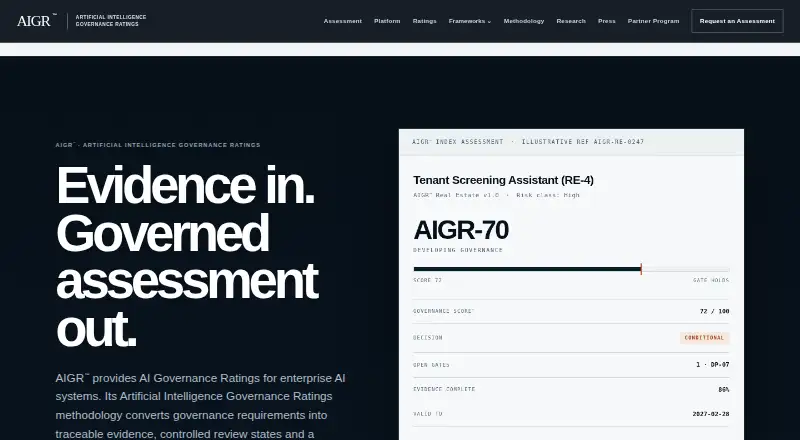
- AIGR separates a 0–100 analytical Governance Score from categorical ratings ranging from AIGR-100 to AIGR-40, with AIGR-NR for cases where conditions do not support an opinion.checked 11 Oct 2026
- Rating scale
- AIGR uses categorical designations from AIGR-100 through AIGR-40, plus AIGR-NR when evidence, scope or review conditions do not support a rating.checked 11 Oct 2026
- Sector frameworks
- The site lists frameworks for real estate, health, finance and government.checked 11 Oct 2026
- Security
- AIGR’s privacy policy describes its services as designed around controlled access, evidence ownership and auditability, and lists safeguards such as role-based access, authentication controls, encryption where appropriate, logging and backup.checked 11 Oct 2026
- Security and privacy scope
- The methodology includes cybersecurity governance covering access, model and data security, supplier controls and incident readiness.checked 11 Oct 2026
- Standards alignment
- AIGR maps external obligations and internal control expectations to evidence, while stating that this alignment does not imply certification, endorsement or legal compliance.checked 11 Oct 2026
- Support and contact
- Organizations can request an assessment discussion by email or through the site's enquiry form.checked 11 Oct 2026
- Who it serves
- AIGR says it develops ratings for organizations deploying AI in regulated and high-accountability environments.checked 11 Oct 2026
- Workflow
- The platform records system ownership and intended use, control expectations, evidence artifacts, findings, exceptions, approvals and challenge history.checked 11 Oct 2026
The company
- Headquarters
- Toronto, Canadachecked 28 Sep 2026
Where it runs
- Platform
- The platform is designed to keep AI system inventories, controls, evidence, review decisions and monitoring events in one system of record.checked 11 Oct 2026
Alternatives to AIGR
- 1
CognitiveView
Free planAndroidiOSWebAPI8.0Free plan - 2
ComplyLayer
Free planWebAPIExtension7.4From $99 a month - 3
Trusys AI
Free planWebAPISelf-hosted7.0From $69 a month - 4
Openlayer Guardrails
Free planWebAPISelf-hosted6.9Free plan - 5
Verisum
Free planWebAPI6.8From £129 a month - 6
AIGovernr
Web6.4From $79 a month