AIDA-X
AIDA-X is a free AI amp model player for loading and playing models of music gear, mainly for high-fidelity amplifier simulations.
What AIDA-X is
AIDA-X is a free AI amp model player for loading and playing models of music gear, mainly for high-fidelity amplifier simulations. It can combine amp and cabinet models with distortion, drive, fuzz, boost, and EQ in a signal chain. The desktop plugin supports CLAP, LV2, VST2, and VST3 formats, and a standalone version is also available. Its cabinet simulator runs after the amp model and accepts impulse-response files in WAV or FLAC format. Controls include input and output meters, bypass, input level, EQ tone controls, and output level adjustment. Desktop installers are provided for Windows and macOS, with Linux binary tarballs. The browser version runs in WebAssembly-capable browsers and allows users to load their own amp models and cabinet IRs, but uses preselected guitar loops rather than audio input. The standalone app connects to the system-default audio device and currently has no option to select another input or output. Desktop builds are unsigned and may prompt untrusted-developer warnings. AIDA-X is licensed under GPL-3.0-or-later.
Good
- Supports CLAP, LV2, VST2, and VST3 plugins.
- Standalone version is available.
- Cabinet simulator accepts WAV and FLAC impulse responses.
- Desktop builds are provided for Windows, macOS, and Linux.
- Browser version can load user amp models and cabinet IRs.
Watch out
- Browser version uses guitar loops instead of audio input.
- Standalone app uses the system-default audio device.
- Unsigned desktop builds may trigger security warnings.
Who it suits
AIDA-X suits musicians who want to play amp models in a plugin or standalone app, or experiment with models in a browser. Its LV2 headless version is also described for embedded systems such as MOD Dwarf and Raspberry Pi.
Verdict
AIDA-X offers amp-model playback in plugin, standalone, and browser forms, with cabinet impulse-response support. The browser version lacks audio input, and the standalone app does not let users choose another audio device.
The facts
Each one read from AIDA-X's own pages, with the date it was checked.
What it does
- Audio formats
- Cabinet impulse-response files support WAV and FLAC formats.checked 30 Sep 2001
- Cabinet simulation
- A cabinet simulator using impulse response files runs after the amp model, and IR files can be WAV or FLAC.checked 30 Sep 2001
- Controls
- The plugin includes input and output meters, bypass and input level controls, EQ tone controls, and output level adjustment.checked 30 Sep 2001
- Embedded systems
- The LV2 engine is optimized for embedded systems including MOD Dwarf, Raspberry Pi, Portenta-X8 and Aida DSP OS.checked 30 Sep 2001
- Integrations
- The LV2 headless version is described as optimized for embedded systems including MOD Dwarf, Raspberry Pi, Portenta-X8 and Aida DSP OS.checked 30 Sep 2001
- Latest release
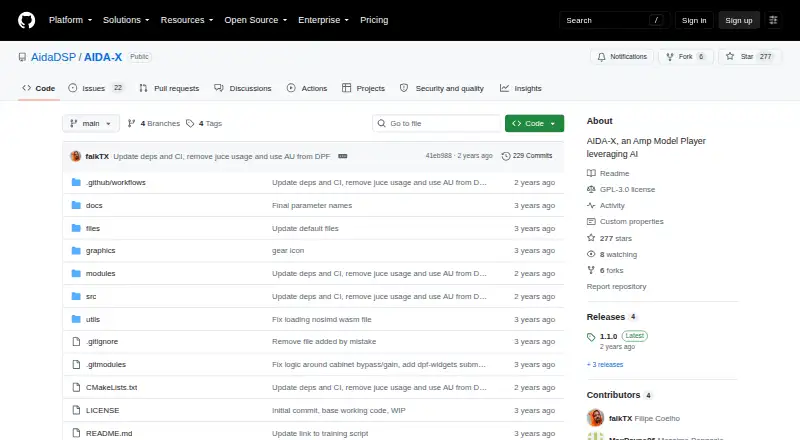
- The latest GitHub release shown is version 1.1.0, released February 1.checked 30 Sep 2001
- License
- The repository states that AIDA-X is licensed under GPL-3.0-or-later.checked 30 Sep 2001
- Model training
- The maker links an online model trainer for creating JSON models, which requires neural-network training.checked 30 Sep 2001
- Online version
- AIDA-X Online runs in a WebAssembly-capable browser, uses preselected guitar loops instead of audio input, and allows users to load their own amp models and cabinet IRs.checked 30 Sep 2001
- Plugin formats
- The desktop version supports CLAP, LV2, VST2 and VST3 formats and also has a standalone version.checked 30 Sep 2001
- Purpose
- AIDA-X is an AI amp model player for loading and playing models of music gear, mainly for high-fidelity amplifier simulations.checked 30 Sep 2001
- Security
- The maker warns that its desktop builds are unsigned and may trigger warnings that they are from an untrusted developer.checked 30 Sep 2001
- Security notice
- The distributed builds are unsigned and may trigger untrusted-developer warnings, especially on macOS.checked 30 Sep 2001
- Signal chains
- It can run signal chains combining amp, cab, distortion, drive, fuzz, boost and EQ.checked 30 Sep 2001
- Standalone limitation
- The standalone app connects to the system-default audio device and currently has no option to select another input or output device.checked 30 Sep 2001
- Support
- The project points users to the MOD Forum's Neural Modelling section for discussion and sharing amp models.checked 30 Sep 2001
- Technical stack
- AIDA-X uses RTNeural, DPF, a custom FFTConvolver fork and r8brain-free-src.checked 30 Sep 2001
- Web limitation
- The online version has no audio input and instead uses a pre-selected list of guitar audio loops.checked 30 Sep 2001
- Web version
- An experimental online version is available and is described as otherwise fully functional and identical to the desktop version.checked 30 Sep 2001
Where it runs
- Desktop platforms
- Installers are provided for macOS and Windows, with binary tarballs for Linux.checked 30 Sep 2001
- Platforms
- Installers are provided for macOS and Windows, and Linux downloads are provided as binary tarballs.checked 30 Sep 2001
The company
- Headquarters
- Turin, Italychecked 28 Sep 2001
- Maker
- Aida DSP describes itself as a startup focused on digital audio processing that offers products and consulting services.checked 30 Sep 2001
The full review of AIDA-X
Overview
AIDA-X is an AI amp model player for loading and playing models of music gear, with its primary focus on high-fidelity amplifier simulation. It is made by Aida DSP, a Turin-based startup working in digital audio processing and offering products and consulting services.
The software comes as a desktop plugin, a standalone app and an experimental browser version. Its LV2 headless engine is also intended for embedded systems. The project is licensed under GPL-3.0-or-later and directs users to the MOD Forum’s Neural Modelling section to discuss the software and share amp models.
For a broader look at this category, see our Guitar Amp Software list.
Key features
AIDA-X can run signal chains that bring together amp and cabinet models with distortion, drive, fuzz, boost and EQ. The cabinet simulator sits after the amp model and loads impulse responses in WAV or FLAC format.
The plugin includes input and output meters, bypass and input-level controls, EQ tone controls, and output-level adjustment. Desktop plugin formats include CLAP, LV2, VST2 and VST3, and the software can also run standalone.
AIDA-X Online works in WebAssembly-capable browsers and is described as otherwise fully functional and identical to the desktop edition. Users can load their own amp models and cabinet IR files, but the browser version has no audio input; it uses a selection of preloaded guitar loops instead.
The maker links an online trainer for creating JSON models, a process that requires neural-network training. The LV2 headless version is optimized for embedded systems such as MOD Dwarf, Raspberry Pi, Portenta-X8 and Aida DSP OS.
Pricing
AIDA-X is free. The project lists a free plan.
Platforms
Desktop installers are available for Windows and macOS, while Linux users can get binary tarballs. The desktop builds are unsigned and may trigger warnings that they come from an untrusted developer, particularly on macOS.
The standalone app connects to the system-default audio device and currently has no option to choose another input or output device. The browser version requires a WebAssembly-capable browser and uses preset guitar loops rather than live audio input.
Who it's for
AIDA-X is suited to musicians looking to play amp models in a plugin or standalone setup, and to users who want to explore amp and cabinet combinations with additional drive, distortion and EQ stages. The online version offers a way to try the software with supplied guitar loops, while model loading supports users with their own amp models and cabinet IRs.
Its embedded LV2 engine may also suit people working with the listed supported systems. Those who want to create models should account for the neural-network training required by the linked trainer.
Pros and cons
- Pros: Free to use; supports CLAP, LV2, VST2 and VST3 as well as standalone operation; cabinet IR support includes WAV and FLAC; browser version allows loading personal models and IRs.
- Cons: The browser version does not accept audio input; standalone operation is limited to the system-default audio device; unsigned desktop builds can prompt security warnings.
Alternatives
Other options in this category include Amp Locker, GENOME, IK Multimedia ReSing, Neural Amp Modeler, Amped, Amplifikation 360, Helix Stadium Native and AmpForge.
Verdict
AIDA-X brings amp-model playback, cabinet impulse responses and several plugin formats together in a free package with desktop, browser and embedded-system options. Its practical fit depends on the setup: the browser edition relies on preset loops instead of audio input, while the standalone app cannot select an alternative audio device. Unsigned desktop builds may also require users to address operating-system warnings before opening them.
Alternatives to AIDA-X
- 1
Amped
Free planAPImacOSWindows7.3€39.99, paid once - 2

Helix Stadium Native
Free planAPImacOSWindows7.3$99.99, paid once - 3
IK Multimedia ReSing
Free planmacOSWindows7.3$129.99, paid once - 4

GENOME
Free planiOSmacOSWindows6.9$89.99, paid once - 5
Amp Locker
Free planLinuxmacOSWindows6.6From $5 a month - 6

Amplifikation 360
Free planmacOSWindows6.6$25, paid once