AetherLake
AetherLake is a Kubernetes-native data lakehouse that brings storage, catalog, federated SQL, stream processing, orchestration, business intelligence, and id…
What AetherLake is
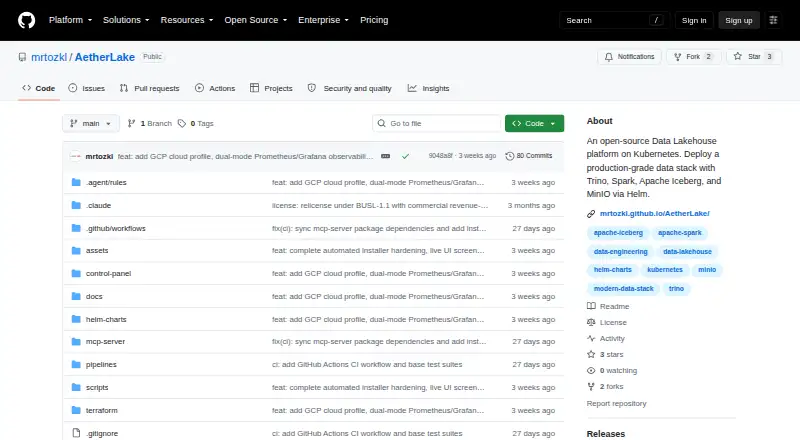
AetherLake is a Kubernetes-native data lakehouse that brings storage, catalog, federated SQL, stream processing, orchestration, business intelligence, and identity into a web control panel. Its components include MinIO, Trino, Apache Polaris, Kafka, Flink, dbt, Airflow, Superset, Spark, Milvus, Prometheus, Grafana, PostgreSQL, and Keycloak. The control panel displays pod health and resource use, supports service restarts, and provides workspaces for dbt, Kafka, Flink SQL, Trino queries, and Iceberg catalogs. Kafka and Flink are enabled by default; project examples describe streaming Kafka data into Iceberg tables and querying Kafka topics through Trino. Keycloak provides OIDC single sign-on across services, with data-admin, data-scientist, and data-engineer role names. An MCP server lets supported AI assistants access platform status, logs and restarts, Trino queries, Polaris catalogs, and Airflow DAGs. The project documents deployment materials for AWS, Azure, and Google Cloud. Setup prerequisites include Kubernetes, Helm 3.12 or later, kubectl, Docker, and an NGINX ingress controller. Internal, evaluation, development, testing, and non-commercial use is free; commercial use requires a separate license.
Good
- Combines SQL analytics, catalog, and stream processing.
- Kafka and Flink are enabled by default.
- Control panel supports service restarts and workspaces.
- OIDC single sign-on spans services through Keycloak.
- Deployment materials cover AWS, Azure, and Google Cloud.
Watch out
- Commercial use requires a separate license.
- Setup requires Kubernetes, Helm, kubectl, Docker, and NGINX ingress.
- Production setup requires replacing placeholders and configuring secrets and TLS.
- Anonymous installation and health heartbeat can be disabled.
Who it suits
AetherLake suits teams looking to self-host a Kubernetes-based data platform with SQL, streaming, orchestration, and catalog components. Users need the listed deployment prerequisites and should review the license before commercial use.
Verdict
AetherLake assembles a broad self-hosted data stack under one web control panel, with streaming and AI-assistant access included. Review the Kubernetes prerequisites, production setup guidance, and commercial licensing terms before deployment.
Plans and prices
From AetherLake's own pricing page, checked 8 Oct 2026.
| Plan | Price | What it gives you |
|---|---|---|
| Internal, evaluation, and non-commercial use | Free | Free for internal, evaluation, development, testing, and non-commercial use; commercial use requires a separate license |
| Commercial license | Priced on request | Case-by-case licensing; may include revenue-sharing terms |
The facts
Each one read from AetherLake's own pages, with the date it was checked.
What it does
- AI assistant integration
- The MCP server documentation lists tools for platform status, service logs and restarts, Trino queries, Polaris catalogs, and Airflow DAGs, with client setup for Claude Desktop and Cursor.checked 8 Oct 2026
- AI integrations
- The MCP server lets AI assistants such as Claude and Cursor access platform status, logs and restarts, Trino queries, Polaris catalogs, and Airflow DAGs.checked 8 Oct 2026
- Cloud deployments
- The project documents Terraform and Helm deployment materials for AWS, Azure, and Google Cloud.checked 8 Oct 2026
- Cloud support
- The repository describes deployment configurations for AWS, Azure, and Google Cloud Platform.checked 8 Oct 2026
- Components
- Its listed components include MinIO, Trino, Apache Polaris, Kafka, Flink, dbt, Airflow, Superset, Spark, Milvus, Prometheus, Grafana, PostgreSQL, and Keycloak.checked 8 Oct 2026
- Control panel
- The control panel shows pod health and resource use, supports service restarts, and includes workspaces for dbt, Kafka, Flink SQL, Trino queries, and Iceberg catalogs.checked 8 Oct 2026
- Data stack
- Its listed components include MinIO, Trino, Apache Polaris, Kafka, Flink, dbt, Airflow, Superset, Spark, and Milvus.checked 8 Oct 2026
- Data transformations
- Its dbt examples describe Bronze, Silver, and Gold stages using Kafka, Flink, Parquet, Iceberg, Superset, and Trino.checked 8 Oct 2026
- Deployment
- The quick start lists Kubernetes, Helm 3.12 or later, kubectl, Docker, and an NGINX ingress controller as prerequisites.checked 8 Oct 2026
- Deployment requirements
- The quick start lists Kubernetes, Helm 3.12 or later, kubectl, Docker, and an NGINX ingress controller as prerequisites.checked 8 Oct 2026
- External Kafka access
- The documented external Kafka listener uses TLS and SCRAM-SHA-512 authentication.checked 8 Oct 2026
- Identity
- Keycloak provides OIDC single sign-on, with oauth2-proxy gates for the Trino UI and Milvus Attu.checked 8 Oct 2026
- Languages
- The control panel is described as bilingual in English and Turkish.checked 8 Oct 2026
- License
- The project's BUSL-1.1 license makes internal, evaluation, development, testing, and non-commercial use free; revenue-generating commercial use requires a separate license, and each release converts to Apache 2.0 four years after publication.checked 8 Oct 2026
- Management
- A Next.js web Control Panel provides platform status, SQL, catalog, Kafka, Flink, dbt, and observability views.checked 8 Oct 2026
- Production setup
- The README advises replacing placeholder values, setting Control Panel secrets, overriding MCP server AIRFLOW_AUTH, and using real ingress TLS certificates before exposing a cluster.checked 8 Oct 2026
- Purpose
- AetherLake is a Kubernetes-native data lakehouse that combines storage, catalog, federated SQL, stream processing, orchestration, BI, and identity in a web control panel.checked 8 Oct 2026
- Security
- The project says credentials are randomly generated per installation and advises setting production secrets and real TLS certificates before exposing a cluster.checked 8 Oct 2026
- Streaming
- Kafka topics can be processed with Flink SQL and queried through Trino, with a documented Kafka-to-Iceberg pipeline.checked 8 Oct 2026
- Telemetry
- An anonymous heartbeat tracks installation counts, detected cloud environments, and component health; the project says it excludes PII, schemas, and dataset contents and can be disabled.checked 8 Oct 2026
The company
- Maker
- The license names Murat Özkul as the licensor and identifies AetherLake as the project.checked 8 Oct 2026
The full review of AetherLake
AetherLake is a self-hosted lakehouse stack managed through a web control panel. It suits teams that can run Kubernetes and want storage, streaming, SQL, orchestration, and BI in one environment. Its breadth is useful, but production deployment calls for careful setup and a separate license for commercial use.
Overview
AetherLake combines object storage, a governance catalog, federated SQL, stream processing, orchestration, BI, and identity. Its components include MinIO, Trino, Apache Polaris, Kafka, Flink, dbt, Airflow, Superset, Spark, Milvus, Prometheus, Grafana, PostgreSQL, and Keycloak. That range gives data teams a shared foundation for several workflows, while leaving them to deploy and operate a substantial set of services.
The web control panel brings together platform status, pod health, resource use, SQL, catalog, Kafka, Flink, dbt, and observability views. It can restart services and provides workspaces for dbt, Kafka, Flink SQL, Trino queries, and Iceberg catalogs. English and Turkish are supported.
Key features
Streaming and lakehouse workflows
Kafka and Flink are enabled by default. Project examples show Kafka data flowing into Iceberg tables and Trino querying Kafka topics. The dbt examples use Bronze, Silver, and Gold stages with Kafka, Flink, Parquet, Iceberg, Superset, and Trino. These workflows make AetherLake a stronger fit for teams building streaming and analytical pipelines together than for those seeking only a query service.
Identity, security, and telemetry
Keycloak provides OIDC single sign-on across services, with role names for data administrators, scientists, and engineers. Credentials are generated randomly for each installation. Before exposing a cluster, the project advises replacing placeholder values, setting production secrets and MCP server Airflow authentication, and configuring real ingress TLS certificates. The external Kafka listener uses TLS and SCRAM-SHA-512 authentication.
An anonymous heartbeat tracks installation counts, detected cloud environments, and component health. It excludes personal information, schemas, and dataset contents, and can be disabled. Teams should still decide whether this telemetry fits their operating policy.
AI assistant access
The MCP server can give Claude Desktop and Cursor access to platform status, service logs and restarts, Trino queries, Polaris catalogs, and Airflow DAGs. That offers a way to work with platform operations and data tools through supported assistants; it does not remove the need to manage the underlying cluster and credentials.
Pricing
AetherLake is free for internal, evaluation, development, testing, and non-commercial use. The free plan is a practical route for teams assessing the stack or running it for non-commercial work, but commercial use requires a separate license.
| Plan | Price | Terms |
|---|---|---|
| Internal, evaluation, and non-commercial use | free | Free for internal, evaluation, development, testing, and non-commercial use; commercial use requires a separate license. |
| Commercial license | Custom pricing | Case-by-case licensing; may include revenue-sharing terms. |
The license permits internal use, modification, and self-hosting under BUSL-1.1. Commercial hosted or managed offerings require a license, and releases convert to Apache-2.0 after four years. Organizations planning a commercial deployment should resolve licensing terms before building around the platform.
Platforms
AetherLake is self-hosted and web-based. The quick start requires Kubernetes, Helm 3.12 or later, kubectl, Docker, and an NGINX ingress controller, so it assumes an existing capacity to run and maintain a Kubernetes environment. Deployment materials cover AWS, Azure, and Google Cloud Platform.
Who it's for
AetherLake makes sense for data engineering teams that want to combine a catalog, SQL analytics, streaming ingestion, transformations, orchestration, and BI in a self-managed environment. Its default Kafka and Flink setup, Iceberg examples, and service workspaces support teams building connected data pipelines. It is a poor fit for readers who need a managed service, lack Kubernetes expertise, or want to avoid production security and licensing work.
Pros and cons
- Broad stack in one control panel: storage, catalog, SQL, streaming, orchestration, BI, identity, and observability sit within one project.
- Useful streaming examples: Kafka and Flink are enabled by default, with documented paths into Iceberg and Trino.
- Operational controls and assistant access: the panel supports health and resource views and service restarts; the MCP server exposes selected platform and data operations to Claude Desktop and Cursor.
- Substantial deployment burden: Kubernetes and several supporting tools are prerequisites, and production exposure requires replacing placeholders and configuring secrets and TLS.
- Commercial terms need planning: commercial use requires a separate, case-by-case license that may include revenue sharing.
- Telemetry is enabled as an option to review: the anonymous heartbeat can be disabled, but teams should account for it in their deployment decisions.
Alternatives
For a broader comparison, see Data Lakehouse Platforms.
- Oracle Autonomous AI Lakehouse is worth considering for readers who want a freemium lakehouse with an always-free plan subject to capacity limits and a free trial.
- Starburst Galaxy offers a free plan capped at three clusters for ad hoc queries, plus a free trial; choose it when that query-focused hosted option better fits than operating AetherLake's Kubernetes stack.
- Databricks Notebooks has a free edition with one serverless workspace and limited compute and usage, making it an option for readers who want a constrained serverless notebook workspace.
- Starburst Data Platform has a free tier for up to three clusters in standard ad hoc execution mode, plus a free trial, for readers comparing another platform with a defined free cluster allowance.
- Amazon SageMaker Autopilot is a paid option with a free trial and pay-as-you-go pricing, for readers looking for that model instead of AetherLake's self-hosted stack.
- Bauplan provides a free public sandbox with CLI, SDK, and API access, suitable for readers who want to explore in a shared environment.
- IOMETE offers a free self-hosted plan capped at 100 vCPUs and an enterprise plan, for readers wanting a stated compute limit and self-hosted alternative.
- LavaLake has a free Core plan for one machine and up to 16 vCPU, with a no-time-limit term, for readers whose workload fits those single-machine limits.
Verdict
Choose AetherLake if your team can operate Kubernetes and wants one self-hosted environment spanning streaming, lakehouse tables, SQL, orchestration, and BI. Its integrated components and control panel are the main draw. Look elsewhere if you need managed operations or cannot take on production hardening and case-by-case commercial licensing.
Getting started
- Prepare Kubernetes, Helm 3.12 or later, kubectl, Docker and an NGINX ingress controller.
- Use the project website at https://github.com/mrtozkl/AetherLake for the quick start.
- Choose a documented deployment configuration for AWS, Azure or Google Cloud Platform, if applicable.
- Replace placeholder values and set production secrets and real ingress TLS certificates before exposing a cluster.
- Configure the MCP server and a supported client such as Claude Desktop or Cursor if needed.
Limits worth knowing
The free plan covers internal, evaluation, development, testing and non-commercial use; commercial use requires a separate license. Commercial licensing is case-by-case and may include revenue-sharing terms.
Questions
Is AetherLake free?
Yes. The free plan is free for internal, evaluation, development, testing and non-commercial use.
What does commercial use cost?
Commercial use requires a separate license. Pricing is case-by-case, and terms may include revenue sharing.
What platforms does it support?
AetherLake is self-hosted and web-based. Deployment configurations are described for AWS, Azure and Google Cloud Platform.
What does the project license allow?
BUSL-1.1 permits internal use, modification and self-hosting. Releases convert to Apache-2.0 after four years.
What is required to deploy it?
The quick start lists Kubernetes, Helm 3.12 or later, kubectl, Docker and an NGINX ingress controller.
Does it integrate with AI assistants?
Its MCP server documentation lists client setup for Claude Desktop and Cursor, with tools for platform status, logs and restarts, Trino queries, Polaris catalogs and Airflow DAGs.
Alternatives to AetherLake
- 1
Databricks Notebooks
Free planAndroidWebAPILinux8.2$0.07 usage-based - 2
Google Cloud Lakehouse for Apache Iceberg
Free planWebAPILinuxSelf-hosted7.5From $0.12 a month - 3

Starburst Galaxy
Free planWebAPILinux7.1Free plan - 4

Starburst Data Platform
Free planWebAPILinuxSelf-hosted6.8Free plan - 5

Bauplan
Free planWebAPI6.7From $700 a month - 6

Datastrato Iceberg Lakehouse Platform
Open sourceAPILinuxSelf-hosted6.6