AEGIS
AEGIS is a free, open-source cybersecurity defense platform that organizations host themselves to detect, analyze, and respond to threats.
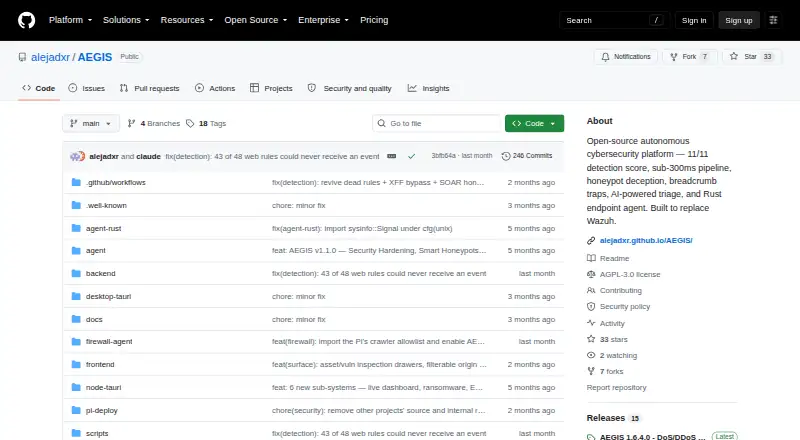
What AEGIS is
AEGIS is a free, open-source cybersecurity defense platform that organizations host themselves to detect, analyze, and respond to threats. Its listed detections cover SQL injection, XSS, path traversal, command injection, brute force, port scans, credential theft, lateral movement, and C2 beacons. The project describes a five-layer detection pipeline and reports an 11/11 detection score, as well as 18-microsecond latency for its middleware layer. Deception tools include SSH and HTTP honeypots, breadcrumb credential traps, and attacker interaction profiling. AI features can use OpenRouter, OpenAI, Anthropic, or Ollama; Sigma rules and playbooks work without an AI API key. The free AGPL-3.0 offering is self-hosted with Docker Compose and is listed for up to 20 nodes, 100 assets, and 3 users. It is described for individuals, homelabs, and small teams. Enterprise adds unlimited nodes, assets, and users, a compliance dashboard for ISO 27001, NIS2, and SOC 2, SAML or OIDC SSO, an SLA, and dedicated support; its price is custom.
Good
- Open-source under the AGPL-3.0 license.
- Sigma rules and playbooks work without an AI key.
- Includes SSH and HTTP honeypots.
- Free tier covers up to 20 nodes.
- Enterprise lists SAML or OIDC SSO.
Watch out
- Free tier is limited to 3 users.
- Free tier is limited to 100 assets.
- Self-hosting requires Docker Compose.
- Enterprise pricing is custom and not listed.
Who it suits
The free offering is aimed at individuals, homelabs, and small teams able to self-host. Enterprise is described for companies seeking more scale and advanced features.
Verdict
AEGIS combines threat detection with deception tools and self-hosted deployment. The free tier has explicit node, asset, and user caps; Enterprise adds broader scale and support.
Plans and prices
From AEGIS's own pricing page, checked 14 Oct 2026.
| Plan | Price | What it gives you |
|---|---|---|
| Free · Open Source | Free | 5-layer detection pipeline · 122 Sigma rules · SSH + HTTP honeypots · breadcrumb traps · AI triage · 20 nodes · 100 assets · 3 users · Free forever |
| Enterprise | Priced on request | Unlimited nodes · unlimited assets · unlimited users · SSO · custom Sigma rules · SLA · dedicated support · Custom |
The facts
Each one read from AEGIS's own pages, with the date it was checked.
What it does
- AI and offline use
- The site says AEGIS can use OpenRouter, OpenAI, Anthropic, or Ollama for AI features, while deterministic Sigma rules and playbooks work without an AI API key.checked 29 Sep 2026
- API authentication
- API endpoints require an X-API-Key header or a JWT Bearer token.checked 14 Oct 2026
- API surface
- The deployment includes a FastAPI backend with more than 140 endpoints across 25 API routers.checked 14 Oct 2026
- Changelog release
- Changelog version 1.6.1 is dated 2026-05-14 and adds ransomware defense and cloud-native CVE coverage.checked 14 Oct 2026
- Changelog security coverage
- The 1.6.1 changelog lists detections for React2Shell, Next.js, Vite, Marimo, vLLM and pickle-related CVEs.checked 14 Oct 2026
- Deception
- AEGIS offers SSH and HTTP honeypots, breadcrumb credential traps, and attacker interaction profiling.checked 29 Sep 2026
- Deployment components
- The Docker stack contains an API container, a Next.js dashboard container and PostgreSQL 16.checked 14 Oct 2026
- Detection
- The site describes a five-layer detection pipeline and reports an 11/11 detection score.checked 29 Sep 2026
- Detection performance
- The repository states that rule evaluation uses an indexed lookup taking less than 1 millisecond per event.checked 14 Oct 2026
- Enterprise additions
- The enterprise page lists smart honeypots, quantum-entropy and C2 detection, SBOM scanning, compliance dashboards, SSO and advanced reports.checked 14 Oct 2026
- Enterprise support
- The Enterprise plan lists an SLA and dedicated support.checked 29 Sep 2026
- Firewall requirement
- Real pfctl or iptables enforcement is optional, requires root or sudo and is disabled by default in favor of an in-memory firewall.checked 14 Oct 2026
- Initial setup
- There are no default credentials; a setup wizard at /setup creates the first administrator account.checked 14 Oct 2026
- Install method
- The documented quick start clones the repository, copies .env.example and starts the stack with docker compose up -d.checked 14 Oct 2026
- Integrations
- The site names OpenRouter, OpenAI, Anthropic, and Ollama as AI providers and describes shared threat intelligence.checked 29 Sep 2026
- Intended users
- The free plan is described for individuals, homelabs, and small teams; Enterprise is for companies seeking advanced features and scale.checked 29 Sep 2026
- Licence
- AEGIS is licensed under GNU Affero General Public License version 3.0.checked 14 Oct 2026
- License
- AEGIS is offered as open source under the AGPL-3.0 license.checked 29 Sep 2026
- Limit: enterprise scale
- The comparison section says AEGIS trades unlimited enterprise scale for deterministic detection and zero licensing cost.checked 14 Oct 2026
- Limit: entropy analysis
- The README labels entropy analysis for mass encryption as still in development.checked 14 Oct 2026
- Limit: recovery maturity
- Process termination and snapshot recovery are marked as in development and gated by AEGIS_REAL_RECOVERY=1.checked 14 Oct 2026
The company
- Company identity
- The maker is identified publicly by the GitHub account name alejadxr.checked 14 Oct 2026
Where it runs
- Endpoint agent platforms
- The Rust endpoint agent is described as building for macOS arm64, Linux x64 and Windows x64.checked 14 Oct 2026
Money
- Free tier limits
- The free plan is listed for up to 20 nodes, 100 assets, and 3 users.checked 29 Sep 2026
The full review of AEGIS
AEGIS is a self-hosted, open-source platform that detects and responds to security threats across systems and applications. It suits individuals, homelabs, and small teams prepared to run their own deployment. Its mix of broad detection, response tools, and decoys is unusual in a free product, though the free tier’s caps limit its reach.
Overview
AEGIS brings threat detection, analysis, and response together in a platform deployed on premises. Its five-layer detection pipeline covers web attacks such as SQL injection and XSS, along with brute force, port scans, credential theft, lateral movement, and C2 beacons. The project reports an 11/11 detection score and 18-microsecond latency for its middleware layer; those figures describe the project’s claims, not a guarantee of results in every environment.
Response features include behavioral detection, automatic isolation, EDR, and rollback or recovery. This breadth makes AEGIS more than a narrow ransomware blocker, but teams should judge it against the response workflows they need. The license is AGPL-3.0, a practical consideration for organizations evaluating open-source software.
Key features
Deception and investigation
SSH and HTTP honeypots, breadcrumb credential traps, and attacker interaction profiling can help reveal suspicious activity around decoy resources. These tools add value for teams that want to observe attacker behavior as well as detect threats. AEGIS also describes shared threat intelligence, though the scope and operation of that sharing are not detailed.
AI with an offline path
AI features can use OpenRouter, OpenAI, Anthropic, or Ollama. Deterministic Sigma rules and playbooks work without an AI API key, so the core rules-based approach does not depend on connecting an AI provider. The choice of AI provider is useful for teams with a preferred service or local Ollama setup.
Self-hosted deployment
The free version is installed with Docker Compose after cloning the repository. That gives users control over an on-premises deployment, but also makes setup and operation their responsibility. AEGIS supports API, Linux, macOS, web, and Windows platforms; it is described as cross-platform.
Pricing
Free · Open Source: free. The plan allows up to 20 nodes, 100 assets, and 3 users. It fits individuals, homelabs, and small teams that can work within those ceilings and manage a self-hosted installation. There is no free trial because the product has a free plan.
Enterprise: custom pricing. Enterprise removes the node, asset, and user limits and includes an SLA and dedicated support. It also adds a compliance dashboard for ISO 27001, NIS2, and SOC 2, plus SSO through SAML or OIDC. This plan is aimed at companies needing broader scale and these enterprise capabilities; its price is custom.
Platforms
AEGIS is self-hosted and supports API, Linux, macOS, web, and Windows environments. Its Docker Compose deployment is suited to users comfortable running software on their own infrastructure, rather than those seeking a managed service.
Who it's for
AEGIS is a strong fit for technically capable individuals, homelabs, and small teams looking for threat detection, active response, and deception tools without a subscription fee. Companies can consider Enterprise when the free plan’s caps are too small or when they need compliance reporting, SSO, an SLA, and dedicated support. Organizations that want a vendor-managed deployment or need more than three users on the free tier should look elsewhere.
Pros and cons
- Pros: Broad named threat coverage combines with behavioral detection, automatic isolation, EDR, and rollback or recovery.
- Pros: Honeypots and credential traps add deception capabilities alongside conventional detection.
- Pros: Sigma rules and playbooks work without an AI API key, while AI features can use several named providers.
- Pros: The free plan costs nothing and includes up to 20 nodes, 100 assets, and 3 users.
- Cons: Docker Compose self-hosting requires users to run and manage the deployment themselves.
- Cons: The free plan’s three-user, 20-node, and 100-asset ceilings may constrain growing teams.
- Cons: Enterprise pricing is custom, so companies must contact AEGIS to assess its cost.
- Cons: AGPL-3.0 licensing may require review by organizations with specific software licensing policies.
Alternatives
For a broader set of ransomware-focused choices, browse Ransomware Protection Software.
AppCheck is worth considering for individual users seeking a free ransomware protection option, or for buyers who prefer a per-year Pro plan for one PC.
ManageEngine Ransomware Protection Plus may suit Windows-oriented teams looking for a free edition capped at 25 endpoints, with web and self-hosted platforms.
Sangfor EasyConnect is a paid alternative with Android and iOS support as well as desktop and web platforms.
NeuShield Ransomware Protection offers a free edition and a per-device annual license for Windows users.
RackTop BrickStor SP offers a 90-day evaluation of its full platform, with two VMs included in its Jumpstart program.
Kaspersky Anti-Ransomware Tool is a free Windows option, with a business plan for up to 50 devices.
Check Point External Risk Management is a paid option for teams seeking external risk management across API, extension, desktop, and web platforms.
Malwarebytes Ransomware Protection is a freemium alternative for Android, iOS, macOS, and Windows.
Verdict
Choose AEGIS if you want a free, self-hosted security platform that combines broad threat detection with response and deception tools, and your deployment fits within 20 nodes, 100 assets, and 3 users. Its AI-optional rules and cross-platform reach add flexibility. Look elsewhere if you need a managed service, higher free-tier limits, or clearly priced enterprise scale.
Getting started
- Open the AEGIS GitHub website.
- Clone the repository.
- Run Docker Compose to self-host the free plan.
- Choose an AI provider if you want AI features: OpenRouter, OpenAI, Anthropic, or Ollama.
Limits worth knowing
The free plan supports up to 20 nodes, 100 assets, and 3 users. Enterprise lists unlimited nodes, assets, and users, with custom pricing.
Questions
Is AEGIS free?
Yes. The Free · Open Source plan is free and includes up to 20 nodes, 100 assets, and 3 users.
Where can I run AEGIS?
Its listed platforms are API, Linux, macOS, self-hosted, web, and Windows. Deployment is on premises.
Is AEGIS open source?
Yes. It is offered under the AGPL-3.0 license.
Which AI providers does AEGIS support?
The listed providers are OpenRouter, OpenAI, Anthropic, and Ollama. Sigma rules and playbooks can work without an AI API key.
What does Enterprise add?
Enterprise includes unlimited nodes, assets, and users, a compliance dashboard for ISO 27001, NIS2, and SOC 2, SAML or OIDC SSO, an SLA, and dedicated support. Pricing is custom.
Alternatives to AEGIS
- 1

AppCheck
Free planWebLinuxWindows7.5Free plan - 2

ManageEngine Ransomware Protection Plus
Free planWebSelf-hostedWindows7.4From $6.99 a year - 3
Rubrik Security Cloud
WebAPILinuxmacOS6.9 - 4
Sophos Intercept X for Mobile
AndroidiOS6.8 - 5
NeuShield Ransomware Protection
Free planWebWindows6.7From $24.99 a year - 6

Malwarebytes Ransomware Protection
AndroidiOSmacOSWindows6.3