
Advanced Policy Firewall
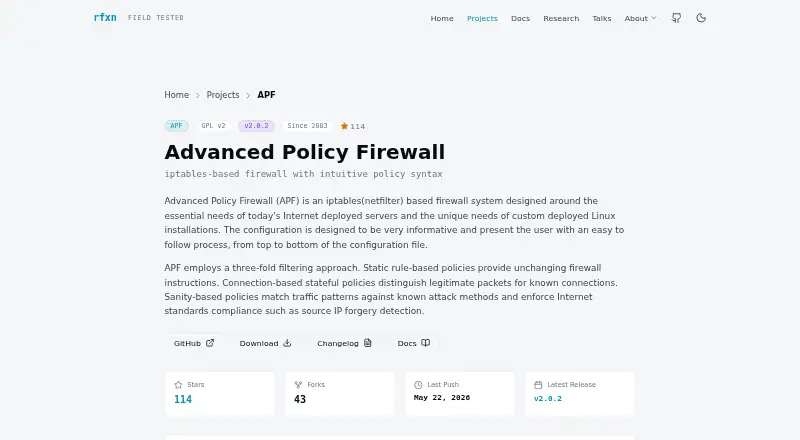
Advanced Policy Firewall (APF) is a free firewall system for Internet-deployed Linux servers, built on iptables/netfilter.
What Advanced Policy Firewall is
Advanced Policy Firewall (APF) is a free firewall system for Internet-deployed Linux servers, built on iptables/netfilter. It combines static rules, stateful connection policies, and checks for attack patterns and forged source IP addresses. Administrators can configure inbound and outbound filtering, including outbound rules based on users and applications. Other controls include reactive address blocking, GeoIP country filtering, and Spamhaus and DShield block lists. APF supports IPv6 dual-stack filtering with automatic ip6tables rules. Its documentation describes fast-load snapshots that can load more than 1,000 rules in under one second, as well as integrations with BFD, cron, systemd, Docker/Kubernetes, and logrotate. It requires Linux with iptables/netfilter and Bash, and supports both legacy and nft iptables backends. Documented systems include RHEL/Rocky/AlmaLinux 8 and 9, CentOS 6 and 7, Debian 12, and Ubuntu 12.04, 20.04, and 24.04. APF is distributed under GNU GPL, with no paid tiers or enterprise editions. By default, only SSH port 22 is open; outbound filtering, reactive blocking, and virtual network policies are disabled. Development mode is enabled by default and flushes the firewall every five minutes to help prevent lockout during initial configuration.
Good
- Free under GNU GPL, with no paid tiers.
- Supports inbound and outbound filtering.
- Includes IPv6 dual-stack filtering.
- Supports reactive blocking and GeoIP country filtering.
- Integrates with BFD, cron, systemd, and logrotate.
Watch out
- Requires Linux, iptables/netfilter, and Bash.
- Only SSH port 22 is open by default.
- Outbound filtering and reactive blocking are disabled by default.
- Development mode flushes the firewall every five minutes.
Who it suits
APF suits administrators of supported Linux servers who need configurable inbound and outbound filtering. It requires familiarity with Linux, iptables/netfilter, and Bash.
Verdict
APF provides configurable filtering and blocking controls for supported Linux servers at no cost. Review its defaults before deployment: outbound filtering and reactive blocking start disabled, while development mode flushes the firewall every five minutes.
Plans and prices
From Advanced Policy Firewall's own pricing page, checked 8 Oct 2026.
| Plan | Price | What it gives you |
|---|---|---|
| Advanced Policy Firewall | Free | GNU GPL v2 · no paid tiers or enterprise editions |
The facts
Each one read from Advanced Policy Firewall's own pages, with the date it was checked.
Where it runs
- Application rules
- Yeschecked 22 Sep 2026
- Supported platforms
- Linuxchecked 22 Sep 2026
What it does
- Blocking
- Features include reactive address blocking, GeoIP country filtering, and Spamhaus and DShield block lists.checked 8 Oct 2026
- Configuration limit
- Only SSH port 22 is open by default, while outbound filtering, reactive address blocking, and virtual network policies are disabled by default.checked 8 Oct 2026
- Filtering
- Its filtering combines static rules, connection-based stateful policies, and sanity checks for attack patterns and source IP forgery.checked 8 Oct 2026
- Integrations
- The documentation describes integration with BFD, cron, systemd, Docker/Kubernetes, and logrotate.checked 8 Oct 2026
- IPv6
- APF supports IPv6 dual-stack filtering with automatic ip6tables rules.checked 8 Oct 2026
- Outbound control
- advancedchecked 22 Sep 2026
- Performance
- The documentation says fast-load snapshots can load more than 1,000 rules in under one second.checked 8 Oct 2026
- Purpose
- APF is an iptables/netfilter-based firewall system designed for Internet-deployed Linux servers.checked 8 Oct 2026
- Requirements
- APF requires a Linux system with iptables/netfilter and Bash; the documentation supports both legacy and nft iptables backends.checked 8 Oct 2026
- Rule direction
- bothchecked 22 Sep 2026
- Safety behavior
- Development mode is enabled by default and flushes the firewall every five minutes to help prevent lockout during initial configuration.checked 8 Oct 2026
- Security reporting
- R-fx Networks asks for vulnerability reports to be sent privately and says it will acknowledge receipt within 48 hours.checked 8 Oct 2026
- Support
- The maker directs users to the APF source repository and invites bug reports and feature requests through its issue tracker.checked 8 Oct 2026
- Supported systems
- The documentation lists RHEL/Rocky/AlmaLinux 8 and 9, CentOS 7 and 6, Debian 12, and Ubuntu 20.04, 24.04, and 12.04.checked 8 Oct 2026
- Traffic controls
- It supports granular inbound and outbound filtering, including user- and application-based outbound rules.checked 8 Oct 2026
The company
- Founded
- 2002checked 28 Sep 2026
Money
- Free plan
- Yeschecked 22 Sep 2026
- License and price
- APF is distributed under GNU GPL without restrictions on use or redistribution, and R-fx Networks says its projects have no paid tiers or enterprise editions.checked 8 Oct 2026
Alternatives to Advanced Policy Firewall
- 1

BitNinja
Free planAndroidiOSWebAPI9.0From $6 a month - 2
Certo AntiSpy
Free planAndroidiOSmacOSWindows8.9From $39.99 a year - 3

Comodo Internet Security
AndroidiOSExtensionWindows8.7 - 4
ClamAV
Free planOpen sourceAPILinuxmacOSSelf-hosted8.3Free plan - 5
Microsoft Quick Assist
Free planWebmacOSWindows7.5Free plan - 6

Spybot – Search & Destroy
Free planWindows7.4Free plan