
Acra
Acra protects sensitive data held in SQL and NoSQL databases, web applications, and backend applications.
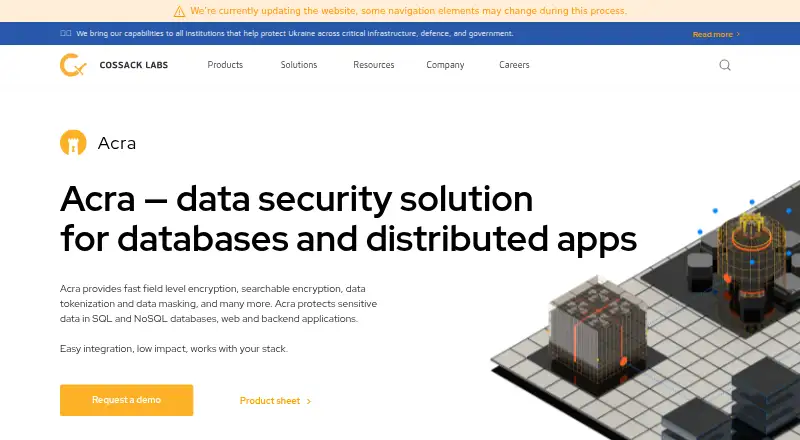
What Acra is
Acra protects sensitive data held in SQL and NoSQL databases, web applications, and backend applications. It offers field-level and searchable encryption, tokenization, and data masking. Teams can deploy it as a transparent SQL proxy, an HTTP/gRPC encryption API, or client-side SDKs. AcraServer supports PostgreSQL and MySQL wire protocols, including MariaDB, while listed NoSQL and key-management integrations include MongoDB, Redis, Cassandra, TimescaleDB, Amazon KMS, Google Cloud KMS, HashiCorp Vault, Keywhiz, and HSMs. It can detect access attempts involving planted poison records or honeytokens, issue alarms, and halt decryption. Security logging supports SIEM/SOC analytics, and a signed audit log records access and security events. Server components run on Linux, with Docker and Kubernetes-compatible images documented. Acra is described as cloud-agnostic and supported on Google Cloud Platform, AWS, and DigitalOcean.
Good
- Offers encryption, tokenization, and data masking
- Supports SQL, NoSQL, and key-management integrations
- Can alert and halt decryption on planted-record access
- Provides security logging and signed audit logs
- Cloud-agnostic deployment with Linux server components
Watch out
- Server components should not run on Windows hosts
- Community Edition lacks MySQL Protocol X support
Who it suits
Community Edition is described as suited to prototyping and small-scale projects. Enterprise Edition is aimed at large-scale and enterprise deployments needing broader features and support options.
Verdict
Acra provides several ways to protect application and database data, with options for both community use and enterprise deployments. Windows is supported as a client platform, but not as the server host operating system.
Plans and prices
From Acra's own pricing page, checked 15 Oct 2026.
| Plan | Price | What it gives you |
|---|---|---|
| Acra Community Edition | Free | core encryption and masking · SQL request firewall · basic intrusion detection · single configuration policy · limited platform, integration and database support · free forever |
| Acra Enterprise Edition | $10,000 a year | all Acra features and controls · support tiers · DevOps/SRE tooling · policy management · deployment assistance · starting at $10000 annually |
| Acra bespoke solution | Priced on request | custom masks and protocols · custom behavior · use-case features · engineering and architecture support · case-by-case |
The facts
Each one read from Acra's own pages, with the date it was checked.
What it does
- API
- AcraTranslator exposes HTTP and gRPC APIs for encryption, searchable encryption, tokenization and related operations.checked 15 Oct 2026
- Audit and SIEM
- Acra provides security logging for SIEM/SOC analytics and a crypto-signed audit log covering access and security events.checked 30 Sep 2026
- Audit logging
- Enterprise editions provide cryptographically signed audit logs covering access and security events.checked 15 Oct 2026
- Changelog event
- Version 0.90.0 dated November 5, 2021 added open-source documentation, searchable encryption, masking, tokenization, AcraBlocks, Vault integration and an OpenAPI/Swagger HTTP API.checked 15 Oct 2026
- Cloud hosting
- Acra is described as cloud-agnostic and actively tested and supported on Google Cloud Platform, AWS, and DigitalOcean.checked 30 Sep 2026
- Community Edition limitation
- Acra Community Edition does not support MySQL Protocol X.checked 30 Sep 2026
- Databases
- Acra is designed for SQL and NoSQL data stores and can operate as a database proxy or API service.checked 15 Oct 2026
- Database support
- AcraServer supports PostgreSQL and MySQL wire protocols, including MySQL 5.7+, PostgreSQL 9.4+, and MariaDB 10.3.checked 30 Sep 2026
- Deployment
- Server components are distributed as Linux packages, Docker images and source builds, with Kubernetes-compatible images.checked 15 Oct 2026
- Deployment forms
- Acra can run as a transparent SQL proxy, an HTTP/gRPC encryption API, or client-side SDKs.checked 30 Sep 2026
- Documentation depth
- The documentation covers use cases, architecture, security controls, cryptography, scaling, load balancing, configuration, installation and tutorials.checked 15 Oct 2026
- Encryption options
- Acra offers field-level encryption, searchable encryption, tokenization, and data masking.checked 30 Sep 2026
- Evaluation
- The maker offers a free evaluation playground running Acra Enterprise Edition for selected popular use cases.checked 30 Sep 2026
- Intended users
- The maker describes Community Edition as best for prototyping and small-scale projects and Enterprise Edition as suited to large-scale and enterprise deployments.checked 30 Sep 2026
- Intrusion detection
- Acra includes poison records and other controls for detecting unauthorized database behavior.checked 15 Oct 2026
- Key management
- Key utilities support generation, export, backup, rollback and enterprise key rotation without re-encrypting data.checked 15 Oct 2026
Where it runs
- Application-level encryption
- The product encrypts selected database cells or fields, including with AES-256-GCM cryptographic containers.checked 15 Oct 2026
- Deployment platforms
- Server components run on Linux distributions including CentOS, RHEL, Debian, and Ubuntu, and the maker documents Docker and Kubernetes-compatible images.checked 30 Sep 2026
The company
- Company founded and size
- LinkedIn lists Cossack Labs as founded in 2014 with 11–50 employees.checked 15 Oct 2026
- Company funding
- The reviewed Crunchbase profile describes products and locations but does not state a funding amount.checked 15 Oct 2026
- Company headquarters
- Cossack Labs is headquartered in London, United Kingdom, with research and development in Kyiv, Ukraine.checked 15 Oct 2026
- Company legal name
- The GitHub project identifies the business entity as Cossack Labs Limited.checked 15 Oct 2026
- Founded
- 2014checked 28 Sep 2026
- Headquarters
- London, United Kingdomchecked 28 Sep 2026
The full review of Acra
Acra is a data-protection platform for teams securing sensitive information in databases and applications. It suits developers and security teams that need encryption close to their data and control over deployment. Its mix of database proxies, APIs, and SDKs is compelling, but the Community Edition’s narrower feature set makes enterprise use a paid decision.
Overview
Acra protects sensitive data in SQL and NoSQL databases, web applications, and backend applications. Rather than requiring one integration pattern, it can sit in the database path as a transparent SQL proxy, serve encryption through HTTP or gRPC APIs, or be used through client-side SDKs. That flexibility helps teams adapt protection to existing systems, though it also means the right fit depends on how an application handles data.
Key features
Acra supports field-level and searchable encryption, tokenization, and data masking. Those options address different needs: field-level encryption protects selected values, searchable encryption supports queries over protected data, and masking or tokenization can limit exposure in application flows. The Community Edition includes encryption and masking, but its single configuration policy is a constraint for teams that need broader policy management.
AcraServer supports PostgreSQL and MySQL wire protocols, including MySQL 5.7+, PostgreSQL 9.4+, and MariaDB 10.3. The Community Edition does not support MySQL Protocol X, so teams relying on that protocol should consider Enterprise or another solution. The maker also identifies MongoDB, Redis, Cassandra, and TimescaleDB among supported NoSQL and key-value stores.
For key storage and management, integrations include Amazon KMS, Google Cloud KMS, HashiCorp Vault, Keywhiz, and HSMs. Acra can detect requests for planted poison records or honeytokens, raise alarms, and halt decryption. Its security logging supports SIEM/SOC analytics, while a crypto-signed audit log records access and security events. These capabilities make it more than an encryption layer for teams that need detection and audit controls alongside data protection.
Pricing
Acra Community Edition is free, billed FREE and free forever for non-profit and business use. It includes encryption and masking, an SQL request firewall, basic intrusion detection, and one configuration policy. The no-cost plan makes prototyping and small-scale projects practical, but lacks the full feature set and policy management of Enterprise.
Acra Enterprise Edition starts at $10,000 a year, billed starting at $10000 annually. Pricing depends on the number of deployments and requested features. It includes all Acra features and controls, policy management, DevOps/SRE tooling, and various support tiers. This is the relevant tier for large-scale deployments that need broader controls or support, but its starting price is a substantial commitment.
Acra bespoke solution has custom pricing based on included services and case-by-case requirements. It covers customized masks and protocols, tailored behavior and use-case-specific features, plus engineering and architecture support. That option is for requirements the standard editions do not cover, rather than teams seeking a predictable subscription.
A free evaluation playground running Acra Enterprise Edition is offered for selected popular use cases, giving teams a way to assess enterprise scenarios before committing.
Platforms
Acra is available for Android, iOS, Linux, API use, and self-hosted deployment. Server components run on Linux distributions including CentOS, RHEL, Debian, and Ubuntu; Docker images and Kubernetes-compatible images support containerized deployments. The service is described as cloud-agnostic and actively tested and supported on Google Cloud Platform, AWS, and DigitalOcean.
Windows is supported for clients connecting to Acra on a Linux server, but server-side Acra components should not run on Windows as the host operating system. Teams that require a Windows-hosted server should look elsewhere.
Who it's for
Acra is best suited to development and security teams protecting sensitive database fields across varied application architectures, especially when they need external key-management integrations, audit trails, or intrusion detection. Community Edition is positioned for prototypes and smaller projects; Enterprise is the intended fit for large-scale and enterprise deployments. Multiple support tiers include integration assistance, solution support, and 24/7 solution support.
Pros and cons
- Multiple integration patterns: A SQL proxy, HTTP/gRPC API, and client SDKs let teams choose how protection fits their application architecture.
- Broad security controls: Encryption choices, masking, key-management integrations, planted-record detection, and signed audit logs cover more than basic data encryption.
- Useful free entry point: Community Edition is free forever for business and non-profit use, but one policy and the MySQL Protocol X exclusion limit its reach.
- Enterprise cost: Enterprise starts at $10,000 a year, which may be difficult to justify for smaller deployments.
- Linux-only server hosting: Windows clients can connect, but Windows cannot host server-side Acra components.
Alternatives
Cloud Encryption Software is a useful category starting point for comparing options.
- Thales CipherTrust Data Security Platform is worth considering if a free community edition and free trial are priorities; it supports API, Linux, self-hosted, and web platforms.
- Protegrity Data Security Platform is another freemium option, with web platform support.
- Cosmian Data Protection Suite may suit teams seeking a paid KMS with per-CPU pricing, all connectors included, and any number of servers; it offers a free trial.
- Cryptomator is a freemium alternative that describes itself as open source, with source code publicly available for community security audits.
- Ubiq Security is a paid API, self-hosted, and web option.
- Baffle Data Protection offers a 30-day free trial for cloud data masking in lower environments, with PostgreSQL source and target hosted in AWS.
- Skyflow is a paid option with a free trial and support for Android, API, iOS, self-hosted, and web platforms.
- Confidencial is another paid, web-based alternative.
Verdict
Choose Acra if your team needs flexible, self-hosted protection for sensitive database data, with a free edition for smaller projects and a fuller enterprise tier for scaled deployments. Its strongest case is the combination of deployment patterns, encryption choices, key integrations, and security monitoring. Look elsewhere if Windows server hosting is essential, MySQL Protocol X is required on the free tier, or Enterprise pricing is beyond your budget.
Getting started
- Visit the Acra website.
- Choose a deployment form: transparent SQL proxy, HTTP/gRPC encryption API, or client-side SDKs.
- Run server components on a supported Linux distribution; Docker and Kubernetes-compatible images are documented.
- Select Community Edition or contact Acra about Enterprise Edition and support tiers.
- Use the free evaluation playground for selected popular use cases.
Limits worth knowing
Community Edition includes basic intrusion detection and a single configuration policy, and it does not support MySQL Protocol X. Enterprise Edition starts at $10,000 annually; pricing depends on deployments and requested features.
Questions
Is there a free plan?
Yes. Acra Community Edition is free forever for nonprofit and business use.
How much does Enterprise Edition cost?
Pricing depends on the number of deployments and requested features.
Which platforms can run Acra?
Server components run on Linux distributions including CentOS, RHEL, Debian, and Ubuntu. Windows clients can connect to Acra on a Linux server, but server-side components should not run on Windows as the host operating system.
Which databases and data stores are supported?
AcraServer supports PostgreSQL and MySQL wire protocols, including MariaDB. Listed NoSQL and key-value stores include MongoDB, Redis, Cassandra, and TimescaleDB.
Does Acra integrate with external key managers?
Yes. Listed integrations include Amazon KMS, Google Cloud KMS, HashiCorp Vault, Keywhiz, and HSMs.
What does Community Edition include?
Its listed features are encryption and masking, a SQL request firewall, basic intrusion detection, and a single configuration policy.
Alternatives to Acra
- 1

MySQL
Free planAPILinuxmacOSSelf-hosted7.9Free plan - 2

Cryptomator
Free planAndroidiOSWebLinux7.5From €10,000 a year - 3
Virtru Data Security Platform
AndroidiOSWebAPI7.5From $119 a month - 4

Cosmian Data Protection Suite
Free planWebAPIExtensionLinux7.1Free plan - 5

Evervault
AndroidiOSWebAPI6.8From $995 a month - 6

Thales CipherTrust Data Security Platform
Free planWebAPILinuxSelf-hosted6.7Free plan