
Accops Remote Browser Isolation
Accops Remote Browser Isolation keeps enterprise web activity separate from user endpoints and corporate networks.
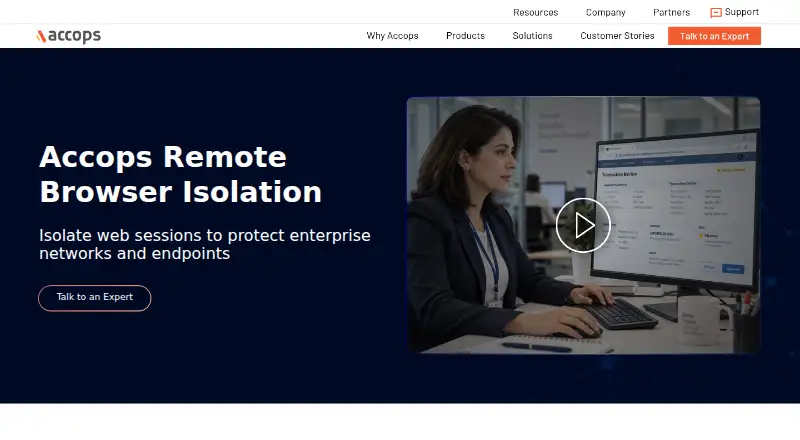
What Accops Remote Browser Isolation is
Accops Remote Browser Isolation keeps enterprise web activity separate from user endpoints and corporate networks. Sessions run in disposable containers hosted in a secure data centre or private cloud; the container is destroyed when the session ends. The endpoint receives encrypted pixels and keystrokes while active web code stays remote. Accops says this isolates untrusted sites, email links, malware, drive-by downloads, and exploit attempts before they reach the enterprise environment.
Administrators can choose shared containers or dedicated virtual machines and restrict uploads, downloads, copy, paste, and screen recording. The service works with existing single sign-on and multi-factor authentication systems. It captures playback, file logs, and activity trails, and can forward alerts through Syslog. Browser instances scale with demand, and GPU-accelerated rendering supports rich web applications on thin clients. Accops lists self-hosted and web platforms, with cloud deployment also described. Pricing is available on request.
Good
- Runs sessions in disposable remote containers
- Supports shared containers and dedicated virtual machines
- Administrators can restrict file and screen actions
- Captures playback, file logs, and activity trails
- Browser instances scale as demand changes
Watch out
- Pricing is available on request
- Requires a deployment choice between shared and dedicated environments
Who it suits
It suits organisations that need staff to reach high-risk or unknown web destinations without exposing endpoints or corporate networks. Administrators can set browser controls and connect existing sign-on and authentication systems.
Verdict
Accops combines remote session isolation with administrative controls, identity integrations, and activity logging. Organisations considering it will need to request pricing and assess its deployment options.
The facts
Each one read from Accops Remote Browser Isolation's own pages, with the date it was checked.
What it does
- Audit and SIEM
- It captures playback, file logs, and activity trails, and forwards alerts through Syslog.checked 7 Oct 2026
- Data controls
- Administrators can centrally restrict uploads, downloads, copy, paste and screen recording.checked 7 Oct 2026
- Deployment options
- The product supports shared containers and dedicated virtual machines for differing compliance requirements.checked 7 Oct 2026
- Example deployment
- A case study describes Azure-hosted RBI providing agentless access to HR and internal applications for employees using customer-provided devices, with Azure AD and MFA sign-in.checked 7 Oct 2026
- Identity integration
- The product works with existing single sign-on and multi-factor authentication stacks.checked 7 Oct 2026
- Identity integrations
- The product works with existing single sign-on and multi-factor authentication stacks.checked 7 Oct 2026
- Intended users
- Accops describes use for organisations needing secure access to high-risk or unknown web destinations without exposing endpoints or corporate networks.checked 7 Oct 2026
- Logging
- It captures playback, file logs and activity trails, and can forward alerts through Syslog.checked 7 Oct 2026
- Purpose
- Accops Remote Browser Isolation isolates enterprise web sessions from endpoints and corporate networks to reduce exposure to web threats.checked 7 Oct 2026
- Remote rendering
- The service streams encrypted pixels and keystrokes to the endpoint while keeping active web code remote.checked 7 Oct 2026
- Scaling
- Browser instances scale dynamically as demand changes, which Accops says can reduce idle infrastructure costs.checked 7 Oct 2026
- Scaling and rendering
- The product dynamically scales browser instances and supports GPU-accelerated rendering for rich web applications on thin clients.checked 7 Oct 2026
- Session isolation
- Browsing runs in a disposable container in a secure data centre or private cloud, and the container is destroyed when the session ends.checked 7 Oct 2026
- Support
- Accops lists technical support by telephone, email at [email protected], and a ticket portal.checked 7 Oct 2026
- Support and sales
- Accops invites prospective customers to connect with technology consultants or find a local partner.checked 7 Oct 2026
- Threat protection
- Accops says it isolates untrusted websites, email links, malware, drive-by downloads, and exploit attempts before they reach the enterprise environment.checked 7 Oct 2026
Where it runs
- Browser controls
- Administrators can centrally restrict uploads, downloads, copy, paste, and screen recording.checked 7 Oct 2026
The company
- Company certification
- Accops's website displays an ISO Certified 27001:2022 designation.checked 7 Oct 2026
- Company security certification
- Accops’ website footer states that the company is ISO Certified 27001:2022.checked 7 Oct 2026
- Founded
- 2012checked 28 Sep 2026
- Headquarters
- Pune, Indiachecked 28 Sep 2026
Alternatives to Accops Remote Browser Isolation
- 1

Kasm Workspaces
Free planOpen sourceAndroidiOSWebAPI8.6From $10 a month - 2

Netzilo Enterprise Browser
Free planAndroidiOSWebAPI8.0From $12 a month - 3
BrowserGap
Free planWebAPILinuxmacOS7.5$3.81 one-time - 4

Check Point Harmony SASE
AndroidiOSWebLinux7.3 - 5

iboss Cloud
AndroidiOSWebAPI7.1 - 6

Authentic8 Silo
WebAPIExtension6.5From $1,450 a year