
10 Minute Mail
10 Minute Mail provides temporary email addresses for website sign-ups, so you can receive messages without sharing your regular address.
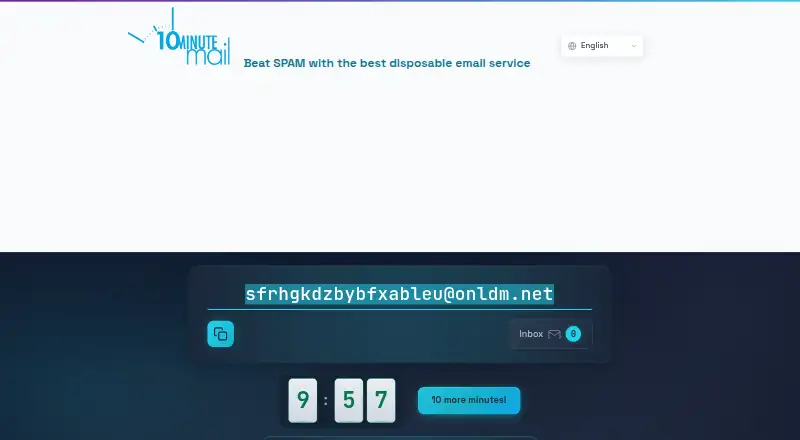
What 10 Minute Mail is
10 Minute Mail provides temporary email addresses for website sign-ups, so you can receive messages without sharing your regular address. Incoming mail appears automatically on the webpage, where you can read messages and open links; the service also supports replies and forwarding to a personal account. An address lasts 10 minutes, with an option to reset its timer for another 10 minutes. You do not need to register or provide information to get an address. The free plan is free and includes a temporary address with the resettable 10-minute expiry. The service lists Android, iOS, and web platforms, plus custom domains and attachments; inbox protection is listed as none. Its security information says session data and mail are held in RAM, erased after the session, and protected in transit by HTTPS/TLS. The privacy policy also says it may collect usage details and use third-party tracking and advertising cookies. The FAQ advises against using it for important accounts that may need password resets, because the address expires.
Good
- No registration is needed to receive an address.
- Inbox messages appear automatically on the webpage.
- Timer can be reset for another 10 minutes.
- Available on Android, iOS, and web.
Watch out
- Addresses expire after 10 minutes unless reset.
- Inbox protection is listed as none.
- Privacy policy describes usage-data collection and tracking cookies.
- Not advised for important accounts needing password resets.
Who it suits
It suits people who want a short-lived inbox for sign-ups, trials, newsletters, forums, or other listed uses. It is not a good fit for important accounts that may need password resets.
Verdict
10 Minute Mail is a free option for short-lived email use, with webpage access to incoming messages and a resettable timer. Its expiry and stated privacy disclosures make it unsuitable for important accounts that may need recovery.
Plans and prices
From 10 Minute Mail's own pricing page, checked 15 Oct 2026.
| Plan | Price | What it gives you |
|---|---|---|
| Free | Free | 10-minute disposable address · inbox and messages self-destruct · extend by 10 minutes · no registration |
The facts
Each one read from 10 Minute Mail's own pages, with the date it was checked.
Where it runs
- Android features
- The Android listing describes disposable addresses, attachments, push notifications, message download and deletion, extensions up to 60 minutes, and recovery of the last three expired addresses in the free version.checked 15 Oct 2026
- Android premium
- The Android listing says premium adds ad removal, timer control, premium domains, multiple simultaneous addresses, custom names, private addresses, and extended storage.checked 15 Oct 2026
What it does
- Automatic deletion
- Expired addresses and messages are permanently deleted with no backups or recovery mechanism.checked 15 Oct 2026
- Creator
- The About page identifies Devon Hillard as the creator of the service.checked 2 Oct 2026
- Deletion
- The service says messages and session data are automatically erased when the session expires and cannot be recovered.checked 2 Oct 2026
- Developer documentation
- The official FAQ documents browser usage but provides no API reference, SDK documentation, or developer integration guide.checked 15 Oct 2026
- Encryption
- The security page says connections use HTTPS/TLS to protect data in transit.checked 2 Oct 2026
- Expiration
- The generated address and its messages expire after 10 minutes; the address stops working about a minute later.checked 15 Oct 2026
- Expiry
- The temporary address expires after 10 minutes, and users can reset the countdown for another 10 minutes.checked 2 Oct 2026
- Extension capabilities
- The Chrome extension generates addresses without registration, supports attachments, and displays new-mail notifications in its popup.checked 15 Oct 2026
- Extension time
- Users can reset the countdown by requesting another 10 minutes.checked 15 Oct 2026
- Founder
- The service was created by software developer Devon Hillard as a side project.checked 15 Oct 2026
- Funding
- The reviewed Crunchbase profile does not display funding rounds or investment amounts.checked 15 Oct 2026
- Inbox
- Emails sent to the temporary address appear automatically on the webpage, where users can read them and click links.checked 2 Oct 2026
- Inbox privacy
- The service says each generated address is unique and only its holder can view the inbox.checked 15 Oct 2026
- Intended uses
- The site lists use cases including software trials, social media, online shopping, gaming, newsletters, WiFi hotspots, forums, and dating apps.checked 2 Oct 2026
- Language coverage
- The about page claims availability in 47 languages.checked 15 Oct 2026
- Languages and users
- The About page says the service is available in 47 languages and had 6.3 million users in 2025.checked 2 Oct 2026
- Licence
- The reviewed official pages do not state an open-source licence or publish source code.checked 15 Oct 2026
- Limit: advertising
- An Apple App Store reviewer said excessive ads made the app undesirable, and another reported ads that would not close.checked 15 Oct 2026
The company
- Company record
- Crunchbase lists 10MinuteMail as a private, for-profit company headquartered in Boston, Massachusetts, with Devon Hillard as founder.checked 15 Oct 2026
- Company size signal
- Crunchbase shows one employee profile for the company.checked 15 Oct 2026
- Founded
- The about page gives November 3, 2006 as the founding date.checked 15 Oct 2026
- Headquarters
- Haifa, Israelchecked 28 Sep 2026
The full review of 10 Minute Mail
10 Minute Mail supplies short-lived email addresses for sign-ups, with incoming messages handled in a webpage inbox. It suits people who need an address for a brief interaction and do not want to share their regular one. Its usefulness ends with the session, so it is a poor choice for accounts that may need recovery.
Overview
Messages arrive automatically, and users can read them and click links from the webpage. Replying and forwarding to a personal account add flexibility when a sign-up requires a response, but they do not make the temporary address durable. The 10-minute timer can be reset for another 10 minutes; once the session expires, its messages and session data are erased and cannot be recovered.
No sign-up or personal information is required to receive an address, which makes the service well suited to quick tasks such as software trials, newsletters, forums, or WiFi hotspots. The FAQ warns against using it for important accounts that may require password resets. That is the right boundary: use it to limit exposure of a regular inbox, not as an account's long-term contact address.
Key features
The service supports attachments, but inbox protection is listed as none. That combination may be useful for ordinary temporary sign-ups, not sensitive correspondence. Its security page says session data and emails stay in RAM rather than being written to disk or persistent files, and are removed when the session expires. It also says connections use HTTPS/TLS and that it does not log IP addresses or email content or track users.
Those privacy claims sit alongside a policy that says usage data such as IP address, browser details, visit times, and pages visited may be collected, and describes third-party tracking and advertising cookies. Readers who want to minimize routine data collection should weigh that disclosure rather than treating the security statements as a guarantee of anonymity.
Pricing
10 Minute Mail has a single Free plan at no cost. It includes a temporary email address that expires after 10 minutes, with the timer resettable for another 10 minutes. There is no paid tier to extend retention or add inbox protection; readers who need a longer-lived mailbox should choose a different service.
Platforms
The service is available on Android, iOS, and the web. Its webpage inbox keeps access straightforward across those listed platforms, though the address remains temporary regardless of where it is used.
Who it's for
This is a practical fit for people trying a service, signing up for a newsletter, or handling another one-off interaction where a disposable address is enough. The site also names online shopping, gaming, social media, and dating apps among its use cases. It is not the right choice when an account matters enough that you may need to recover it later.
The About page says the service is available in 47 languages and had 6.3 million users in 2025. It was created by Devon Hillard in 2006 and is headquartered in Haifa, Israel.
Pros and cons
- Quick access without registration: users can receive an address without signing up or providing information.
- More than receive-only: users can reply, forward mail, and open links from incoming messages.
- Limited lifespan: the 10-minute expiry, even with a reset, rules it out for accounts that may need future recovery.
- Privacy caveat: RAM-only session handling and stated no-logging practices are useful assurances, but the privacy policy also describes usage-data collection and third-party advertising cookies.
- No inbox protection: attachments are supported, but the service does not list inbox protection.
Alternatives
For other options, see Temporary Email Services.
- SecureTempMail is worth considering if you need retention of up to 30 days, private domains, attachment downloads, inbox history and search, and no ads; its Premium plan is $39 a year.
- Temp-Mail.org may suit readers who want messages retained for up to 1–2 hours on its free receive-only plan, or a paid monthly plan.
- 1SecMail is an alternative with a free plan and a separate Standard plan.
- EmailOnDeck offers a free, ad-supported option limited to one email at a time, with logs securely wiped.
- EmptyInbox may fit readers who want a free plan with five inbox credits and REST API and MCP access.
- Getnada offers a free Guest tier with up to three distinct @getnada.com addresses per browser or IP.
- Mail.cx is an option if one-hour retention or a paid plan with custom domains and API access better fits your needs.
- Mailinator offers a free plan and a free trial.
Verdict
Choose 10 Minute Mail for a disposable address that can receive messages immediately without registration, especially for sign-ups you expect to finish in minutes. Its resettable timer and reply or forwarding options cover brief tasks well. Look elsewhere for important accounts, longer retention, or inbox protection: once the session expires, the address and messages are gone.
Getting started
- Open https://10minutemail.com/ or use the service on Android or iOS.
- Receive a temporary email address without signing up or providing information.
- Use the address for a sign-up, then read incoming mail on the webpage.
- Click links in messages, reply, or forward email to a personal account as needed.
- Reset the countdown for another 10 minutes if you need more time.
Limits worth knowing
The free plan provides a temporary address that expires after 10 minutes; the countdown can be reset for another 10 minutes. The FAQ advises against using it for important accounts that may require password resets.
Questions
What does 10 Minute Mail cost?
The listed Free plan costs nothing.
Which devices can use it?
Its listed platforms are web, Android, and iOS.
Do I need to register?
No. The service says you do not need to sign up or provide information to receive an address.
How long does an address last?
It expires after 10 minutes, and you can reset the countdown for another 10 minutes.
Can I use it for important accounts?
The FAQ advises against this for accounts that may need password resets, because the address expires.
What does its privacy information say?
The security page says email and session data are held in RAM and erased at session expiry, with HTTPS/TLS protecting data in transit. The privacy policy describes possible collection of usage details and third-party tracking and advertising cookies.
Alternatives to 10 Minute Mail
- 1

EmailOnDeck
Free planAndroidiOSWebAPI8.9Free plan - 2

Guerrilla Mail
Free planOpen sourceAndroidWebAPIExtension8.9From $9.99 a year - 3

1SecMail
Free planAndroidWebAPIExtension8.5From $35.99 a year - 4
Mail.cx
Free planWebAPI8.1From $9.90 a year - 5
TempMailo
Free planAndroidiOSWebExtension8.1Free plan - 6

MailDrop
Free planWebAPI8.1From $5 a month