ZStack
ZStack provides self-hosted cloud infrastructure software for organizations managing data-center compute, networking and storage.
What ZStack is
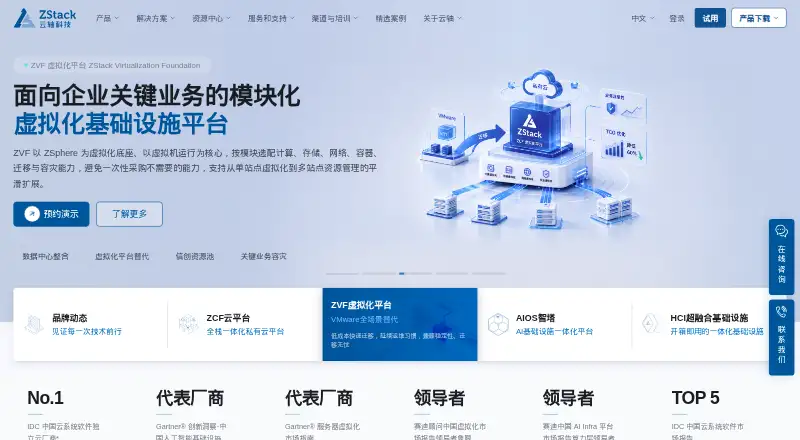
ZStack provides self-hosted cloud infrastructure software for organizations managing data-center compute, networking and storage. Its product range includes private cloud, virtualization, AI infrastructure, hyperconverged infrastructure, container cloud and multi-cloud management. ZCF combines compute, storage, networking, containers and security in a software-defined private-cloud platform with unified portal, operations and identity management. It manages hosts, disks, images and snapshots, and supports scheduling and elastic scaling. ZStack also offers KVM virtualization, elastic bare metal, and management of heterogeneous virtualization platforms. ZStone provides block, file and object storage, while Zaku handles Kubernetes clusters and containers alongside virtual machines. ZStack Cloud Enterprise integrates with Alibaba Cloud, provides a RESTful API, and supports local, cross-region and hybrid-cloud backup and recovery. Listed free plans offer full features for three months for ZStack ZSphere or one year for ZStack Cloud. ZStack describes its products as enterprise infrastructure, including for organizations running private clouds in their own data centers. ZLR enterprise disaster recovery is marked as coming soon, with capabilities and metrics subject to the released version.
Good
- Self-hosted infrastructure covers compute, networking and storage.
- Supports KVM and heterogeneous virtualization management.
- Offers a RESTful API and Alibaba Cloud integration.
- Listed free plans offer full features for three months or one year.
Watch out
- ZStack Cloud Standard is limited to selected regions.
- ZLR enterprise disaster recovery is marked as coming soon.
- Free-plan durations vary by product.
Who it suits
ZStack is for enterprises managing infrastructure in data centers, including organizations building private clouds. Its stated audience includes organizations with high compliance, security, stability or performance requirements.
Verdict
ZStack brings private-cloud, virtualization, storage and container management into a broad infrastructure offering. Organizations should check product and regional limits, including the stated status of ZLR.
Plans and prices
From ZStack's own pricing page, checked 4 Oct 2026.
| Plan | Price | What it gives you |
|---|---|---|
| ZStack Cloud | Free | Single server deployment · full features · free for one year |
| ZStack ZSphere | Free | Unlimited server deployment · full features · free for three months |
The facts
Each one read from ZStack's own pages, with the date it was checked.
What it does
- API
- The product provides a native RESTful API and documentation for development with HTTP-supported languages.checked 4 Oct 2026
- Audience
- ZStack describes its offerings as cloud infrastructure for enterprises and lists industry solutions including education, energy, manufacturing, finance, telecom, healthcare, and government.checked 4 Oct 2026
- Availability
- ZStack Cloud Enterprise includes high-availability policies for business continuity.checked 4 Oct 2026
- Backup
- ZStack Cloud Enterprise backup supports local, cross-region, and hybrid-cloud backup and recovery scenarios.checked 4 Oct 2026
- Compliance
- The company says its ZCF-based compliance capabilities support classified cybersecurity protection and cryptographic assessment construction.checked 3 Oct 2026
- Compute
- ZCF manages cloud hosts, disks, images, and snapshots and supports scheduling, elastic scaling, and scheduled tasks.checked 3 Oct 2026
- Containers
- Zaku supports one-click Kubernetes cluster creation and management, container orchestration, Helm and image repositories, and can manage containers alongside virtual machines.checked 3 Oct 2026
- Deployment
- The download page offers ZStack Cloud installation files, a high-availability suite, historical versions, images, and SDKs.checked 4 Oct 2026
- Downloads and API
- The official download page lists ZStack Cloud installation files and SDKs, while the documentation menu links to an API Explorer.checked 3 Oct 2026
- Hybrid cloud
- ZStack Cloud Enterprise integrates with Alibaba Cloud public cloud in both control and data planes.checked 4 Oct 2026
- Integrations
- ZCF can manage public-cloud resources and work with platforms such as Alibaba Cloud; its network virtualization is based on OVN/OVS.checked 3 Oct 2026
- Limits
- ZStack Cloud Standard is available only in selected regions.checked 4 Oct 2026
- Migration
- The migration service supports moving cloud hosts running mainstream Windows and Linux systems to ZStack Cloud through a UI.checked 4 Oct 2026
- Notable limit
- ZLR enterprise disaster recovery is marked as coming soon, and the page says its capabilities and metrics are subject to the released version.checked 3 Oct 2026
- Product
- ZStack Cloud is an Infrastructure as a Service platform for managing compute, network, and storage resources in data centers.checked 4 Oct 2026
- Product scope
- ZStack offers private-cloud, virtualization, AI infrastructure, hyperconverged infrastructure, storage, networking, container-cloud, and multi-cloud management products.checked 3 Oct 2026
- Security
- ZStack's security solution lists virus protection, access control, intrusion detection and prevention, virtual patching, integrity monitoring, and log auditing.checked 4 Oct 2026
- Storage
- ZStone provides block, file, and object storage, with optional replication or erasure coding and support for existing SAN, NAS, and shared block storage.checked 3 Oct 2026
- Support
- The company says it provides product and service support and lists sales and contact email addresses on its site.checked 4 Oct 2026
- Virtualization
- ZStack Cloud can manage KVM and VMware vCenter resources through the same interface.checked 4 Oct 2026
- Who it serves
- ZStack describes ZCF as suitable for enterprises with high compliance, security, stability, or performance requirements, including organizations building private clouds in their own data centers.checked 3 Oct 2026
The company
- Company
- The company identifies itself as Shanghai Yunzhou Technology Co., Ltd. (云轴科技), headquartered in Shanghai and founded in 2015.checked 3 Oct 2026
- Founded
- 2015checked 28 Sep 2026
- Headquarters
- Shanghai, Chinachecked 28 Sep 2026
The full review of ZStack
ZStack is a self-hosted infrastructure platform for organizations managing private cloud, virtualization, storage and containers in their own data centers. It suits enterprise teams that need a broad control plane with security and hybrid-cloud options; its free deployments are appealing, but regional availability and the unfinished ZLR disaster-recovery product deserve attention.
Overview
ZStack spans private cloud, virtualization, AI infrastructure, hyperconverged infrastructure, storage, networking, container cloud and multi-cloud management. ZStack Cloud is its IaaS platform for managing compute, network and storage resources in data centers, while ZCF combines those infrastructure functions with containers and security in a unified portal with shared operations and identity management.
The breadth is useful for teams seeking one management environment across virtual machines, containers and storage. It also makes ZStack a better fit for infrastructure operators than for people looking for a desktop virtualization utility. The company, Shanghai Yunzhou Technology Co., Ltd., was founded in 2015 and is headquartered in Shanghai.
Key features
ZCF manages cloud hosts, disks, images and snapshots, with scheduling, elastic scaling and scheduled tasks. Its KVM virtualization, elastic bare metal support and management of heterogeneous virtualization platforms can help consolidate infrastructure operations. Supported hypervisors include KVM, XDragon and VMware vSphere, and live migration and high availability are supported.
Storage is handled by ZStone, which offers block, file and object storage, optional replication or erasure coding, and compatibility with existing SAN, NAS and shared block storage. Zaku adds one-click Kubernetes cluster creation, orchestration, Helm and image repositories, and management of containers alongside virtual machines. This is a practical combination for teams that operate both conventional workloads and Kubernetes, though the breadth brings several product components to administer.
ZCF can manage public-cloud resources and work with Alibaba Cloud; ZStack Cloud Enterprise integrates with Alibaba Cloud in both control and data planes. The platform also offers a native RESTful API, with documentation for HTTP-supported languages. Enterprise backup supports local, cross-region and hybrid-cloud recovery, and a UI-based migration service moves cloud hosts running mainstream Windows and Linux systems to ZStack Cloud.
Security features include vTPM 2.0, Secure Boot, KMS key management, role-based access controls, audit logs and national-cryptography encryption. ZStack says its ZCF-based compliance capabilities support classified cybersecurity protection and cryptographic assessment construction. Those features are relevant to regulated operators, but the claims do not replace checking suitability against an organization’s specific requirements. ZLR enterprise disaster recovery is marked as coming soon, with capabilities and metrics dependent on its released version; teams should not treat it as a ready component of a recovery plan.
Pricing
ZStack’s pricing model is freemium, with a free plan and a 365-day trial. The named free plans have distinct deployment limits:
- ZStack ZSphere: free, with unlimited server deployment and full features, free for three months. Its server allowance suits broader evaluation or a short deployment, but the free period is much shorter than ZStack Cloud’s.
- ZStack Cloud: free, with single-server deployment and full features, free for one year. It gives teams time to evaluate the full feature set, but its single-server cap limits its usefulness for a larger production footprint.
The 365-day trial aligns with the one-year ZStack Cloud offer, while ZSphere’s stated free period is only three months. ZStack Cloud Standard is available only in selected regions, so regional eligibility matters before planning around it. No paid plan price is provided; paid deployment should be treated as custom pricing.
Platforms
ZStack supports API, Linux, self-hosted and web access, and its deployment model is self-hosted. That makes it suitable for organizations keeping infrastructure in their own data centers, rather than teams seeking a hosted service. The official download page offers installation files, a high-availability suite, historical versions, images and SDKs; documentation includes an API Explorer. Support resources include documentation, training videos, certification training, a community, a knowledge base, and separate sales and after-sales phone options.
Who it's for
ZStack is aimed at enterprise infrastructure teams with high compliance, security, stability or performance requirements, particularly those building private clouds in their own data centers. Its stated industry solutions cover education, energy, manufacturing, finance, telecom, healthcare and government. It is less compelling for a single-machine virtualization need or for buyers who require a ready enterprise disaster-recovery product now.
Pros and cons
- Pro: Compute, storage, networking, containers and security share a private-cloud environment, reducing the need to operate separate management platforms for those functions.
- Pro: Full-featured free plans provide a no-cost evaluation path, including one year for single-server ZStack Cloud and three months of unlimited-server ZSphere.
- Pro: Alibaba Cloud integration, REST API access, migration and backup options give teams routes to hybrid operations and workload movement.
- Con: ZStack Cloud Standard is limited to selected regions, which can rule it out for otherwise suitable organizations.
- Con: ZStack Cloud’s free plan is capped at one server, while ZSphere’s unlimited-server offer lasts only three months.
- Con: ZLR enterprise disaster recovery is still coming soon, so it cannot yet anchor a current recovery design.
Alternatives
For a focused virtualization-management comparison, browse Virtualization Management Software. Choose Proxmox VE if its freemium model and Linux, Windows, web, API and self-hosted platform coverage better match your environment. Virtuozzo Infrastructure is another freemium option, with a self-install offer capped at 96 physical cores and 1TB of storage.
VMware Workstation Pro is a free option for Windows or Linux hosts on 64-bit Intel or AMD PCs, rather than a broad private-cloud platform. Pick Apache CloudStack for free, open-source IaaS cloud software without commercial plan pricing. LXD offers free self-hosted KVM-based virtual machines and system containers, while oVirt is a free open-source virtualization option with production use stated for version 4.5.7. For Linux-only self-hosted virtualization, virt-manager and Xen Project Hypervisor are free alternatives; Xen provides hypervisor source releases for building, packaging and platform integration.
Verdict
Choose ZStack if your organization needs a self-hosted private-cloud environment spanning virtual machines, storage and containers, with security controls and Alibaba Cloud integration. Its broad feature set and free evaluation plans make it worth considering for enterprise infrastructure teams, but confirm regional access and custom pricing before committing. Look elsewhere if you need ZLR-grade enterprise disaster recovery immediately or only need a narrower virtualization tool.
Getting started
- Visit https://www.zstack.io/.
- Choose ZStack ZSphere or ZStack Cloud: both list full features at no charge for a limited term.
- Download ZStack Cloud installation files, SDKs, or other deployment materials from the official download page.
- Deploy the software in a self-hosted environment.
- Use the documentation menu’s API Explorer or native RESTful API resources for development.
Limits worth knowing
ZStack ZSphere is listed as free for three months, while ZStack Cloud is listed as free for one year. ZStack Cloud Standard is available only in selected regions; ZLR enterprise disaster recovery is marked as coming soon, with capabilities and metrics subject to the released version.
Questions
Is ZStack free?
The listed ZStack ZSphere plan is free for three months, with unlimited server deployment and full features. ZStack Cloud is free for one year, with single-server deployment and full features.
Where can I deploy ZStack?
The deployment model is self-hosted. Its platforms are listed as API, Linux, self-hosted, and web.
Which hypervisors does it support?
Supported hypervisors are KVM, XDragon, and VMware vSphere.
Does ZStack provide an API?
Yes. ZStack Cloud provides a native RESTful API, and the documentation menu links to an API Explorer.
Can it integrate with a public cloud?
ZStack Cloud Enterprise integrates with Alibaba Cloud in both the control and data planes. ZCF can also manage public-cloud resources.
What support resources are available?
ZStack’s site provides documentation, training videos, certification training, a community, a knowledge base, and separate sales and after-sales phone options.
Alternatives to ZStack
- 1

Proxmox VE
Free planAndroidWebAPILinux8.1From €120 a year - 2

oVirt
Free planOpen sourceAndroidiOSWebAPI8.0Free plan - 3

Apache CloudStack
Free planOpen sourceWebAPILinuxSelf-hosted7.4Free plan - 4
ZSvirt
Free planOpen sourceWebAPILinuxSelf-hosted7.2Free plan - 5
HPE Morpheus VM Essentials Software
WebLinuxSelf-hosted7.0From $600 a year - 6

LXD
Free planWebAPILinuxSelf-hosted7.0From $25 a year