
Woodpecker CI
Woodpecker CI is an open-source CI/CD engine for running project pipelines, with self-hosted installation and no hosted option.
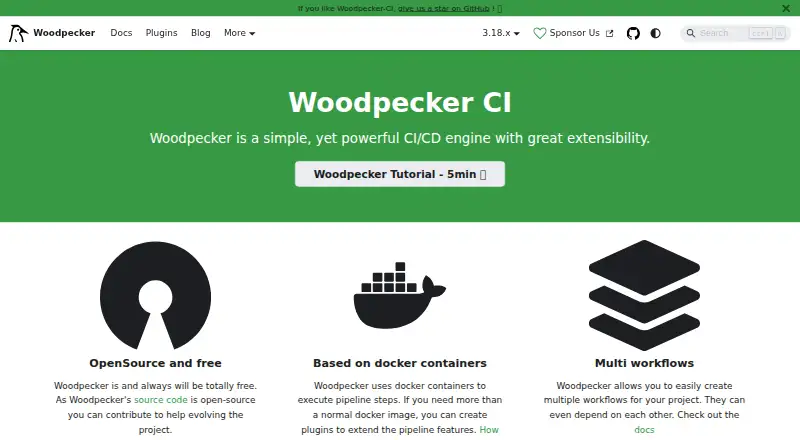
What Woodpecker CI is
Woodpecker CI is an open-source CI/CD engine for running project pipelines, with self-hosted installation and no hosted option. Pipeline steps run in Docker containers, while plugins can extend pipeline features. A project can have multiple workflows that depend on one another, and supported forges can trigger pipelines for pushes, tags, and pull requests. Documented integrations include GitHub, Gitea, Forgejo, GitLab, Bitbucket, and Bitbucket Datacenter, though feature support differs by forge; release events are not supported for the two Bitbucket options. Woodpecker supports YAML configuration and artifact or dependency caching. It is distributed as container images and pre-built binaries, with official DEB and RPM packages for Linux amd64 and arm64. Agents can use Docker, Kubernetes, or Local backends, depending on operating-system support. The Local backend runs commands on the agent host without isolation and is intended only for trusted private setups. Authentication uses OAuth2 through a configured forge. SQLite is the default database, with PostgreSQL and MySQL also supported. The project says it will always be free.
Good
- Free, open-source, self-hosted CI/CD engine.
- Supports multiple forge integrations.
- Pipelines can use Docker or Kubernetes backends.
- Supports YAML configuration and caching.
- Offers SQLite, PostgreSQL, and MySQL database options.
Watch out
- There is no hosted option.
- Local backend runs commands without isolation.
- Forge feature support differs.
- Multiple-forge connections are experimental and not recommended for untrusted environments.
Who it suits
Woodpecker CI suits teams that want a free, self-hosted pipeline engine and can manage its deployment. Its Local backend is appropriate only for trusted private setups because commands run without isolation.
Verdict
Woodpecker CI offers a free self-hosted pipeline engine with several forge integrations and execution backends. Its deployment and security limits matter: the Local backend lacks isolation, and connecting multiple forges is not recommended for untrusted environments.
Plans and prices
From Woodpecker CI's own pricing page, checked 7 Oct 2026.
| Plan | Price | What it gives you |
|---|---|---|
| Woodpecker CI | Free | Open-source CI/CD engine · self-hosted installation · Free; Woodpecker says it will always be free. |
The facts
Each one read from Woodpecker CI's own pages, with the date it was checked.
What it does
- Database
- Woodpecker uses SQLite by default; PostgreSQL and MySQL are also listed as database options.checked 7 Oct 2026
- Deployment
- The Docker Compose guide shows a server and agent deployment, persistent server data, and shared-secret authentication between the server and agents.checked 7 Oct 2026
- Execution backends
- Agents can use Docker, Kubernetes, or Local backends, with backend availability varying by host operating system.checked 7 Oct 2026
- Extensions
- External HTTP extensions can modify or generate pipeline configuration and provide registry credentials or secrets.checked 7 Oct 2026
- Extension security
- Woodpecker signs HTTP requests to extensions, which may receive private information and return configurations that can be executed.checked 7 Oct 2026
- Forge integrations
- Built-in forge support includes GitHub, Gitea, Forgejo, GitLab, Bitbucket, and Bitbucket Datacenter.checked 7 Oct 2026
- Installation
- Woodpecker is distributed as container images and pre-built binaries; official DEB and RPM packages are built for Linux amd64 and arm64.checked 7 Oct 2026
- Local backend limitation
- The local backend runs pipeline commands on the agent host without isolation and is recommended only for trusted private setups.checked 7 Oct 2026
- Multiple forges
- Connecting multiple forges is described as experimental and is not recommended for public or otherwise untrusted environments.checked 7 Oct 2026
- Pipeline events
- Supported forges can trigger pipelines on events such as pushes, tags, and pull requests; release events are not supported for Bitbucket or Bitbucket Datacenter.checked 7 Oct 2026
- Pipeline execution
- Woodpecker runs pipeline steps in Docker containers, and plugins can extend pipeline features.checked 7 Oct 2026
- Project history
- Woodpecker was forked from Drone 0.8 in 2019 and was originally forked by @laszlocph.checked 7 Oct 2026
- Purpose
- Woodpecker is a CI/CD engine with extensibility.checked 7 Oct 2026
- Secret handling
- Woodpecker supports repository, organization, and global secrets, and warns that externally sourced secrets may be exposed in pipeline logs.checked 7 Oct 2026
- Security limitation
- The Local backend runs pipeline commands without isolation and is recommended only for private setups where code and pipelines are trusted.checked 7 Oct 2026
- Support channels
- The project lists Matrix, Mastodon, and Bluesky as community links.checked 7 Oct 2026
- User access
- Woodpecker uses OAuth2 authentication through the configured forge and does not have its own user registration.checked 7 Oct 2026
- Workflows
- A project can have multiple workflows that depend on one another.checked 7 Oct 2026
The company
- Founded
- 2019checked 28 Sep 2026
Where it runs
- Platform support
- The supported-platforms page lists Windows, macOS, and Linux builds for selected components and architectures; backend availability varies by operating system.checked 7 Oct 2026
Money
- Price
- The project says Woodpecker is open source and free, and will always be totally free.checked 7 Oct 2026
Alternatives to Woodpecker CI
- 1

Codemagic
Free planAndroidiOSWebAPI8.2From $99 a month - 2

TeamCity
Free planAndroidWebAPILinux8.2From $15 a month - 3

Azure Test Plans
Free planWebAPIExtensionLinux8.1From $6 a month - 4
Bitbucket Pipelines
Free planWebAPILinuxmacOS8.0From $3.65 a month - 5

AppVeyor
Free planWebAPILinuxmacOS7.9From $29 a month - 6

AWS CodeBuild
Free planWebAPILinuxmacOS7.9From $0.01 a month