Woboq Code Browser
Woboq Code Browser creates a web interface for exploring C and C++ codebases.
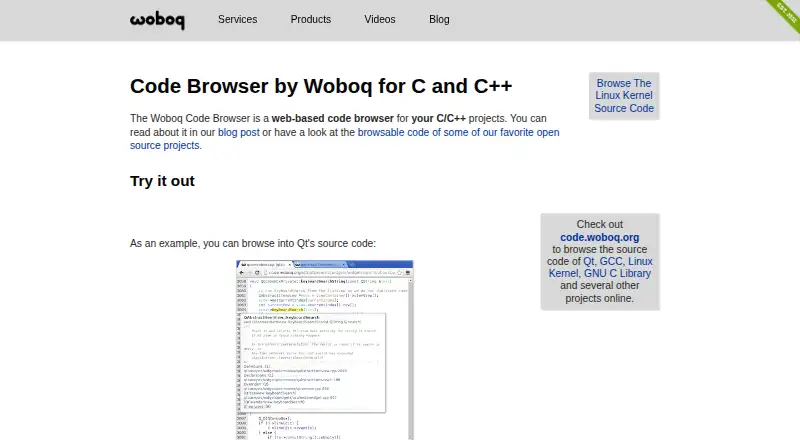
What Woboq Code Browser is
Woboq Code Browser creates a web interface for exploring C and C++ codebases. Its generator uses LLVM and Clang tooling to analyze code semantically, linking identifiers to declarations and implementations. Readers can search identifiers, inspect tooltips, expand macros, and view inheritance diagrams; tooltips can include variable types and whether an identifier is read or written. Qt SIGNAL and SLOT macros are supported, with tooltip details about where signals connect or are emitted. The generator produces static HTML that can be hosted or served locally without a server-side database or CGI script. It can integrate with CMake and QMake or run from a version-control or CI hook. Project analysis requires a compile_commands.json file or compiler arguments shared across files. The generator runs on Linux or Mac; building it on Linux requires LLVM and Clang 16 or higher. Woboq offers a commercial license or CC BY-NC-SA 3.0, which excludes use to assist development of commercial software. The company was founded in 2011 and is headquartered in Berlin, Germany.
Good
- Semantic cross-references for C and C++
- Static HTML requires no server-side database or CGI
- Integrates with CMake and QMake
- Supports Qt SIGNAL and SLOT macro details
Watch out
- Requires compile_commands.json or compiler arguments
- Linux builds require LLVM and Clang 16 or higher
- CC BY-NC-SA 3.0 excludes commercial software development assistance
Who it suits
Woboq Code Browser suits developers who need to inspect C and C++ code, trace dependencies, or share code documentation. Its static output can also help teams who prefer serving generated pages without a server-side database.
Verdict
Woboq Code Browser offers detailed navigation for C and C++ projects and produces portable static pages. Check the project’s compilation setup and licensing needs before choosing it.
The facts
Each one read from Woboq Code Browser's own pages, with the date it was checked.
What it does
- Build integration
- The generator can be integrated with build systems including CMake and QMake, and can run from a version-control or CI hook.checked 8 Oct 2026
- Build requirement
- The current repository README says building the generator on Linux requires LLVM and Clang version 16 or higher.checked 8 Oct 2026
- Compilation database
- The generator uses Clang tooling and needs a compile_commands.json file or compilation arguments supplied for each file.checked 8 Oct 2026
- Generated output
- The generator produces static HTML pages that can be served by a web server without a server-side database or CGI script.checked 8 Oct 2026
- Hosting
- Generated files can be uploaded to a web host or served locally with a web server such as Apache or nginx.checked 8 Oct 2026
- Intended use
- Woboq says the browser helps developers understand existing code, inspect library dependencies, and share code through documentation, project software, chat, or an intranet.checked 8 Oct 2026
- Intended users
- Woboq describes the browser as a way for developers to understand code and dependencies without installing all source code on each developer's machine.checked 8 Oct 2026
- License
- The README describes use under a commercial license from Woboq or a CC BY-NC-SA 3.0 license that excludes use to assist development of commercial software.checked 8 Oct 2026
- Navigation
- Features include identifier search, links to declarations and implementations, tooltips, macro expansion, and inheritance diagrams.checked 8 Oct 2026
- Other features
- The feature list includes inheritance diagrams, macro expansion, class and struct sizes, and theme customization.checked 8 Oct 2026
- Privacy
- Woboq's privacy policy says its website uses cookies and collects general server-log data such as IP addresses and browser details.checked 8 Oct 2026
- Purpose
- Woboq Code Browser is a web-based browser for C and C++ projects.checked 8 Oct 2026
- Qt support
- The feature tour says Qt SIGNAL and SLOT macros are supported, including tooltip information about where signals are connected or emitted.checked 8 Oct 2026
- Requirements
- The README says LLVM and Clang version 16 or higher are required to build the generator on Linux.checked 8 Oct 2026
- Security and privacy
- Woboq's privacy policy says its website uses cookies and that internet-based data transmission may have security gaps.checked 8 Oct 2026
- Semantic analysis
- It uses LLVM to semantically analyze C and C++ code for cross-references.checked 8 Oct 2026
- Static output
- The generator creates static HTML pages that can be served by any web server without a server-side database or CGI script.checked 8 Oct 2026
- Support
- The README invites licensees and other users to contact [email protected] for help and directs bug reports to GitHub issues.checked 8 Oct 2026
- Support contact
- Woboq invites questions and inquiries by email and says it accepts inquiries in English or German.checked 8 Oct 2026
- Supported project setup
- The README says the generator uses Clang tooling and requires a compile_commands.json file or compiler arguments shared across files.checked 8 Oct 2026
The company
- Founded
- 2011checked 28 Sep 2026
- Headquarters
- Berlin, Germanychecked 28 Sep 2026
Where it runs
- Generator platforms
- The product page says the generator runs on Linux or Mac.checked 8 Oct 2026
- Platforms
- The product page says the generator runs on Linux or Mac, and the README provides build instructions for Linux and macOS.checked 8 Oct 2026
Alternatives to Woboq Code Browser
- 1
Avidemux
Free planOpen sourceWebLinuxmacOSWindows7.3Free plan - 2

Understand
APIExtensionLinuxmacOS7.2From $100 a month - 3

ast-grep
Free planWebAPIExtensionLinux7.0Free plan - 4

Chromium
Open sourceAndroidiOSExtensionLinux6.9 - 5
Semantic Designs Source Code Search Engine
Free planAPILinuxSelf-hostedWindows6.7Free plan - 6

Code Fundi
Free planWebAPIExtension6.6From $21 a month