WHIMO
WHIMO is a supply-chain service for capturing and sharing transaction and location data as goods move from origin to destination.
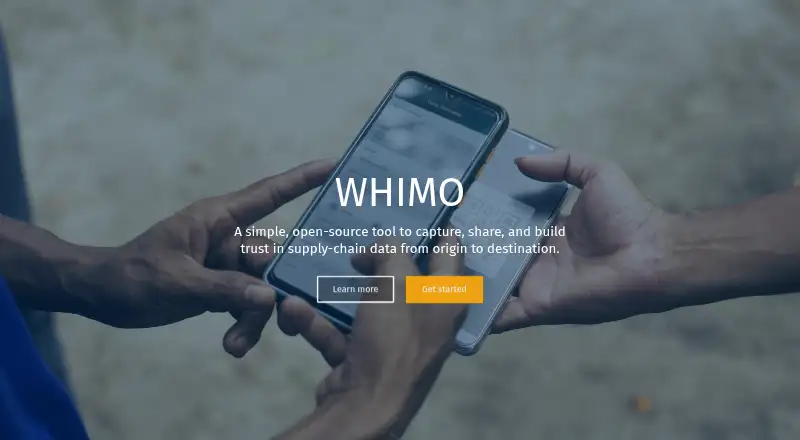
What WHIMO is
WHIMO is a supply-chain service for capturing and sharing transaction and location data as goods move from origin to destination. It is designed for cooperatives, local aggregators, transporters, processors, and exporters, including people working in low-infrastructure settings. Users can document buying, collection, sales, and deliveries, track traded volumes, record the conversion of raw materials into processed products, and review transaction histories. Farm locations can be captured by scanning QR codes, recording GPS positions, placing map pins, or adding geolocation later. WHIMO can display chains spanning direct and indirect suppliers, assess how much transaction data has location coverage, and help participants seek missing geodata. Users can gather traceability data from suppliers, pass it on to customers, inspect supply-chain diagnostics, and download information for due diligence. The service is available on Android, iOS, and the web, and can also be self-hosted. The European Forest Institute hosts the ready-to-use service and manages its data under its data policy; companies and institutions can replicate and adapt its open-access source code for their own system. WHIMO is based in Joensuu, Finland.
Good
- Free plan costs nothing.
- Records buying, collection, sales, and delivery events.
- Captures farm geodata through QR codes, GPS, map pins, or later entry.
- Shows supply chains across direct and indirect suppliers.
- Runs on Android, iOS, and the web.
- Open-access source code can be adapted for self-hosting.
Watch out
- No free trial is offered.
- Hosted data is managed by the European Forest Institute under its data policy.
- The service does not guarantee information completeness or accuracy.
Who it suits
WHIMO suits cooperatives, aggregators, transporters, processors, and exporters that need to record supply-chain transactions and geolocation. Its mobile, web, and self-hosting options, along with support for low-infrastructure contexts, suit varied operating environments.
Verdict
Choose WHIMO if your organization needs to document transactions and geolocation across a supply chain, including supplier-to-customer data exchange. Its free hosted service and adaptable source code offer two deployment paths. Organizations needing named third-party software integrations should look elsewhere, since the described exchange is between supply-chain participants and QR-code scanning.
Plans and prices
From WHIMO's own pricing page, checked 8 Oct 2026.
| Plan | Price | What it gives you |
|---|---|---|
| WHIMO | Free | Open-source · hosted by EFI or self-host your own version |
The facts
Each one read from WHIMO's own pages, with the date it was checked.
What it does
- Data exchange
- Users can collect traceability data from suppliers, transfer it to customers, view supply-chain diagnostics, and download data for due diligence.checked 8 Oct 2026
- Data hosting
- The ready-to-use solution is hosted by the European Forest Institute, which stores and manages its data under its data policy.checked 8 Oct 2026
- Deployment
- EFI hosts the ready-to-use service, while companies and institutions can replicate and adapt the open-access source code to host their own system.checked 8 Oct 2026
- Farm geodata
- Users can collect farm polygons by scanning QR codes, record GPS locations, drop map pins, or add geolocation later.checked 8 Oct 2026
- Integrations
- The pages reviewed describe data exchange between supply-chain participants and QR-code scanning, but do not name third-party software integrations.checked 8 Oct 2026
- Intended users
- It is designed for cooperatives, local aggregators, transporters, processors, and exporters, including users in low-infrastructure contexts.checked 8 Oct 2026
- Privacy
- EFI's privacy notice says it may collect website and mobile-device data, uses essential and Google Analytics cookies, and processes personal data only as long as needed for its stated purpose.checked 8 Oct 2026
- Purpose
- WHIMO captures and shares supply-chain transaction and geolocation data from origin to destination.checked 8 Oct 2026
- Responsibility
- EFI says it does not guarantee the completeness or accuracy of WHIMO information and places responsibility on users to ensure their use complies with applicable laws and requirements.checked 8 Oct 2026
- Support
- The site says tutorial videos and a user manual are under development and directs users to contact the support team for assistance.checked 8 Oct 2026
- Traceability
- WHIMO can show supply chains across direct and indirect suppliers, measure transaction geodata coverage, and help request missing geodata.checked 8 Oct 2026
- Transactions
- Users can record buying, collecting, selling, and delivery transactions; track traded volumes; convert raw materials to processed products; and view transaction history.checked 8 Oct 2026
The company
- Headquarters
- Joensuu, Finlandchecked 28 Sep 2026
Where it runs
- Platforms
- WHIMO offers iOS and Android apps and an online web portal for accessing and managing data.checked 8 Oct 2026
The full review of WHIMO
WHIMO is a free traceability system that connects supply-chain transactions with geolocation from origin to destination. It suits cooperatives, aggregators, transporters, processors, and exporters, particularly where field connectivity and infrastructure are limited. Its central advantage is a no-license-cost route to shared, end-to-end records; organizations wanting named commercial integrations or a vendor-managed support program should consider alternatives.
Overview
WHIMO brings buying, collection, sales, and delivery records together with farm and shipment locations. The resulting view can span both direct and indirect suppliers, helping organizations understand where materials came from and how they moved through processing and distribution. Participants can pass traceability data to customers, inspect supply-chain diagnostics, and download records for due-diligence work.
The European Forest Institute (EFI) operates the ready-to-use hosted service and manages its data under its own data policy. Companies and institutions can also replicate and adapt the open-access source code for self-hosting. That second route can provide more control over deployment and data operations, but it requires the organization to run and maintain its own instance. EFI places responsibility on users to ensure their use complies with applicable laws and does not guarantee that WHIMO information is complete or accurate.
Key features
Location capture and transaction records
Farm polygons can be collected by scanning QR codes, recording GPS positions, dropping map pins, or adding a location later. This range is useful when different participants have different field routines or cannot capture coordinates at the point of activity. Users can record buying, collecting, selling, and delivery events, track traded volumes, and convert raw materials into processed products. A transaction history preserves the chain of activity rather than reducing it to a current stock figure.
End-to-end traceability
WHIMO shows supply chains across direct and indirect suppliers and measures transaction geodata coverage. It can help identify missing geodata and request it from suppliers, giving coordinators a practical way to close location gaps. Participants can collect information from suppliers, transfer it to customers, review diagnostics, and export data for due diligence. The emphasis is on structured exchange between supply-chain participants, not on a catalog of named third-party software connections.
Deployment and support
EFI hosting is the shortest path to adoption, while the open-access code supports organizations that need to adapt or host the system themselves. The trade-off is operational: self-hosting brings control but also makes the organization responsible for running its version. Tutorial videos and a user manual are under development, with support directed through the support team, so teams should plan for assistance that is primarily contact-based.
Pricing
WHIMO — free. The sole plan is open-source and can be used through EFI hosting or a self-hosted version. There is no free trial because the service itself is free, and no paid tier, seat charge, usage quota, or renewal term is stated. This makes WHIMO suitable for organizations that need broad participation without software fees. The cost advantage does not remove hosting and administration work when a company chooses to operate its own deployment.
Platforms
WHIMO is available on Android, iOS, the web, and as a self-hosted deployment. Mobile applications support participants collecting locations and events in the field, while web access suits coordination, diagnostics, and data exchange. Self-hosting adds a deployment option rather than a separate paid edition.
Who it's for
WHIMO is aimed at cooperatives, local aggregators, transporters, processors, and exporters that must document material movement and origin data across several organizations. It is a particularly strong fit for supply chains operating in low-infrastructure contexts, where QR scanning, map pins, and later geolocation entry can accommodate uneven data-collection conditions. It is less suitable for buyers seeking a packaged integration marketplace or a narrowly scoped, single-facility inventory tool.
Pros and cons
- Pros: Free access avoids software licensing costs for participating organizations.
- Pros: End-to-end records cover transactions, volumes, processing conversions, supplier relationships, and geodata coverage.
- Pros: Multiple location-capture methods and QR scanning support varied field workflows.
- Pros: EFI hosting and adaptable source code provide both a managed starting point and a self-hosting route.
- Cons: Self-hosting shifts infrastructure and maintenance responsibility to the adopting organization.
- Cons: Named third-party software integrations are not part of the described exchange model.
- Cons: Documentation is still being developed, and EFI disclaims completeness and accuracy, so compliance controls remain with the user.
Alternatives
Choose Trace-X instead when an open-source, self-hosted or API-accessible traceability system with no stated usage limits better matches your architecture.
LotThread is the better choice for a web-based operation centered on one facility, three users, materials and batch tracking, finished lots, and basic trace reports, with a paid Growth tier for expansion.
Select ReposiTrak Traceability Network when retailer or wholesaler network access, or a supplier program with commercial terms, is the priority.
Scantrust fits organizations wanting a 90-day trial and a paid e-label platform across mobile, desktop, API, and web environments.
FoodTraze is an alternative for teams evaluating an open-source traceability product with private-blockchain pricing determined through its calculator.
SusChain suits users seeking software that is free to run, modify, and distribute through API, web, or self-hosted deployment.
FoodLogiQ Traceability is an alternative paid traceability service with Android, iOS, API, and web support.
TraceSense is for organizations that also need paid maintenance-management capabilities alongside traceability-related operations.
Verdict
Choose WHIMO if your organization needs to document transactions and geolocation across a multi-party supply chain at no software cost, with the option to use EFI hosting or adapt the open-access code. Look elsewhere if you require named third-party integrations, mature published documentation, or a vendor that assumes responsibility for deployment and compliance.
Getting started
- Open the WHIMO website.
- Choose Android, iOS, or web access, or arrange to host an adapted version of the open-access source code.
- Use the free WHIMO plan.
- Contact the support team for assistance.
Limits worth knowing
The WHIMO plan is free at no cost. No trial period is offered.
Questions
How much does WHIMO cost?
The WHIMO plan is free, and the service has a free plan.
Which platforms does WHIMO support?
WHIMO is available on Android, iOS, and the web. A self-hosted deployment is also possible.
Can an organization host WHIMO itself?
Yes. Companies and institutions can replicate and adapt the open-access source code to host their own system.
Who makes or hosts WHIMO?
The European Forest Institute hosts the ready-to-use service and manages its data under its data policy. WHIMO is based in Joensuu, Finland.
Does WHIMO integrate with other software?
The described data exchange is between supply-chain participants and includes QR-code scanning; no third-party software integrations are named.
Alternatives to WHIMO
- 1

Wholechain
Free planAndroidiOSWebAPI7.5Free plan - 2
Trace-X
Free planOpen sourceWebAPILinuxSelf-hosted7.2Free plan - 3

Scantrust
AndroidiOSWebAPI7.1From €230 a year - 4
TraceSense
AndroidiOSWeb7.1From £295 a month - 5
SusChain
Free planOpen sourceWebAPISelf-hosted7.0Free plan - 6

ReposiTrak Traceability Network
Free planWeb6.6From $59 a month