VAT Engine
VAT Engine provides an EU VAT API for calculation and compliance workflows aimed at ecommerce and finance teams.
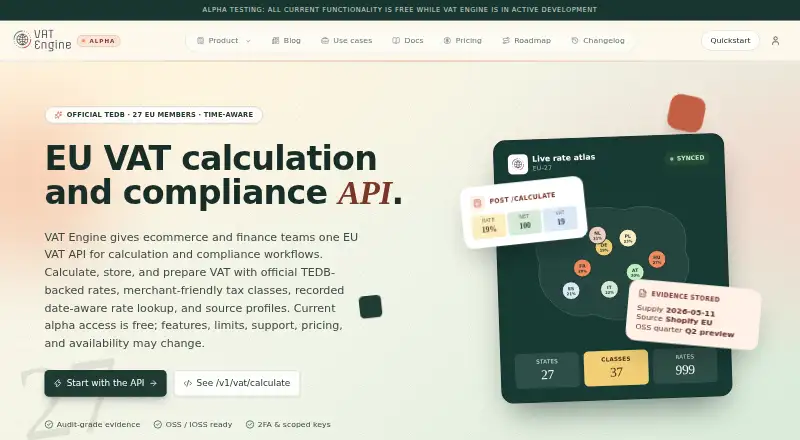
What VAT Engine is
VAT Engine provides an EU VAT API for calculation and compliance workflows aimed at ecommerce and finance teams. It covers all 27 EU member states and 37 merchant-facing tax classes mapped from 88 official categories. Its VAT-rate and SME-threshold data is imported from the European Commission’s Taxes in Europe Database. A transaction date can select a reviewed rate version when one is available; periods without coverage are marked unverifiable. Calculation results can become transaction records, while source profiles, OSS thresholds, quarter previews, and accountant exports use the same model. The dashboard includes API-key generation, rotation and revocation, scoped permissions, usage tracking, two-factor authentication, backup codes, and activity logs. Shopify processing is described for an authorized connected store; Shopify, WooCommerce, Magento, and Sylius platform-specific connectors are listed as planned. Alpha access is free at no cost with no payment method required, but availability, limits, support, pricing, and features may change. VAT Engine does not file returns or provide tax or legal advice, and advises users to review results against their business facts and professional advice.
Good
- Covers all 27 EU member states.
- Uses date-aware reviewed rates when available.
- Calculation results can become transaction records.
- Dashboard supports scoped API keys and activity logs.
- Current alpha access is free without a payment method.
Watch out
- Periods without rate coverage are marked unverifiable.
- Tax returns are not submitted.
- Legal or tax advice is not provided.
- Alpha support is best-effort with no service-level commitment.
Who it suits
It suits ecommerce and finance teams that need VAT calculations and records for audit or accountant review. Developers can also use its API and dashboard controls.
Verdict
VAT Engine combines EU VAT calculations with transaction records and review exports. Its alpha status, uncovered historical periods, and lack of filing or advisory services are important limitations to weigh.
Plans and prices
From VAT Engine's own pricing page, checked 8 Oct 2026.
| Plan | Price | What it gives you |
|---|---|---|
| Alpha access | Free | Available during active alpha; availability, limits, support, pricing, and features may change · Current access is free; no payment method required |
The facts
Each one read from VAT Engine's own pages, with the date it was checked.
What it does
- API and account controls
- The dashboard includes API-key generation, rotation, revocation, scoped permissions, usage tracking, two-factor authentication, backup codes, and activity logs.checked 8 Oct 2026
- Audience
- The maker describes the product as built for ecommerce and finance teams, with developer-facing endpoints and records for audit and accountant review.checked 8 Oct 2026
- Coverage
- The product describes coverage of all 27 EU member states and 37 merchant-facing tax classes mapped from 88 official categories.checked 8 Oct 2026
- Date-aware calculations
- Calculations can use the transaction date to select a reviewed rate version when one is available; uncovered legacy windows are marked unverifiable.checked 8 Oct 2026
- Evidence and reporting
- Calculation results can become transaction records, and source profiles, OSS thresholds, quarter previews, and accountant exports use the same model.checked 8 Oct 2026
- Integrations
- Shopify processing is described for an authorized connected store; Shopify, WooCommerce, Magento, and Sylius are listed as planned platform-specific connectors.checked 8 Oct 2026
- Privacy
- The privacy policy says Shopify-connected processing requests country codes rather than street address, city, or postcode, and excludes customer names, emails, and telephone numbers from retained connector data.checked 8 Oct 2026
- Purpose
- VAT Engine provides an EU VAT API for calculation and compliance workflows aimed at ecommerce and finance teams.checked 8 Oct 2026
- Rate data
- It imports supported VAT-rate and SME-threshold data from the European Commission’s Taxes in Europe Database (TEDB).checked 8 Oct 2026
- Security
- The maker lists account isolation, scoped API keys, session and CSRF protections, rate limiting, activity logs, and security-focused operational controls, while stating these do not guarantee alpha suitability for every use case.checked 8 Oct 2026
- Support
- Alpha support is best-effort through the public contact channel, with no service-level commitment.checked 8 Oct 2026
- Tax and filing limits
- VAT Engine says it does not submit returns or provide legal or tax advice, and advises users to review results against their business facts and professional advice.checked 8 Oct 2026
- Usage limits
- The maker says availability, limits, and product behavior can change during alpha, and does not present a long-term commercial commitment for the current service boundary.checked 8 Oct 2026
The full review of VAT Engine
VAT Engine is an EU VAT calculation service with an API and web dashboard, aimed at ecommerce and finance teams that need to connect tax calculations with transaction records. It is best suited to teams exploring or building EU VAT workflows during an active alpha, rather than those that need dependable filing or support commitments.
Overview
The product connects calculations with transaction records, source profiles, OSS thresholds, quarter previews, and accountant exports. Because these workflows use the same model, finance teams can carry results into review; developers can work with them through the API. That continuity is useful for preparation, but VAT Engine does not submit returns or provide tax or legal advice.
Coverage spans all 27 EU member states, with 37 merchant-facing tax classes mapped from 88 official categories. Supported VAT rates and SME thresholds are imported from the European Commission’s Taxes in Europe Database. Calculations can use a transaction date to select a reviewed rate version when one is available; uncovered legacy periods are marked unverifiable. This is a useful distinction for historical checks, but it leaves those periods needing separate verification.
Key features
Calculation records and review
Results can be turned into transaction records, while source profiles, OSS thresholds, quarter previews, and accountant exports draw on the shared model. This makes VAT Engine more than a calculation endpoint for teams preparing material for accountant review. It remains a workflow aid, not a substitute for professional advice or filing.
API and account controls
The dashboard supports API-key creation, rotation, revocation, scoped permissions, and usage tracking. Two-factor authentication, backup codes, and activity logs add useful account safeguards for teams managing access. The maker also describes account isolation, session and CSRF protections, rate limiting, and security-focused operational controls, while cautioning that these do not establish alpha suitability for every use case.
Shopify and privacy
Shopify processing is described for an authorized connected store. The privacy policy says those requests use country codes rather than street addresses, cities, or postcodes, and that retained connector data excludes customer names, email addresses, and telephone numbers. Shopify, WooCommerce, Magento, and Sylius platform-specific connectors are planned, so teams should not assume those integrations are already available.
Pricing
Alpha access: free. Current access is free, requires no payment method, and is available during active alpha. That makes it practical to evaluate the workflow without a subscription cost, but availability, limits, support, pricing, and features may change. The service boundary carries no long-term commercial commitment.
Alpha support is best-effort through the public contact channel, with no service-level commitment. Teams relying on predictable availability or support for business-critical processes should account for that uncertainty before building around the service.
Platforms
VAT Engine is available on web and through an API. API access is included, which suits developers connecting calculations to ecommerce or finance workflows. Its tax type is VAT/GST, with the stated focus on EU VAT.
Who it's for
VAT Engine makes the most sense for ecommerce and finance teams that need EU-focused calculations, transaction records, and exports for accountant review, particularly when they can tolerate an evolving alpha. Developer-facing endpoints and account controls also suit teams integrating the service into their own workflows.
It is a poor fit for businesses that need returns submitted, legal or tax advice, committed support, or confidence in historical periods the service marks unverifiable. Results should be checked against the business’s circumstances and professional advice.
Pros and cons
- Connected calculation-to-review workflow: transaction records and accountant exports use the same model as calculations, reducing the gap between generating a result and preparing it for review.
- Broad stated EU coverage: 27 member states and 37 merchant-facing classes give EU-focused teams a defined scope for evaluation.
- Date-aware rates: reviewed rate versions can be selected by transaction date when available, while unverifiable legacy windows are clearly distinguished.
- Useful access controls: scoped, revocable API keys, usage tracking, and two-factor authentication help teams manage access.
- Alpha uncertainty: features, limits, availability, pricing, and support may change, and there is no long-term commercial commitment or service-level promise.
- No filing or advice: teams must handle returns elsewhere and review results with appropriate professional guidance.
- Connector scope is limited: Shopify processing is described for authorized connected stores, while other named platform connectors remain planned.
Alternatives
Tax Engine Software is a broader category directory for comparing tax-engine options.
Vatstack is worth considering for a freemium API and web service whose Developer plan is free for life, with unlimited quotes, dummy validations, and dummy supplies.
Zamp may suit teams looking for a U.S.-focused compliance option: its free plan includes a 30-day sandbox, while its U.S. plan has custom pricing.
ShipVAT offers a free API and web plan with 100 API calls per month, making it an option for teams whose needs fit that stated allowance.
Kintsugi is an API alternative for teams focused on global nexus monitoring, historical liability auditing, and risk assessment.
OpenSalesTax is a free, Apache 2.0, self-hostable API for U.S. sales-tax calculation, rather than EU VAT workflows.
ONESOURCE Determination is a paid option with pricing by request for teams seeking a broader deployment choice across API, web, desktop, Linux, and self-hosted platforms.
CCH SureTax offers paid API plans ranging from technology-only to filing and remittance or fully outsourced service; it may suit teams seeking those services rather than calculation and review alone.
Vertex for e-Commerce is another paid API and web option for ecommerce tax workflows.
Verdict
Choose VAT Engine if your ecommerce or finance team wants a free way to connect EU VAT calculations with transaction records and accountant-review exports, and can accept alpha uncertainty. Its strongest advantage is the joined-up, date-aware workflow; its clearest reason to look elsewhere is the lack of filing, advice, and committed support, alongside historical periods that may remain unverifiable.
Alternatives to VAT Engine
- 1

Kintsugi
Free planAndroidiOSWebAPI8.1$75 one-time - 2

Numeral
Free planWebAPI7.5$75 one-time - 3
OpenSalesTax
Free planOpen sourceWebAPILinuxmacOS7.4Free plan - 4
ShipVAT
Free planWebAPI7.3From $49 a month - 5

Avalara AvaTax
WebAPI6.8From $699 a year - 6
Vatstack
Free planWebAPI6.8From $15 a month