Trino
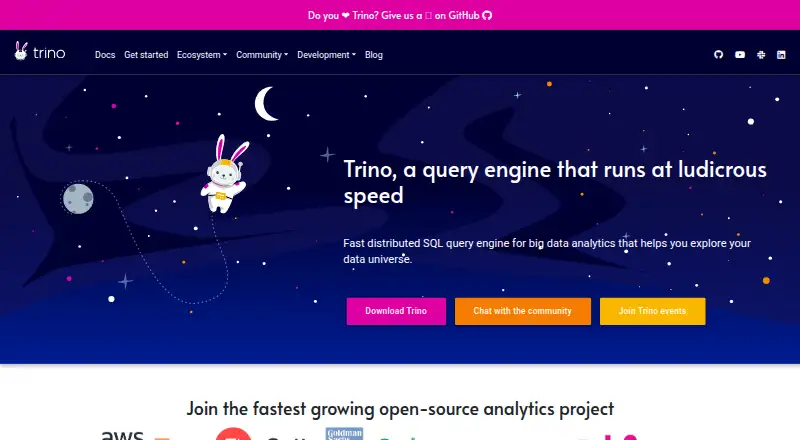
Trino is a distributed SQL query engine for analyzing large datasets across different data systems.
What Trino is
Trino is a distributed SQL query engine for analyzing large datasets across different data systems. It supports ANSI SQL and can query multiple sources together, such as combining data in S3 object storage and MySQL in one query. Its parallel, distributed design targets efficient, low-latency data warehousing and analytics; it is not intended as a general-purpose relational database or an OLTP replacement. Connectors cover systems including BigQuery, Cassandra, ClickHouse, Elasticsearch, MongoDB, MySQL, Oracle, PostgreSQL, Redis, Snowflake and SQL Server. Client options maintained by the project include JDBC, Go, JavaScript, Python and C#, along with a command-line interface and Grafana data-source plugin. Trino can run in Kubernetes, Docker or as a manually deployed server, in cloud and on-premises environments. AI functions support OpenAI and Anthropic directly, and other models through Ollama; the model is supplied as an external service. Trino is free under the Apache License 2.0 as self-managed software. It supports multiple authentication and access-control methods, but security is disabled in a default installation.
Good
- Combines queries across heterogeneous data sources.
- Supports ANSI SQL.
- Runs in Kubernetes, Docker or as a deployed server.
- Offers connectors for databases, warehouses and other systems.
- Free self-managed software under Apache License 2.0.
Watch out
- Not designed as an OLTP replacement.
- Default installation has no security features enabled.
- Self-managed deployment requires the user to operate it.
- AI language models are supplied as external services.
Who it suits
Trino suits data teams querying and combining data across systems for warehousing and analytics. It is not intended for general-purpose relational database or OLTP workloads.
Verdict
Trino is a free option for distributed SQL analytics when data spans multiple systems. Plan for deployment and security configuration, since the default installation enables no security features.
Plans and prices
From Trino's own pricing page, checked 30 Sep 2026.
| Plan | Price | What it gives you |
|---|---|---|
| Trino open source | Free | Apache License 2.0 · self-managed deployment |
The facts
Each one read from Trino's own pages, with the date it was checked.
What it does
- AI functions
- Trino provides AI functions supporting OpenAI and Anthropic directly and other models through Ollama, with the language model supplied as an external service.checked 30 Sep 2026
- Client interfaces
- The Trino project maintains JDBC, Go, JavaScript, Python, and C# client drivers, plus a command-line interface and Grafana data-source plugin.checked 30 Sep 2026
- Cloud and on-premises
- Trino is optimized for on-premises and cloud environments including Amazon, Azure, and Google Cloud.checked 30 Sep 2026
- Deployment
- Trino can run on Kubernetes, in Docker containers, or through a manually deployed server tarball.checked 30 Sep 2026
- Integrations
- Trino provides connectors for data sources including BigQuery, Cassandra, ClickHouse, Elasticsearch, MongoDB, MySQL, Oracle, PostgreSQL, Redis, Snowflake, and SQL Server.checked 30 Sep 2026
- License and governance
- The Trino Software Foundation is an independent nonprofit that governs the project, whose projects use the Apache License 2.0.checked 30 Sep 2026
- Performance
- Trino is highly parallel and distributed and is built for efficient, low-latency analytics.checked 30 Sep 2026
- Query federation
- Trino can query multiple systems within a single query, such as joining S3 object storage data with MySQL data.checked 30 Sep 2026
- Security
- Trino supports TLS 1.2 and TLS 1.3, password-file, LDAP, Salesforce, OAuth 2.0, certificate, JWT, and Kerberos authentication, plus file-based, Open Policy Agent, and Ranger access control.checked 30 Sep 2026
- Security default
- A default Trino installation has no security features enabled.checked 30 Sep 2026
- SQL support
- Trino is an ANSI SQL compliant query engine.checked 30 Sep 2026
- Support
- The project directs users to Slack for help and GitHub issues for bug reports.checked 30 Sep 2026
- What it does
- Trino is a distributed SQL query engine for querying large datasets across heterogeneous data sources.checked 30 Sep 2026
- Workload scope
- Trino is designed for data warehousing and analytics and is not a general-purpose relational database or an OLTP replacement.checked 30 Sep 2026
The full review of Trino
Trino is a distributed SQL engine for analytics across large datasets and multiple data systems. It suits data teams that can manage their own deployment and want to query existing sources together. Its open-source license and broad connectors are compelling; configuring security is essential because a default installation enables none.
Overview
Trino runs SQL queries across heterogeneous sources rather than storing data as a general-purpose relational database. A single query can, for example, join data in S3 with a MySQL database, which can help teams analyze information where it already resides instead of first consolidating it.
It is built for data warehousing and analytics, with parallel distributed execution aimed at efficient, low-latency queries. That focus makes it a poor fit as an OLTP replacement or an all-purpose database. The project is governed by an independent nonprofit, and its projects use the Apache License 2.0.
Key features
Federated SQL and integrations
Trino supports ANSI SQL and provides connectors for systems including BigQuery, Cassandra, ClickHouse, Elasticsearch, MongoDB, MySQL, Oracle, PostgreSQL, Redis, Snowflake, and SQL Server. This breadth makes it useful when analytics spans cloud warehouses, databases, and other stores; teams still need to account for operating the engine and its connections.
Project-maintained client options include JDBC, Go, JavaScript, Python, and C# drivers, a command-line interface, and a Grafana data-source plugin. AI functions support OpenAI and Anthropic directly and other models through Ollama; the language model is supplied as an external service.
Deployment and security
Teams can deploy on Kubernetes, in Docker containers, or with a manually deployed server tarball. Trino is optimized for on-premises and cloud environments, including Amazon, Azure, and Google Cloud, so it can suit organizations with varied infrastructure rather than requiring one hosting model.
Security options include TLS 1.2 and 1.3, several authentication methods—including LDAP, OAuth 2.0, certificates, JWT, and Kerberos—and file-based, Open Policy Agent, or Ranger access control. But none is enabled by default. An installation therefore needs deliberate security configuration before it is suitable for a protected environment.
Pricing
Trino open source: free, under the Apache License 2.0, with self-managed deployment. The free plan includes SQL querying, query result cache, row-level security, and API access. It is the natural fit for teams able to deploy and operate the software themselves; the trade-off is that the plan is self-managed, not a hosted service.
Trino’s pricing model is free, and cloud-hosted and self-hosted options are supported. The free plan does not remove the operational work of deployment or the need to enable and configure security.
Platforms
Trino supports API, Linux, self-hosted, and web environments. Its Kubernetes, Docker, and server-tarball deployment options give infrastructure teams several ways to run it, while the cloud and on-premises focus covers organizations working across different environments.
Who it's for
Trino is best for data engineering and analytics teams that need SQL across multiple existing systems and have the capacity to manage distributed infrastructure. It is less suitable for buyers seeking a turnkey hosted database, teams without security configuration resources, or workloads that need an OLTP system.
Pros and cons
- Pro: Queries can span multiple systems, including joins across object storage and databases, reducing the need to bring every dataset into one place first.
- Pro: Broad connectors, SQL support, and maintained client drivers make it practical to connect diverse sources and applications.
- Pro: The Apache-licensed, self-managed plan costs nothing and can run across cloud or on-premises infrastructure.
- Con: The default installation enables no security features, so administrators must configure protection rather than assume it is active.
- Con: Self-managed deployment favors teams with operational capacity; it is not a general-purpose relational database or OLTP substitute.
Alternatives
Starburst Galaxy is worth considering for readers who want a freemium option with a free tier billed free forever and up to three clusters for ad hoc queries, or a Pro plan starting at $0.5 per contact. PrestoDB is another free, self-hosted open-source SQL query engine for teams comparing that deployment approach. Apache Arrow DataFusion may suit developers looking for a Rust library and CLI distributed as source artifacts rather than a hosted service. Firebolt offers a free-forever self-hosted Core plan with no usage limits, but it cannot be used to build a hosted SaaS competing with Firebolt’s managed service.
Alibaba Cloud MaxCompute is a paid web option with subscription computing resources starting at $22 a month and a 50-CU minimum. Apache Impala is a free Apache-licensed open-source option with source and binary releases. Denodo Platform has a free Developer plan with a single server, four cores, 50 data products, and 2.5 TB/year. Dremio offers a forever-free Standard tier with three projects; customer cloud infrastructure costs may still apply.
Readers comparing products across the category can also browse Query Engine Software, Data Virtualization Software, Data Federation Software, and OLAP Databases.
Verdict
Choose Trino if your analytics team needs distributed SQL across multiple data systems and can own deployment and security. Its strongest case is federated querying on a free, Apache-licensed engine; look elsewhere if you need a turnkey service or an operational database rather than an analytics engine.
Alternatives to Trino
- 1

Stardog
Free planAndroidiOSWebAPI7.7Free plan - 2

Starburst Galaxy
Free planWebAPILinux7.1Free plan - 3
Apache Drill
Free planAPILinuxmacOSSelf-hosted6.7Free plan - 4
Denodo Platform
Free planWebAPILinuxSelf-hosted6.7Free plan - 5
Enterprise Enabler
WebAPILinuxmacOS6.7From $2.17 a month - 6
QoreDB
Free planLinuxmacOSWindows6.7From €99 a year