
Tavern
Tavern is a free tool for developers who want to automate API tests using YAML.
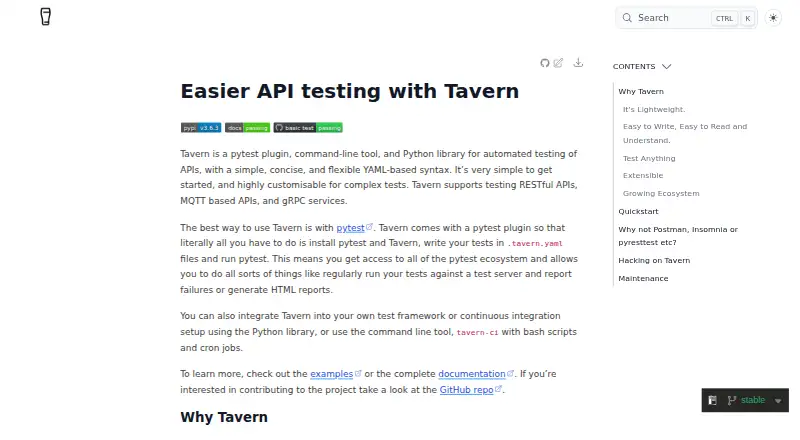
What Tavern is
Tavern is a free tool for developers who want to automate API tests using YAML. It can be used as a pytest plugin, a command-line program, or a Python library; its documentation recommends running it with pytest. A test file names a test and defines stages containing requests and expected responses. Checks can cover status codes, JSON, headers, and redirect query parameters. Tavern supports RESTful APIs, MQTT-based APIs, gRPC services, and GraphQL. Tests can draw values from configuration files, reuse values from earlier responses, and read environment variables for credentials such as passwords or bearer tokens. Default request backends use requests for HTTP, paho-mqtt for MQTT, grpcio for gRPC, and gql for GraphQL. A plugin system can change how requests are made, and documented plugins cover Flask and FastAPI/Starlette test clients. Tavern can run through tavern-ci or integrate with test frameworks and continuous integration setups through its Python library. The project started in 2017 and names @michaelboulton as its current maintainer. It has no GUI, API monitoring, or mock servers.
Good
- Free plan and open-source API test automation.
- Supports REST, MQTT, gRPC, and GraphQL.
- Tests can reuse response values and configuration variables.
- Can integrate into continuous integration setups.
Watch out
- No graphical user interface.
- Does not provide API monitoring or mock servers.
Who it suits
Tavern suits developers who prefer to define API tests in YAML and run them through pytest, a command-line interface, or Python. It also fits workflows that need REST, MQTT, gRPC, or GraphQL testing.
Verdict
Tavern offers YAML-based API testing across several protocols, with options for pytest, command-line, and Python workflows. Choose it if those testing features suit your workflow; it does not include a GUI, monitoring, or mock servers.
Plans and prices
From Tavern's own pricing page, checked 9 Oct 2026.
| Plan | Price | What it gives you |
|---|---|---|
| Tavern | Free | Free and open-source API test automation tool |
The facts
Each one read from Tavern's own pages, with the date it was checked.
What it does
- Assertions
- Response checks can validate status codes, JSON bodies, headers, and redirect query parameters.checked 9 Oct 2026
- Audience
- The project describes Tavern as a focused tool for developers to automate API tests.checked 9 Oct 2026
- Backends
- The documented default backends use requests for HTTP, paho-mqtt for MQTT, grpcio for gRPC, and gql for GraphQL.checked 9 Oct 2026
- CI use
- The project documentation says Tavern can be integrated into test frameworks or continuous integration setups through its Python library or the tavern-ci command-line tool.checked 9 Oct 2026
- Community plugin
- The plugins page lists tavern-grpc-web as a community-maintained backend for unary gRPC-Web calls over HTTP.checked 9 Oct 2026
- Development
- The changelog lists version 3.6.0, dated 2026-05-31, as the latest release shown.checked 9 Oct 2026
- Extensibility
- Tavern has a plugin system for changing how requests are made, and its documentation names plugins for Flask and FastAPI/Starlette test clients.checked 9 Oct 2026
- GraphQL
- The plugin documentation lists GraphQL as a built-in request backend.checked 9 Oct 2026
- How to run
- The documentation recommends using Tavern with pytest; it can also be run through the tavern-ci command-line interface or integrated using its Python library.checked 9 Oct 2026
- Integrations
- The documented default backends use requests for HTTP, paho-mqtt for MQTT, grpcio for gRPC, and gql for GraphQL.checked 9 Oct 2026
- Limitations
- Tavern does not have a GUI, API monitoring, or mock servers, according to its comparison with Postman and Insomnia.checked 9 Oct 2026
- Maintenance
- The documentation names @michaelboulton as the current maintainer.checked 9 Oct 2026
- Notable limits
- Tavern has no GUI and does not provide API monitoring or mock servers.checked 9 Oct 2026
- Project history
- The project says Tavern was started in 2017.checked 9 Oct 2026
- Protocols
- Tavern supports testing RESTful APIs, MQTT-based APIs, and gRPC services.checked 9 Oct 2026
- Purpose
- Tavern is a pytest plugin, command-line tool, and Python library for automated API testing using YAML syntax.checked 9 Oct 2026
- Pytest
- The documentation recommends using Tavern with pytest, which can discover and run Tavern YAML test files.checked 9 Oct 2026
- Response checks
- Response checks can include status codes, JSON, headers, and redirect query parameters.checked 9 Oct 2026
- Reusable data
- Tests can save values from responses and reuse them in later requests, and can load variables from configuration files.checked 9 Oct 2026
- Reusable test data
- Tests can use variables from configuration files or earlier stages, and can read environment variables for values such as passwords or bearer tokens.checked 9 Oct 2026
- Secrets
- The documentation shows environment variables being used for credentials such as passwords or bearer tokens that should not be shipped with test code.checked 9 Oct 2026
- Security-related capability
- The documentation shows using environment variables to keep passwords or bearer tokens out of test code shipped with the tests.checked 9 Oct 2026
- Supported APIs
- Tavern supports testing RESTful APIs, MQTT-based APIs, and gRPC services.checked 9 Oct 2026
The company
- Founded
- 2017checked 28 Sep 2026
Alternatives to Tavern
- 1
HTTPie
Free planOpen sourceWebLinuxmacOSWindows8.3From $10 a month - 2

Karate
Free planOpen sourceAPIExtensionLinuxmacOS8.2From $100 a year - 3

SoapUI
Free planOpen sourceAPILinuxmacOSSelf-hosted8.2From $1,069 a year - 4

Bruno
Free planOpen sourceAPIExtensionLinuxmacOS8.1From $6 a month - 5

Apidog
Free planWebAPIExtensionLinux8.0From $9 a month - 6

PactFlow
Free planWebAPILinuxSelf-hosted7.6From $115.42 a month