
Store norske leksikon
Store norske leksikon (SNL) is a free reference work with expert-written articles based on research.
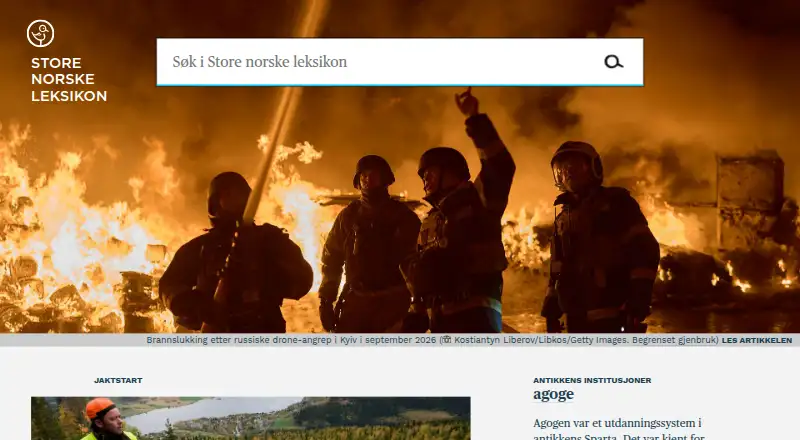
What Store norske leksikon is
Store norske leksikon (SNL) is a free reference work with expert-written articles based on research. Its encyclopedia spans subjects and fields, with articles in both Bokmål and Nynorsk. Subject editors maintain their areas, write material, and provide academic quality control. Registered users may submit article or change proposals, which an editor reviews before publication. Articles are intended to use clear language, structured headings, definitions, fact boxes, and links to related material; many are linguistically adapted for school pupils. SNL says its articles are useful for pupils, students, and teachers. Reading does not require an account, although an account is needed to send proposals or comments and internal messages. The publisher says AI-generated text may not be published in the encyclopedia. SNL offers an open API and metadata marked for free reuse, and its works are updated daily. The encyclopedia is available on the web, through an API, and on iOS. The publisher says some explanatory image captions are not adapted for screen readers, while related articles also present image information in text.
Good
- Free access without registration for reading
- Articles cover topics in Bokmål and Nynorsk
- Editors review reader proposals before publication
- Open API and metadata are marked for free reuse
- Content is updated daily
Watch out
- Some explanatory image captions are not screen-reader adapted
- An account is required to submit proposals or comments
Who it suits
SNL suits readers looking for a free reference across subjects, including pupils, students, and teachers. Its API and reusable metadata may also interest people working with reference content.
Verdict
SNL offers broad, free reference content with editorial review and regular updates. Readers who rely on screen readers should note the stated limitation with some explanatory image captions.
Plans and prices
From Store norske leksikon's own pricing page, checked 3 Oct 2026.
| Plan | Price | What it gives you |
|---|---|---|
| Free access | Free | Free, freely accessible reference work |
The facts
Each one read from Store norske leksikon's own pages, with the date it was checked.
What it does
- Accessibility
- SNL says it aims to meet most WCAG 2.0 AAA requirements and all AA requirements, and to fix WCAG errors as they are found.checked 3 Oct 2026
- Account requirement
- Registration is not required to read articles; an account is needed to submit comments or proposals and send internal messages.checked 3 Oct 2026
- AI content policy
- The publisher says AI-generated text may not be published in the encyclopedia.checked 3 Oct 2026
- API and metadata
- The publisher says its works have an open API and metadata marked for free reuse.checked 3 Oct 2026
- Content guidelines
- Articles are expected to use clear language, structured headings, definitions, fact boxes, and links to related material.checked 3 Oct 2026
- Coverage
- The main encyclopedia covers all topics and fields and has articles in Bokmål and Nynorsk.checked 3 Oct 2026
- Editorial review
- Subject editors are selected experts who maintain assigned areas, write content, and provide academic quality control.checked 3 Oct 2026
- Known accessibility limitation
- The accessibility statement says some explanatory image captions are not adapted for screen readers, while information in images is also provided in text in the relevant articles.checked 3 Oct 2026
- Privacy and analytics
- SNL says it collects de-identified, aggregated visitor statistics and uses Google Analytics on its website.checked 3 Oct 2026
- Publisher
- SNL is operated by the nonprofit, non-commercial association Store norske leksikon, established in 2014.checked 3 Oct 2026
- Reader audience
- SNL says its articles are useful for pupils, students, and teachers, and many articles are adapted linguistically for school pupils.checked 3 Oct 2026
- Reader contributions
- Registered users can submit article and change proposals, which are reviewed by a subject editor or editor before publication.checked 3 Oct 2026
- Support
- SNL directs general questions to [email protected] and says it responds as quickly as it can.checked 3 Oct 2026
- What it is
- Store norske leksikon is a free, freely accessible reference work with content written by subject experts and based on research.checked 3 Oct 2026
The company
- Founded
- 1978checked 28 Sep 2026
- Headquarters
- Oslo, Norwaychecked 28 Sep 2026
The full review of Store norske leksikon
Store norske leksikon (SNL) is a Norwegian reference work covering a wide range of subjects. It is best suited to readers who want material in Bokmål or Nynorsk, particularly pupils, students, and teachers. Its subject-editor model makes it a strong choice for research-informed reading in Norwegian; readers who need other languages should consider alternatives.
Overview
SNL’s main encyclopedia spans all topics and fields, with articles written by subject experts and maintained by editors responsible for particular areas. That editorial structure gives readers academic quality control, rather than leaving changes to appear without review. Registered users can propose new articles or changes, but an editor must review them before publication.
Reading does not require an account. Registration is needed to submit proposals or comments and to send internal messages. The publisher says AI-generated text may not be published in the encyclopedia, a policy that reinforces its emphasis on expert-authored content.
Founded in 1978, SNL is operated by the nonprofit, non-commercial association Store norske leksikon, established in 2014. The work is freely accessible, with no trial needed. Articles combine text and images, include citation tools, and are updated daily.
Key features
Articles are available in Bokmål and Nynorsk. SNL’s guidance calls for clear language, structured headings, definitions, fact boxes, and links to related material. Many articles are linguistically adapted for school pupils, making the encyclopedia useful not only for quick reference but also for readers building subject knowledge.
Subject editors write and maintain content in their fields and provide academic quality control. Reader proposals add a way to suggest corrections or additions, while editorial review helps keep publication decisions with those responsible for the relevant subject area.
SNL offers citation tools and an open API; its publisher says associated metadata is marked for free reuse. These features make the encyclopedia useful beyond casual browsing, including for readers who need citations or want to work with its metadata.
Pricing
| Plan | Price | What it includes |
|---|---|---|
| Free access | free | Free, freely accessible reference work |
There is no paid tier or free-trial period to weigh against the free access: readers can consult articles without registering. The free model makes SNL a practical default for Norwegian-language reference, though it does not solve the need for content in other languages.
Platforms
SNL is available on the web and iOS, and its works are accessible through an API. Android is not among the stated platforms, so readers choosing an encyclopedia specifically for an Android app should compare other options.
SNL says it aims to meet most WCAG 2.0 AAA requirements and all AA requirements, and to address WCAG errors when found. Its accessibility statement identifies a limitation: some explanatory image captions are not adapted for screen readers, although the information in the images is also provided in article text. That textual fallback is helpful, but the caption issue may still matter to screen-reader users.
The publisher says it collects de-identified, aggregated visitor statistics and uses Google Analytics on its website. General questions can be sent to [email protected]; SNL says it responds as quickly as it can.
Who it's for
SNL is a particularly good fit for Norwegian-speaking pupils, students, teachers, and other readers who value expert-written articles with editorial oversight. Its school-oriented language adaptations, structured article guidance, and citation tools suit both study and everyday fact-checking. The free, no-account reading access also works well for occasional lookups.
It is a weaker fit for readers who need a language beyond Bokmål or Nynorsk, or who require an Android app. Screen-reader users should also take the stated caption limitation into account, despite the accompanying text for information shown in images.
Pros and cons
- Pros: Subject experts and responsible editors provide academic quality control, which is valuable for readers who want more than unreviewed contributions.
- Pros: Bokmål and Nynorsk coverage, with many pupil-adapted articles, serves Norwegian-language learning across school and higher education.
- Pros: Daily updates, citation tools, and free API and metadata reuse support both regular reference and more structured use.
- Pros: Reading is free and requires no account, so checking an article has little friction.
- Cons: The stated platform set omits Android, limiting its fit for readers who specifically want an Android app.
- Cons: Some explanatory image captions are not adapted for screen readers, a meaningful accessibility gap even with the text alternative in articles.
- Cons: Its article languages are Bokmål and Nynorsk, so readers needing another language should look elsewhere.
Alternatives
For a broader directory of reference choices, browse Online Encyclopedias. Choose Wikipedia instead if you want a free encyclopedia available on Android as well as iOS, web, and API; it is also described as having no advertising or paywalls. Encyclopedia.com is a free web alternative with over 300,000 reference entries and more than 50,000 topic summaries.
The Canadian Encyclopedia is a free web resource to consider when bilingual English and French content matters more than SNL’s Bokmål and Nynorsk coverage. Treccani is an alternative for readers who want Android or iOS access; its Zero pubblicità plan offers ad-free portal browsing across devices, selectable duration, and up to six months free.
Infoplease is another free web encyclopedia option. World Book Online is worth considering if you prefer a paid service with Android, iOS, and web access: individual access is $250 a year, with discounted multi-user institutional pricing available. For a library-oriented paid option, Britannica Library uses weighted user enrollment and custom quotes.
For readers seeking a focused national encyclopedia, Te Ara – The Encyclopedia of New Zealand is another free web option.
Verdict
Choose SNL if you want free, research-informed reference in Bokmål or Nynorsk, especially for study or teaching: expert authorship, editorial oversight, and daily updates are its strongest reasons to use it. Look elsewhere if you need another language, Android access, or fully adapted explanatory image captions for screen readers.
Alternatives to Store norske leksikon
- 1

Wikipedia
Free planOpen sourceAndroidiOSWebAPI7.7Free plan - 2
Encyclopaedia Britannica
Free planAndroidiOSWebExtension7.4Free plan - 3

Encyclopaedia Universalis
AndroidiOSWeb7.2From €1 a month - 4
Encyclopedia.com
Free planWeb6.6Free plan - 5
Enciclopèdia.cat
Free planWeb6.5Free plan - 6
Encyclopedia of Arkansas
Free planWeb6.4Free plan