Sitewright
Sitewright is a free, open-source, self-hosted website platform for agencies managing client sites.
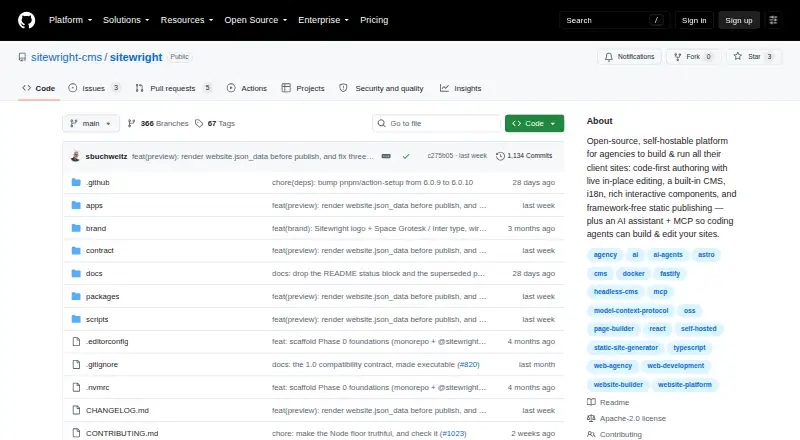
What Sitewright is
Sitewright is a free, open-source, self-hosted website platform for agencies managing client sites. Pages are authored in HTML with Tailwind and DaisyUI, while clients can edit content in place without code access. Its built-in CMS provides typed datasets with 17 field types, detail pages, localized datasets, and interface strings; multilingual pages can inherit from a master page. Publishing creates portable, framework-free static sites deployable through local hosting, FTP or FTPS, SFTP, and Git. Sitewright includes reusable templates, white labeling, multi-site management, client collaboration, and role permissions. An AI assistant supports Anthropic and OpenAI-compatible endpoints, and coding agents can edit projects through a remote OAuth MCP endpoint. Authentication features include MFA/TOTP, passkeys/WebAuthn, OIDC SSO, and project-scoped API keys. Consent controls gate embeds and analytics, while version history, a 90-day media recycle bin, and upgrade snapshots support recovery. Production requires Docker, a domain, and a TLS reverse proxy; registration is invite-only, and multiple replicas are not yet supported.
Good
- Open-source and self-hosted
- CMS includes 17 typed field types
- Portable static-site publishing
- Client editing without code access
- Multiple authentication options
Watch out
- Production requires Docker and TLS proxy
- Registration is invite-only
- Multiple replicas are unsupported
- Local stdio MCP bridge is deprecated
Who it suits
Sitewright is aimed at agencies running multiple client websites that need self-hosting, collaboration, localization, and deployment control. It suits teams comfortable operating Docker-based infrastructure.
Verdict
Sitewright offers agencies a broad self-hosted toolkit for authoring, collaboration, localization, security, and static publishing. Its infrastructure requirements and unsupported multi-replica setup matter for deployment planning.
The facts
Each one read from Sitewright's own pages, with the date it was checked.
What it does
- Account access
- Registration is invite-only, with additional users invited from the editor.checked 8 Oct 2026
- AI and integrations
- Its AI assistant supports Anthropic and OpenAI-compatible endpoints, and external coding agents can edit projects through a remote OAuth MCP endpoint.checked 8 Oct 2026
- Authentication
- The project lists MFA/TOTP, passkeys/WebAuthn, OIDC SSO, and project-scoped API keys as authentication features.checked 8 Oct 2026
- Authoring
- Pages are authored as HTML with Tailwind and DaisyUI, with live in-place editing for clients that does not give them code access.checked 8 Oct 2026
- Backups
- Sitewright creates automatic database snapshots before upgrades and provides project version history and a 90-day media recycle bin.checked 8 Oct 2026
- Backups and recovery
- Sitewright provides project-wide version history, a 90-day media recycle bin, and automatic database snapshots before upgrades.checked 8 Oct 2026
- CMS
- The built-in CMS includes typed datasets with 17 field types and detail pages for individual items.checked 8 Oct 2026
- CMS and languages
- The built-in CMS supports typed datasets with 17 field types, and multilingual pages can inherit from a master page.checked 8 Oct 2026
- Deployment requirement
- The deployment guide says production requires Docker, a domain, and a TLS-terminating reverse proxy.checked 8 Oct 2026
- Hosting requirement
- The project says Sitewright runs as a single container with a persistent volume and recommends putting a TLS reverse proxy in front.checked 8 Oct 2026
- Integrations
- The AI assistant supports Anthropic or OpenAI-compatible endpoints, and coding agents can edit projects through the remote MCP endpoint.checked 8 Oct 2026
- Intended users
- The project describes Sitewright as a platform for agencies managing multiple client websites.checked 8 Oct 2026
- License
- The repository lists the project under the Apache-2.0 license.checked 8 Oct 2026
- Localization
- Multilingual pages inherit from a master page, and localized datasets and UI strings are supported.checked 8 Oct 2026
- Notable limitation
- The repository says the local stdio MCP bridge is deprecated in favor of the remote HTTP endpoint and is no longer developed.checked 8 Oct 2026
- Privacy
- The Consent Manager gates third-party embeds and analytics by consent category and derives a per-site Content-Security-Policy.checked 8 Oct 2026
- Product
- Sitewright describes itself as an open-source, self-hostable website platform for agencies to build and run client sites.checked 8 Oct 2026
- Publishing
- Sitewright publishes portable, framework-free static sites and supports deployment through local hosting, FTP/FTPS, SFTP, and Git.checked 8 Oct 2026
- Scale limit
- The deployment guide says running multiple replicas is not yet a supported configuration.checked 8 Oct 2026
- Security
- The project lists MFA/TOTP, passkeys/WebAuthn, OIDC SSO, and project-scoped API keys among its authentication features.checked 8 Oct 2026