SEO Keyword Clustering Tool
SEO Keyword Clustering Tool is a Python and Streamlit desktop application for analyzing and organizing SEO keywords.
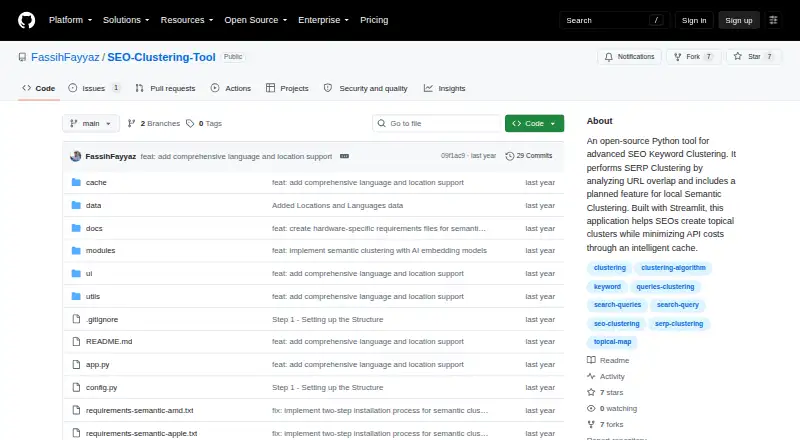
What SEO Keyword Clustering Tool is
SEO Keyword Clustering Tool is a Python and Streamlit desktop application for analyzing and organizing SEO keywords. Its SERP clustering groups keywords when their search-result URLs overlap, with Default, Strict, and Balanced Strict algorithms and Search Volume or CPC strategies. Through DataForSEO, it fetches search results, search volume, CPC, keyword difficulty, and search intent. A local SQLite cache checks for stored API responses before making calls, and users can set its duration. The interactive workbench supports analyzing, filtering, and summarizing clusters, with reports exportable as multi-sheet Excel files. The project describes local embedding-based semantic clustering as unlimited and without API costs, though its roadmap also lists semantic clustering as planned. It runs locally on Windows, macOS, or Linux with Python and Streamlit and is MIT-licensed. The README lists SERP clustering API costs at $0.50+ per keyword and says the keyword limit depends on those costs. The project connects to DataForSEO Sandbox and Live environments.
Good
- Offers three SERP clustering algorithms.
- Fetches keyword metrics through DataForSEO.
- SQLite cache can reduce repeat API calls.
- Exports reports as multi-sheet Excel files.
- Free and MIT-licensed.
Watch out
- SERP clustering API costs start at $0.50+ per keyword.
- Keyword volume depends on API costs.
- Secure multi-user authentication remains a roadmap item.
- Semantic clustering is also listed as planned.
Who it suits
It suits SEO users who want to organize keywords by overlapping search results or explore semantic grouping. SERP clustering fits precise SERP targeting, while semantic clustering is described as suited to large lists.
Verdict
This local tool combines SERP-based grouping, keyword metrics, caching, and report exports. Account for DataForSEO costs, and note the mixed status of semantic clustering in the project description and roadmap.
The facts
Each one read from SEO Keyword Clustering Tool's own pages, with the date it was checked.
What it does
- Analysis and export
- The interactive workbench supports analysis, filtering, and summaries, and exports reports to multi-sheet Excel files.checked 30 Sep 2026
- Caching
- A local SQLite cache stores API responses and is checked before API calls; users can configure the cache duration.checked 30 Sep 2026
- Development status
- The roadmap lists additional languages and locations, a login system, performance improvements, and documentation work as future features.checked 30 Sep 2026
- Installation
- The maker provides local installation instructions for Windows, macOS, and Linux using Python and Streamlit.checked 30 Sep 2026
- Integration
- The tool connects to DataForSEO, with configuration for its Sandbox and Live API environments.checked 30 Sep 2026
- Intended users
- The README says semantic clustering is best for large lists and semantic grouping, while SERP clustering is best for precise SERP targeting.checked 30 Sep 2026
- Keyword metrics
- The tool fetches SERP results, search volume, CPC, keyword difficulty, and search intent through the DataForSEO API.checked 30 Sep 2026
- License and contributions
- The project says it is MIT-licensed and welcomes contributions through GitHub issues and pull requests.checked 30 Sep 2026
- Purpose
- It is a Python desktop tool for SEO keyword analysis and organization using SERP clustering and local semantic clustering.checked 30 Sep 2026
- Security and trust
- The README instructs users to store DataForSEO credentials in a local .streamlit/secrets.toml file and states that the project is licensed under MIT.checked 30 Sep 2026
- Security status
- The roadmap lists adding a secure authentication system for multiple users as a future feature.checked 30 Sep 2026
- Semantic clustering
- The README describes local embedding-based semantic clustering as unlimited and without API costs, while also listing semantic clustering as a planned feature in its roadmap.checked 30 Sep 2026
- SERP clustering
- It groups keywords based on overlapping SERP URLs and offers Default, Strict, and Balanced Strict algorithms with Search Volume or CPC strategies.checked 30 Sep 2026
- SERP data
- The tool fetches SERP results, search volume, CPC, keyword difficulty, and search intent through the DataForSEO API.checked 30 Sep 2026
Money
- API cost limit
- The README lists SERP clustering API costs as $0.50+ per keyword and says the number of keywords is limited by API costs.checked 30 Sep 2026
- Cost limit
- The README says SERP clustering incurs API costs of $0.50+ per keyword and that its keyword limit depends on API costs.checked 30 Sep 2026
The company
- Maker
- The GitHub profile identifies the maker as Fassih Fayyaz and lists Multan, Pakistan.checked 30 Sep 2026
The full review of SEO Keyword Clustering Tool
Overview
SEO Keyword Clustering Tool is a locally run Python and Streamlit application for organizing SEO keyword lists. It is best suited to users who want SERP-based grouping and can manage a DataForSEO account and its usage costs. Its strongest case is combining keyword metrics, adjustable clustering, and exportable reports in a self-hosted workflow.
Key features
SERP clustering and metrics
The core method groups terms according to overlapping URLs in search results. Default, Strict, and Balanced Strict algorithms, plus Search Volume and CPC strategies, give users several ways to shape the grouping; that flexibility is useful when targeting precise SERP opportunities, but the results depend on paid DataForSEO calls. Those calls retrieve SERP results, search volume, CPC, keyword difficulty, and search intent.
Batch uploads suit larger keyword lists, though API expense is the practical ceiling: the project says SERP clustering costs $0.50+ per keyword and that the number of keywords is limited by API costs. DataForSEO's Sandbox and Live environments can be configured, which gives users a way to choose between those API modes.
Cache, analysis, and exports
A local SQLite cache checks for saved API responses before making calls, and users can set its duration. That can reduce repeat requests, but it does not remove the cost of fetching new data. The interactive workbench supports filtering and summarizing clusters, and reports can be exported as CSV or multi-sheet Excel files, making the output practical to carry into other analysis workflows.
Semantic clustering
The project describes local embedding-based semantic clustering as unlimited and free of API costs, and says this mode suits large lists and semantic grouping. However, semantic clustering also appears in the roadmap as a planned feature. That conflicting status makes it difficult to recommend this mode as a dependable reason to choose the tool; SERP clustering is the clearer use case.
Pricing
The tool is free, with no paid product plan described. Free access to the application does not make SERP analysis cost-free: DataForSEO API usage is priced at $0.50+ per keyword, and API costs determine how many keywords users can process. There is no seat or quota structure described for the application itself, so the meaningful budget constraint is the external API usage.
There is no lower application tier that trades away features, but users who need frequent or very large SERP runs should account for the per-keyword API charge before adopting it. The local semantic mode could avoid those API costs if it is usable, though its status is uncertain.
Platforms
The application is described as a Python and Streamlit desktop tool that runs locally on Windows, macOS, or Linux. It is also categorized for web and self-hosted use, but the documented installation path is local setup with Python and Streamlit rather than a hosted service. DataForSEO credentials are stored in a local .streamlit/secrets.toml file. The roadmap includes secure multi-user authentication as future work, so this is better suited to individual or controlled local use than to a team needing built-in account management.
Who it's for
SEO practitioners who need precise SERP-oriented clustering, batch keyword processing, and spreadsheet-ready reporting are the natural audience, provided they are comfortable setting up a local Python application and paying DataForSEO charges. Users primarily seeking semantic grouping for large lists should wait for clearer confirmation of that feature, while teams that require secure multi-user access should look elsewhere for now.
Pros and cons
- Pros: Multiple SERP algorithms and prioritization strategies let users adapt grouping to their targeting approach.
- Pros: The local cache, interactive filtering, and CSV and Excel exports support a repeatable analysis workflow.
- Pros: The application is free and MIT-licensed, and the project welcomes contributions through GitHub issues and pull requests.
- Cons: SERP calls cost $0.50+ per keyword, making large runs potentially expensive despite the free application.
- Cons: Semantic clustering's simultaneous description as a feature and roadmap item leaves its availability uncertain.
- Cons: Secure multi-user authentication remains planned, limiting its fit for teams that need built-in account controls.
Alternatives
Keyword Clustering Tools is the broader category directory for comparing options. Consider Topvisor instead if you want a freemium service with a free XS plan for unlimited projects and keywords, or a paid S plan at $29 a month. Absolute Cluster is another freemium option, with a free plan capped at one project and 1,000 keywords that also includes content briefs, an internal linking map, exports, and one article draft generation.
ContentGecko Keyword Clustering may fit users who want a free web plan for up to 200 keywords using its standard algorithm, with a paid plan at €19.90 a month for 50,000 keyword credits. For a free web tool with a stated monthly allowance, NeedMyLink Keyword Clustering Tool offers 500 keywords per month, or 1,000 total after email confirmation.
SEO Algorithm Keyword Clustering is worth considering if a free, no-signup stem-based option for up to 200 keywords is a better fit; its SERP-based PRO and AI Semantic plans use credits. 100 SEO Tools Keyword Clustering Tool is a free browser-based alternative described as having no signup, limits, or hidden costs. Optiwing is another freemium option, with a Starter subscription at $20 a month for 5,000 credits and one-time credit packages. Pro SERP Cluster is a free web alternative with CSV import and export and a limit of 500 keywords per clustering run.
Verdict
Choose SEO Keyword Clustering Tool if you want flexible, SERP-overlap clustering in a locally run workflow and are prepared to manage Python setup and DataForSEO costs. Its combination of clustering controls, cached responses, analysis tools, and spreadsheet exports makes it a credible fit for SERP-focused work. Look elsewhere if you need predictable high-volume costs, confirmed semantic clustering, or secure multi-user access today.
Alternatives to SEO Keyword Clustering Tool
- 1
SEOcluster.ai
Free planWeb7.4From $29 a month - 2
Seonio Keyword Clustering
Free planWebAPIExtension7.3Free plan - 3

Topvisor
Free planWebAPIExtension6.9From $29 a month - 4
SEO Clusterizer
Free planWebAPI6.7From $29 a month - 5

100 SEO Tools Keyword Clustering Tool
Free planWeb6.6Free plan - 6

Absolute Cluster
Free planWeb6.6From $19 a month