
Revenium
Revenium is a cloud-based service for tracking AI costs, controlling spending and connecting usage to business outcomes.
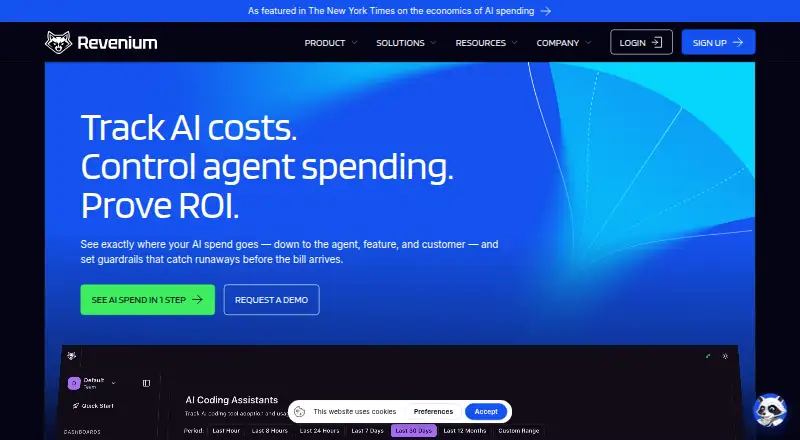
What Revenium is
Revenium is a cloud-based service for tracking AI costs, controlling spending and connecting usage to business outcomes. It attributes model calls, agent turns and tool calls to teams, customers, features and agents, helping engineering, finance, FinOps and product teams understand where costs arise. Configurable spend guardrails, alerts and budget thresholds can block or throttle requests that cross cost limits. Its ROI analysis connects costs to workflow outcomes such as total cost of ownership, cost of goods sold and return on investment, while accounting for tool calls and human rescue time.
Revenium is available through web and API. Named integrations include Arize, Ollama, ClickHouse, LangChain, GitHub, Anthropic, OpenAI, Google Gemini, Databricks, Datadog, Snowflake and Claude. Supported providers named in its pricing FAQ include OpenAI, Anthropic, Azure OpenAI, AWS Bedrock, Google Vertex AI and custom models through its SDK. Revenium says it meters usage metadata and does not access prompts or store responses by default; payload capture requires organization opt-in. Its Observe plan costs nothing and includes 100,000 transactions per month, seven days of data retention and one user. The company is HyperCurrent, Inc. doing business as Revenium.
Good
- Attributes model, agent and tool calls across teams and customers.
- Can block or throttle requests at configured cost thresholds.
- Connects workflow costs with TCO, COGS and ROI.
- Unlimited dashboards, charts, API queries and exports on all plans.
- Meters usage metadata without default prompt access or response storage.
Watch out
- Observe retains data for seven days.
- Observe includes one user and community support without an SLA.
- Growth overages cost $1.50 per 1,000 transactions.
- Revenium does not currently hold ISO 27001.
Who it suits
Revenium suits engineering, finance and FinOps teams that need to track AI usage costs and set spending controls. Product teams managing or pricing AI usage may also use its workflow-level cost and ROI analysis.
Verdict
Choose Revenium if your team needs to attribute AI costs, apply spend controls and relate usage to workflow outcomes. Its free Observe plan provides a starting point, while teams needing more retention, users or service commitments will need to consider another plan. The stated plan details give Growth a 90-day retention period and Enterprise custom or unlimited retention.
Plans and prices
From Revenium's own pricing page, checked 15 Oct 2026.
| Plan | Price | What it gives you |
|---|---|---|
| Observe | Free | 100,000 transactions/month · 7 days retention · 1 user · community support · no SLA · Free |
| Enterprise | Priced on request | 1M+ transactions/month · custom or unlimited retention · unlimited users · dedicated CSM · 99.99% SLA · enterprise controls · Custom pricing |
| Growth | Priced on request | 350,000 transactions/month · 90 days retention · 10 users · $1.50 per 1,000 overage transactions · 99.9% SLA · Month-to-month; cancel anytime |
The facts
Each one read from Revenium's own pages, with the date it was checked.
What it does
- Anomaly alerts
- Anomaly alerts notify users when spending diverges from a baseline.checked 15 Oct 2026
- Availability commitment
- The published SLA commits to 99.99% monthly availability and service credits below 99.95%.checked 15 Oct 2026
- Budget controls
- Soft thresholds notify users, while hard controls can block or throttle requests over configured limits.checked 15 Oct 2026
- Coding assistant coverage
- The service can measure Claude Code, Claude Cowork, Cursor, Copilot, Gemini CLI and Codex usage.checked 15 Oct 2026
- Compliance
- Revenium states that it holds a SOC 2 Type II report, while ISO 27001 is not currently held.checked 15 Oct 2026
- Data captured
- Default telemetry includes tokens, model, provider, latency, duration, session and attribution fields rather than prompts or completions.checked 15 Oct 2026
- Data residency
- US cloud infrastructure is the default processing location and an EU region is available on Enterprise plans.checked 15 Oct 2026
- Enterprise controls
- The trust center lists SAML and OIDC/OAuth SSO, role-based access control, multi-factor authentication, audit logging, and configurable retention as enterprise controls.checked 30 Sep 2026
- Enterprise integrations
- Enterprise plans can push data to Snowflake, Datadog, Splunk and ERP systems.checked 15 Oct 2026
- Funding
- PR Newswire reports that Revenium closed a $13.5 million seed round led by Two Bear Capital with participation from WestWave Capital on November 20, 2025.checked 15 Oct 2026
- Identity controls
- Enterprise controls include SAML or OIDC SSO, MFA, role-based access control, audit logs and customer-managed provisioning.checked 15 Oct 2026
- Independent listing: deployment
- SourceForge describes Revenium as a cloud product with documentation-based training and online support.checked 15 Oct 2026
- Independent listing: integrations
- Slashdot lists no integrations for Revenium.checked 15 Oct 2026
- Independent listing: reviews
- SourceForge states that the product had not been reviewed and invited the first review.checked 15 Oct 2026
- Independent praise: waste detection
- The New Stack reported that Revenium's AI Insights feature ranks waste findings such as circular agent dependencies, outdated models and failed calls by potential monthly savings.checked 15 Oct 2026
- Integrations
- The site names Arize, Ollama, ClickHouse, LangChain, GitHub, Anthropic, OpenAI, Google Gemini, Databricks, Datadog, Snowflake, and Claude among its integrations.checked 30 Sep 2026
- Intended users
- The site presents Revenium for engineering, finance and FinOps, and product teams managing or pricing AI usage.checked 30 Sep 2026
- Legal name
- Crunchbase identifies the legal entity as Revenium, Inc., also known as HyperCurrent.checked 15 Oct 2026
Money
- Billing imports
- Provider billing APIs can be imported with read-only keys without application code changes.checked 15 Oct 2026
- Cost attribution
- The product attributes AI cost to customers, features, workflows and teams.checked 15 Oct 2026
- Cost controls
- It offers spend guardrails, alerts, budget thresholds, and controls that can block or throttle requests exceeding configured cost thresholds.checked 30 Sep 2026
The company
- Company identity
- The legal and support pages identify the company as HyperCurrent, Inc. doing business as Revenium.checked 30 Sep 2026
- Company profile
- LinkedIn lists Revenium as a privately held software-development company founded in 2023 with 11–50 employees and headquarters in Herndon, Virginia.checked 15 Oct 2026
- Headquarters
- Herndon, Virginia, United Stateschecked 28 Sep 2026
The full review of Revenium
Revenium is a cloud service for tracking AI costs and tying usage to business outcomes. It is aimed at engineering, finance and FinOps, and product teams managing or pricing AI use. Its strongest case is cost attribution paired with controls that can affect live usage, rather than a broad API analytics toolkit.
Overview
Revenium breaks down model calls, agent turns, and tool calls by team, customer, feature, and agent. That gives teams a way to investigate who or what is driving AI spend instead of treating it as one aggregate bill. Its ROI analysis connects costs to workflow measures such as TCO, COGS, and ROI, including tool calls and human rescue time. Those measures are most useful when teams need to price AI-powered products or evaluate whether a workflow's economics make sense.
Spend guardrails, alerts, and budget thresholds help teams monitor costs, while configured thresholds can block or throttle requests. That moves Revenium beyond reporting: it can help contain spend, though teams must decide which thresholds should interrupt or slow their service. The product meters usage metadata and does not access prompts or store responses by default; payload capture requires organization opt-in. Customer data is encrypted at rest with AES-256 and in transit with TLS 1.2 or higher. Revenium holds a SOC 2 Type II report available under NDA, but does not currently hold ISO 27001, which rules it out for organizations requiring that certification.
Key features
Cost attribution and workflow economics
Attributing usage to teams, customers, features, and agents can help engineering and finance teams locate costly parts of an AI product and give product teams a basis for pricing or prioritization. Including tool calls and human rescue time makes the workflow view more complete than model-call costs alone. The value depends on whether those attribution categories match how an organization manages its products and budgets.
Spend controls and integrations
Alerts and budget thresholds provide visibility, while blocking or throttling requests can enforce a cost boundary. That is useful for teams that need budgets to shape usage, but can be too restrictive if an interruption would harm a workflow. Named integrations include Arize, Ollama, ClickHouse, LangChain, GitHub, Anthropic, OpenAI, Google Gemini, Databricks, Datadog, Snowflake, and Claude. Provider support includes OpenAI, Anthropic, Azure OpenAI, AWS Bedrock, Google Vertex AI, and custom models through its SDK, giving teams several common routes for tracking use.
Security and administration
Metadata-only metering by default limits exposure to prompts and responses, while opt-in payload capture gives organizations a choice when they need it. Enterprise controls include SAML and OIDC/OAuth SSO, role-based access control, multi-factor authentication, audit logging, and configurable retention. These controls make Enterprise the relevant tier for organizations that need centralized access management; teams requiring ISO 27001 should choose a different service.
Pricing
Revenium uses a freemium model, and its pricing page also offers a 30-day trial. The free Observe plan costs nothing and allows 100,000 transactions/month, 7 days of data retention, one user, and community support with no SLA. It is a reasonable starting point for an individual or small team evaluating metering, but the short history window, single seat, and absence of a service commitment make it a limited operating tier.
Growth has custom pricing and is billed month-to-month, with cancellation at any time. It includes 350,000 transactions/month, 90 days of retention, 10 users, standard support, and a 99.9% SLA. Overages cost $1.50 per 1,000 transactions. This tier suits teams that need a longer history, shared access, and a defined support commitment without moving to enterprise administration. Enterprise also has custom pricing; it covers 1M+ transactions/month, custom or unlimited retention, unlimited users, a dedicated customer success manager, a 99.99% SLA, and enterprise controls. It is the fit for larger deployments needing higher volume and administration, though its price must be assessed against a custom quote.
A transaction is one write to the metering API. Dashboards, charts, API queries, and data exports are unlimited and free on every plan, so the metering-write quota—not routine analysis or export activity—is the usage limit to watch. Growth and Enterprise provide more capacity and retention than Observe, while Observe gives up both quickly for teams with sustained or multi-user use.
Platforms
Revenium is a cloud service with API and web access. It also provides consumer analytics, latency analytics, and business activity metrics, making it relevant to teams that need to examine usage alongside operational and business signals.
Who it's for
Revenium is best suited to organizations that need to allocate AI costs across teams or customers, set spend limits, or connect workflow costs with product economics. Engineering teams can use attribution and thresholds to understand and contain usage; finance and FinOps teams can use the cost breakdowns for allocation; product teams can relate usage to pricing and outcomes. It is less suitable for buyers seeking general API analytics alone, or for organizations whose compliance requirements include ISO 27001.
Pros and cons
- Useful cost allocation: attribution covers model calls, agent turns, and tool calls across teams, customers, features, and agents.
- Controls can enforce budgets: configured thresholds can block or throttle requests rather than only flag overspending.
- Workflow-level economics: ROI analysis includes tool calls and human rescue time, useful when judging the cost of an end-to-end process.
- Metadata-focused default: prompts and responses are not accessed or stored by default, with payload capture requiring opt-in.
- Free tier is constrained: Observe has one user and only 7 days of retention, so it is a trial ground more than a durable shared workspace.
- ISO 27001 is absent: organizations that mandate the certification will need another option.
Alternatives
For broader API analytics, compare API Analytics Software; for tools focused on charging for API usage, see API Monetization Software. Among named products, Apirelio is worth considering if its Growth plan's 2M events/month, five projects, 30-day retention, and five members better match a team's event-analytics needs; its $19 a month Growth plan follows 14 days free. BetterMeter is another freemium API and web option, with a free plan that retains events for 30 days. For analysis of sample datasets and uploaded files rather than AI cost controls, Clavio has a free plan with core analysis and charting, limited saved analyses, and no credit card requirement.
Helicone is an alternative for teams seeking an open-source option with API, self-hosted, and web platforms. KeepRouter may suit teams testing or prototyping on a pay-as-you-go model billed at $0 per input and output token. Langfuse offers API, self-hosted, and web access, with a free Hobby plan that includes 50k units/month, 30 days of data access, two users, and community support via GitHub. Moesif is another freemium option with API, self-hosted, and web platforms. AI Nazar is a free alternative whose SDK and dashboard are open source under the MIT license.
Verdict
Choose Revenium when your team needs to attribute AI costs, make budgets enforceable, and relate spend to workflow outcomes. Its combination of attribution, throttling or blocking, and ROI analysis is more compelling for AI economics than for general API monitoring. The free Observe plan can start an evaluation, but its one-user cap and 7-day retention are narrow; teams should weigh Growth or Enterprise against their volume and access needs. Look elsewhere if ISO 27001 is mandatory or if your main requirement is broad API analytics rather than AI cost management.
Getting started
- Visit the Revenium website.
- Use the web platform or connect through its API.
- Start with the free Observe plan, which includes 100,000 transactions per month and one user.
- Choose Growth or Enterprise if their listed retention, transaction, user or support provisions fit your needs.
- Connect relevant named integrations or providers.
Limits worth knowing
Observe includes 100,000 transactions per month, seven days of data retention, one user and community support with no SLA. Growth includes 350,000 transactions per month and 90 days of retention; extra transactions are $1.50 per 1,000. Enterprise starts at 1M+ transactions per month with custom or unlimited retention.
Questions
Is Revenium free?
Yes. Observe costs nothing and includes 100,000 transactions per month.
What does a transaction mean?
A transaction is one write to the metering API. Dashboards, charts, API queries and data exports are unlimited and free on all plans.
Which providers does Revenium support?
The pricing FAQ names OpenAI, Anthropic, Azure OpenAI, AWS Bedrock, Google Vertex AI and custom models through its SDK.
What platforms can I use?
Revenium is available on web and through an API.
Does Revenium access prompts or store responses?
It says it meters usage metadata and does not access prompts or store responses by default. Payload capture requires organization opt-in.
What security and compliance provisions does it state?
Customer data is encrypted at rest with AES-256 and in transit with TLS 1.2 or higher. Revenium states it holds a SOC 2 Type II report available under NDA and does not currently hold ISO 27001.
Alternatives to Revenium
- 1
Flexprice
Free planOpen sourceWebAPILinuxSelf-hosted8.0Free plan - 2

Boomi
WebAPILinuxSelf-hosted7.6$99 usage-based - 3

Zuplo
Free planWebAPILinuxSelf-hosted7.6From $25 a month - 4

Lago
Free planOpen sourceWebAPISelf-hosted7.5Free plan - 5

Younium
AndroidiOSWebAPI7.4From 500 SEK a month - 6

DigitalAPI
WebAPISelf-hosted7.1From $2,500 a month