REGnosys
REGnosys provides Rosetta, a collaborative low-code platform for regulatory reporting.
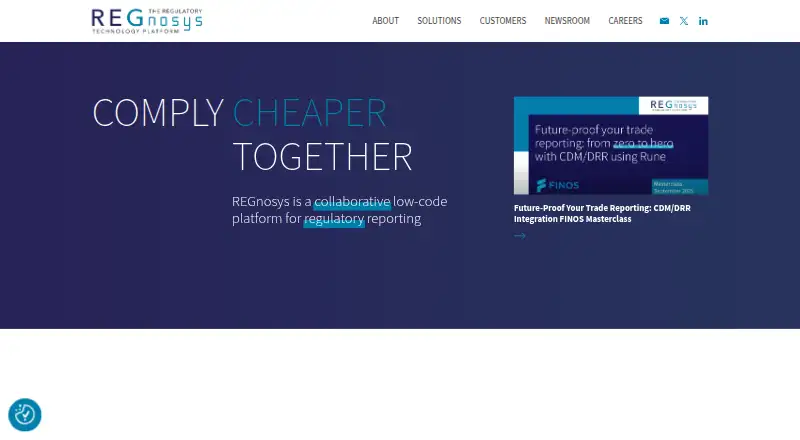
What REGnosys is
REGnosys provides Rosetta, a collaborative low-code platform for regulatory reporting. Its tools cover the lifecycle of data pipelines: teams can develop them from design through deployment and monitoring. Rosetta’s domain-specific language, the Rosetta DSL, turns models into executable code that can also be packaged as an API. Integration tools include a universal API and mapping support for existing systems, databases and messaging formats. Rosetta Monitor traces and audits data movement through physical pipelines.
The platform is aimed at financial institutions, regulators, trade associations and market infrastructure providers. It can be deployed on-cloud or on-premises and is described as platform agnostic. REGnosys says data is encrypted in transit and at rest using TLS; it also offers client key management, peered VPN setup, dedicated servers and hardware for data separation, and live-live systems for continuity. The Rosetta DSL is open source and was released in 2019 with the ISDA Common Domain Model. REGnosys was founded in 2016 and is headquartered in London, England. Its Community plan is free indefinitely, but limited to non-commercial public projects.
Good
- Models can generate executable code and be packaged as an API.
- Pipeline work spans design, deployment and monitoring.
- Mapping tools support existing systems, databases and messaging formats.
- Rosetta Monitor traces and audits physical data flow.
- The Rosetta DSL is open source.
- Deployment can be on-cloud or on-premises.
Watch out
- The free Community plan is for non-commercial use only.
- Community projects must be public.
- Essentials uses shared hardware and allows 1,000 API requests per user/month.
- Private projects start with Pro.
Who it suits
REGnosys suits financial institutions and other organizations working on regulatory reporting and data pipelines. Teams that need private projects, commercial use or larger workspace and API allowances can consider its paid plans.
Verdict
Choose REGnosys if your organization needs a low-code regulatory reporting platform with pipeline modelling, integration and auditing tools. The free Community plan is limited to non-commercial public projects, so teams needing private projects must look to Pro or Enterprise.
Plans and prices
From REGnosys's own pricing page, checked 7 Oct 2026.
| Plan | Price | What it gives you |
|---|---|---|
| Community | Free | For non-commercial use · Public project only · 3 workspaces per user · 500 API requests per user/month |
| Essentials | £417 a month | Regular commercial contributor · Public project only · 5 workspaces per user · 1,000 API requests per user/month · Shared hardware · billed annually (£500 billed monthly) |
| Pro | £1,334 a month | Private commercial use · Public and private projects · 10 workspaces per user · 1 guest user per user · 1,000 API requests per user/month, then £0.01 per API request · Private hardware · billed annually (£1,600 billed monthly) |
| Enterprise | £2,000 a month | Commercial use · Public and private projects · 50 workspaces per user · 5 guest users per user · Project administration · 10,000 API requests per user/month, then £0.01 per API request · Private hardware · billed annually (£2,400 billed monthly) |
The facts
Each one read from REGnosys's own pages, with the date it was checked.
What it does
- Auditability
- Rosetta Monitor audits and traces physical data flow through pipelines.checked 7 Oct 2026
- Data pipeline modelling
- Rosetta manages data pipeline development from design through deployment and monitoring.checked 7 Oct 2026
- Executable models
- The Rosetta DSL generates executable code from models and can package it as an API.checked 7 Oct 2026
- Hosting
- Rosetta says it can be deployed on-cloud or on-premises and is platform agnostic.checked 7 Oct 2026
- Integration
- Rosetta provides a universal integration API and tools to map existing systems, databases and messaging formats.checked 7 Oct 2026
- Open source
- The Rosetta DSL is open source, and REGnosys says it was released in 2019 with the ISDA Common Domain Model.checked 7 Oct 2026
- Product
- REGnosys describes its collaborative low-code platform as a tool for regulatory reporting.checked 7 Oct 2026
- Security
- Rosetta says data is encrypted in transit and at rest using TLS and offers client key management and peered VPN setup.checked 7 Oct 2026
- Security controls
- Rosetta says data can be separated using dedicated servers and hardware and that systems run live-live for continuity.checked 7 Oct 2026
- Support
- REGnosys directs product support inquiries to the Rosetta support page.checked 7 Oct 2026
- Supported users
- REGnosys lists financial institutions, regulators, trade associations and market infrastructure providers as customer groups.checked 7 Oct 2026
The company
- Company location
- REGnosys Limited lists its address as 85 Great Portland Street, London W1W 7LT.checked 7 Oct 2026
- Founded
- 2016checked 28 Sep 2026
- Headquarters
- London, England, United Kingdomchecked 28 Sep 2026
Money
- Free access
- Rosetta's free version has no time limit and requires no credit card; the pricing page describes the Community plan as for non-commercial use.checked 7 Oct 2026
- Plan limits
- The Community plan is limited to public projects, while private projects are included in Pro and Enterprise.checked 7 Oct 2026
The full review of REGnosys
REGnosys is a low-code platform for building regulatory-reporting pipelines with Rosetta. It is aimed at teams in financial institutions and related market organizations that need to model, integrate and trace data flows. Its connected pipeline tools are the draw; the Community plan’s non-commercial, public-project restriction rules it out for private production work.
Overview
Rosetta manages pipeline development from design through deployment and monitoring. Its domain-specific language generates executable code from models and can package that code as an API, while integration tools map existing systems, databases and messaging formats. Rosetta Monitor traces physical data flow through pipelines, giving teams an auditability feature tied to the pipeline itself.
The Rosetta DSL is open source and was released with the ISDA Common Domain Model in 2019. Rosetta can run on-cloud or on-premises and is platform agnostic, a useful fit for organizations with varied infrastructure requirements. REGnosys says it encrypts data in transit and at rest using TLS, supports client key management and peered VPN setup, and can separate data with dedicated servers and hardware. Live-live systems support continuity. The plans’ shared-versus-private hardware distinction is worth checking against an organization’s isolation needs.
Key features
- Pipeline modelling: Rosetta spans design, deployment and monitoring. That end-to-end scope can reduce handoffs between modelling and operations for teams building regulatory data workflows.
- Executable models and API packaging: The DSL turns models into executable code and can package it as an API, making it relevant to teams that want models to connect directly with software interfaces.
- Integration tools: A universal integration API and mapping tools cover existing systems, databases and messaging formats. This is a practical strength for organizations connecting established infrastructure rather than starting from scratch.
- Traceability: Rosetta Monitor audits and traces physical data flow through pipelines, supporting teams that need an auditable view of how data moves.
- Open-source DSL: The Rosetta DSL is open source, but the Community plan’s public-project and non-commercial terms still constrain how organizations can use REGnosys at no charge.
Pricing
REGnosys uses a freemium model. Community is free with no time limit or credit card requirement, but it is for non-commercial use and public projects only. It allows 3 workspaces per user and 500 API requests per user/month, making it suitable for public, non-commercial work rather than private commercial pipelines.
Essentials costs £417 a month when billed annually (£500 billed monthly). It permits regular commercial contribution, but remains limited to public projects; users get 5 workspaces per user, 1,000 API requests per user/month and shared hardware. It suits commercial contributors who can keep projects public and accept shared infrastructure, but it does not solve the private-project requirement.
Pro costs £1,334 a month when billed annually (£1,600 billed monthly). It adds private commercial use and public and private projects, 10 workspaces per user, 1 guest user per user, 1,000 API requests per user/month followed by £0.01 per API request, and private hardware. This is the first suitable tier for a team whose commercial work must remain private.
Enterprise costs £2,000 a month when billed annually (£2,400 billed monthly). It includes public and private commercial projects, 50 workspaces per user, 5 guest users per user, project administration, 10,000 API requests per user/month followed by £0.01 per request, and private hardware. Its higher quota and administration features make it the more fitting tier for larger or more collaborative deployments. There is no free trial.
Platforms
REGnosys is available through web and API access, as well as self-hosted deployment. Its hybrid deployment model and on-cloud or on-premises options give organizations flexibility in where the platform runs.
Who it's for
REGnosys names financial institutions, regulators, trade associations and market infrastructure providers among its customer groups. It is best suited to organizations building regulatory data pipelines that benefit from model-driven development, integration across existing systems and data-flow auditing. Teams needing private commercial projects should budget for Pro or Enterprise; those with public-only commercial work may find Essentials sufficient. It is a poor fit for teams seeking a free private commercial plan.
Pros and cons
- Pro: Modelling, executable code, integration and monitoring sit in one pipeline workflow, supporting teams that need to carry regulatory data work from design into operation.
- Pro: Cloud, on-premises and self-hosted options, alongside stated data-separation and encryption controls, give organizations several deployment and security choices.
- Pro: The open-source Rosetta DSL provides a public-project route for non-commercial users without a time limit or card requirement.
- Con: Community is restricted to non-commercial public projects, so private work immediately requires a paid plan.
- Con: Essentials still permits public projects only and uses shared hardware, limiting its fit for organizations that require private projects or private infrastructure.
- Con: Pro and Enterprise have substantial monthly costs, and API overages are charged per request after their respective quotas.
Alternatives
For a broader category comparison, see Regulatory Reporting Software.
- Arelle is a free, open-source XBRL platform with desktop builds, a Python package, Docker image and community plugins. Choose it if a free XBRL toolset is a better fit than REGnosys’s commercial pipeline plans.
- Elite Reporting Platform is a paid option spanning web, mobile, desktop, API and self-hosted platforms; consider it when that broader platform coverage is the priority.
- FIS Data Integrity Manager is a paid, web-based alternative for readers considering another commercial reporting product.
- Altova Regulatory Solutions has a free plan and free trial, with its CbC Reporting App subscription starting at $999 a year, billed per user per year. Choose it if that per-user subscription and its Windows, web, API or self-hosted availability better match the requirement.
- Reg360 is a paid web-based alternative with pricing available upon request.
- REGREP offers a free plan and paid options including TIN validation at €0.01, paid once in 100-record blocks and FATCA at €500 a year for one entity. Consider it when those validation or FATCA offerings fit the task.
- Amelkis XBRL is a paid web option with custom-quote pricing and a free demo.
- CoreFiling Seahorse is a paid web-based alternative.
Verdict
Choose REGnosys when regulatory data work calls for a model-driven pipeline that combines integration, executable models and data-flow auditing. Its flexible deployment options strengthen the case for organizations with specific infrastructure needs. Look elsewhere if the budget cannot stretch to Pro or Enterprise but private commercial projects are essential, or if a narrower free XBRL tool is enough.
Getting started
- Visit the REGnosys website.
- Choose the Community plan for non-commercial public projects, or select a paid plan for commercial use.
- Use the web platform, API or self-hosted deployment route.
- For product support, use the Rosetta support page.
Limits worth knowing
Community is limited to public projects, three workspaces per user and 500 API requests per user/month. It is for non-commercial use; private projects are available in Pro and Enterprise.
Questions
Is REGnosys free?
Yes. The Community plan is free with no time limit and requires no credit card. It is for non-commercial use and public projects only.
What do the paid plans cost?
Essentials is £417 a month billed annually (£500 billed monthly). Pro is £1,334 a month billed annually (£1,600 billed monthly), and Enterprise is £2,000 a month billed annually (£2,400 billed monthly).
Can Rosetta handle private projects?
Private projects are included in Pro and Enterprise. Community and Essentials are limited to public projects.
Is the Rosetta DSL open source?
Yes. REGnosys says the Rosetta DSL is open source and was released in 2019 with the ISDA Common Domain Model.
Where can Rosetta be deployed?
Rosetta can be deployed on-cloud or on-premises and is described as platform agnostic.
Which platforms does REGnosys support?
REGnosys lists web, API and self-hosted platforms.
Alternatives to REGnosys
- 1

Altova Regulatory Solutions
AndroidiOSWebAPI7.6From $679 a year - 2

Arelle
Free planOpen sourceWebAPILinuxmacOS7.5Free plan - 3

REGREP
AndroidiOSWebAPI7.5From €500 a year - 4

Semansys Compliance Platform
iOSWebAPISelf-hosted6.6 - 5
Elite Reporting Platform
AndroidiOSWebAPI6.4 - 6

Diligence XBRL Suite
WebmacOSSelf-hostedWindows6.2From €10,000 a year