Recall
Recall is a web application for memorizing information through spaced repetition and active recall.
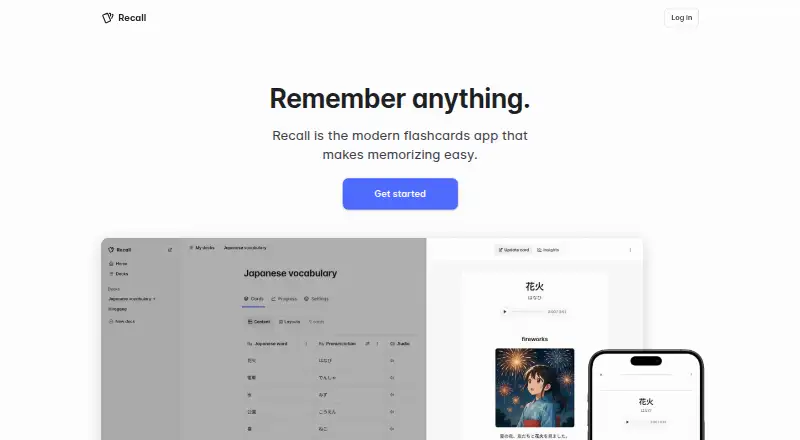
What Recall is
Recall is a web application for memorizing information through spaced repetition and active recall. Its review algorithm predicts when each card should be reviewed, and adaptive review adjusts the schedule. Cards use a basic format, with text as the listed source format, and study takes place through flashcards. AI Autofill can generate card answers, translations, custom text, speech audio, and images. Recall also offers an MCP server for AI assistants to manage decks and cards using natural language, plus a REST API for managing decks, fields, cards, and layouts with JSON requests and responses. Cards and learning progress sync across a user's devices, and users can export cards for use elsewhere. The free plan is free and is limited to 3 decks · 300 cards. Pro plans list unlimited decks and cards with import, media, and analytics tools, but no prices. Recall collects account email, card and deck content, review history, and performance statistics; connected AI assistants may access card data.
Good
- Adaptive review schedules card repetition.
- AI Autofill creates text, audio, and image content.
- Cards sync across a user's devices.
- Users can export cards for use elsewhere.
Watch out
- Free plan is limited to 3 decks and 300 cards.
- Connected AI assistants may read and write card data.
Who it suits
Recall suits learners who want a flashcard-based spaced-repetition tool with synchronized progress and card export. Its API and MCP server may also suit people managing decks programmatically or through AI assistants.
Verdict
Recall combines spaced-repetition flashcards with card generation, export, and device sync. Check the free plan's card and deck limits, and consider the data access involved before connecting an AI assistant.
Plans and prices
From Recall's own pricing page, checked 20 Sep 2026.
| Plan | Price | What it gives you |
|---|---|---|
| Pro Monthly | — | Unlimited decks and cards · Full import, media, and analytics toolkit |
| Pro Annual | — | Unlimited decks and cards · Full import, media, and analytics toolkit |
| Lifetime Pro | — | Unlimited decks and cards · Full import, media, and analytics toolkit |
| Free | Free | 200 text/audio generations per month · 3 free image generation credits |
The facts
Each one read from Recall's own pages, with the date it was checked.
What it does
- Account deletion
- Users can delete their account and associated data in account settings; the policy says associated data is deleted when the account is deleted.checked 2 Oct 2026
- Adaptive review
- Yeschecked 20 Sep 2026
- AI card generation
- AI Autofill can generate answers, translations, custom text, speech audio, and images for cards.checked 2 Oct 2026
- AI connector privacy
- When connected through MCP, an AI assistant can read and write deck and card data, which may be sent to and processed by that assistant's provider.checked 2 Oct 2026
- AI models
- The documentation says text generation uses OpenAI gpt-5-mini and image generation uses OpenAI gpt-image-2.5-sunburst.checked 2 Oct 2026
- API
- The REST API can manage decks, fields, cards, and layouts using JSON requests and responses.checked 2 Oct 2026
- Card formats
- basicchecked 20 Sep 2026
- Cookies
- Recall says it uses cookies for sessions and preferences, not for tracking or advertising.checked 2 Oct 2026
- Export
- Recall says users can export their cards and use them elsewhere.checked 2 Oct 2026
- Export options
- Yeschecked 20 Sep 2026
- Integrations
- Recall provides an MCP server that lets AI assistants manage decks and cards using natural language.checked 2 Oct 2026
- Privacy collected data
- Recall collects account email, card and deck content, review history, and performance statistics to operate the app.checked 2 Oct 2026
- Purpose
- Recall is a web application for memorizing information using spaced repetition and active recall.checked 2 Oct 2026
- Review scheduling
- Recall uses a spaced-repetition algorithm to predict when each card should be reviewed.checked 2 Oct 2026
- Source formats
- textchecked 20 Sep 2026
- Study modes
- flashcardschecked 20 Sep 2026
- Support
- The site lists [email protected] for support or policy questions.checked 2 Oct 2026
- Sync
- Recall says cards are synced across a user's devices and learning progress follows them.checked 2 Oct 2026
Money
- Free plan
- Yeschecked 20 Sep 2026
Where it runs
- Mobile apps
- Yeschecked 20 Sep 2026
- Platforms
- Recall describes itself as a web application, and its official site displays desktop and mobile app imagery; this does not specify operating systems.checked 2 Oct 2026
The full review of Recall
Overview
Recall is a web app for learning with spaced-repetition flashcards and active recall. It suits learners who want cards synced across devices and the option to generate card content or connect an AI assistant. The free plan is capped at three decks and 300 cards, so check those limits before committing a larger collection.
Key features
Recall schedules reviews with an algorithm that predicts when each card is due, and supports adaptive review. That gives regular learners a structured way to revisit material, rather than leaving review timing entirely to memory. Study is organized around flashcards, with basic card formats and text as a source format.
AI Autofill can generate answers, translations, custom text, speech audio, and images for cards. The documented text and image models are OpenAI gpt-5-mini and OpenAI gpt-image-2.5-sunburst, respectively. This breadth can speed up building cards, but it also makes the privacy implications worth considering: Recall collects card and deck content, review history, and performance statistics, and an AI assistant connected through MCP can read and write that content. Data may be sent to and processed by the assistant provider.
The MCP server lets AI assistants manage decks and cards using natural language. Separately, the REST API supports managing decks, fields, cards, and layouts through JSON requests and responses. Those interfaces make Recall more adaptable for technical workflows, though they are unlikely to matter to someone who only wants to study on their own.
Cards and learning progress sync across a user's devices, and cards can be exported for use elsewhere. Recall collects account email as well as learning data to operate the app. Cookies are used for sessions and preferences, not tracking or advertising; users can delete their account and associated data in account settings.
Pricing
Recall is freemium. The Free plan costs nothing and allows three decks and 300 cards. That is a useful starting point for a modest collection, but active learners may outgrow the cap.
Pro Monthly, Pro Annual, and Lifetime Pro each include unlimited decks and cards plus the full import, media, and analytics toolkit. Each has custom pricing. The added capacity and toolkit suit users who need more than the free cap, but compare the terms before choosing a duration: no price or renewal terms are stated for these plans.
Platforms
Recall is available on web, Android, iOS, and macOS, and provides an API. Mobile apps and sync make it practical to continue studying across devices; Linux and Windows are not among its listed platforms.
Who it's for
Recall is a strong fit for learners who want scheduled flashcard reviews, cross-device progress, and help generating varied card content. It is less compelling for someone who needs a large free library, a non-flashcard study approach, or wants to avoid giving an AI assistant access to learning content.
Pros and cons
- Pro: Review scheduling and adaptive review help make repetition systematic.
- Pro: AI Autofill can create several kinds of card content, including translations, speech audio, and images.
- Pro: Sync and export support studying across devices and taking cards elsewhere.
- Con: The free plan stops at three decks and 300 cards, limiting its usefulness for a large collection.
- Con: MCP access allows a connected assistant to read and write deck and card data, with possible processing by its provider.
- Con: Pro plans have custom pricing, making their cost harder to weigh against the free cap.
Alternatives
Mochi is worth considering if you want unlimited cards and decks on a free plan that is billed forever and requires no sign-up; it supports Android, iOS, Linux, macOS, and Windows.
StudyGlen is another freemium option, with a free trial and Android, iOS, and web support.
diStudero is a paid option with a free plan and trial, and is available on Android, iOS, web, and as an extension.
Brainscape is an alternative with Android, iOS, web, and API support; its Pro plan is $7.99 a year and includes unlimited AI flashcard creation.
Jambo offers a free plan with up to 2,000 cards, 15 decks, and daily AI-generation and translation quotas, for learners who want higher stated card and deck caps.
Nibomo is a free hosted service during beta, with sync across web, iOS, and Android.
Cogni is a freemium alternative with a free plan that includes spaced repetition, notes, sync, and Anki import, alongside a daily review limit.
RemNote is available on Android and iOS; its free plan includes annotated PDFs, image occlusion cards, handwritten documents, file quotas, and monthly AI credits.
Browse AI Flashcard Generators or Flashcard apps for more options.
Verdict
Choose Recall if you want scheduled flashcard study with device sync, export, and flexible AI-assisted card creation. Its strongest case is combining those learning tools with both an API and an AI-assistant connector. Look elsewhere if 300 free cards will not be enough, or if you are not comfortable with an assistant potentially accessing your deck content.
Getting started
- Open recall.cards in a web browser or use Recall on Android, iOS, or macOS.
- Create an account to keep cards and learning progress synced across devices.
- Create decks and basic flashcards using text as the listed source format.
- Use AI Autofill to generate card answers, translations, custom text, speech audio, or images.
- Use the REST API or connect an AI assistant through MCP if you want to manage decks and cards programmatically or through natural language.
Limits worth knowing
The Free plan costs nothing and is limited to 3 decks and 300 cards.
Questions
Is Recall free?
Yes. The Free plan costs nothing and includes 3 decks and 300 cards.
Which platforms does Recall support?
Recall is available on Android, iOS, macOS, and the web. It also provides an API.
Can I export cards or use an API?
Yes. Users can export cards, and the REST API manages decks, fields, cards, and layouts through JSON requests and responses.
What happens when I connect an AI assistant through MCP?
The assistant can read and write deck and card data. That data may be sent to and processed by the assistant's provider.
Alternatives to Recall
- 1

Brainscape
Free planAndroidiOSWebAPI8.2From $7.99 a month - 2

StudyGlen
Free planAndroidiOSWeb8.1$4.99 one-time - 3
Mochi
Free planAndroidiOSLinuxmacOS8.0From $5 a month - 4

Lernoa
Free planAndroidiOSWeb7.7$2 one-time - 5

RemNote
Free planAndroidiOS7.7From $8 a month - 6

diStudero
Free planAndroidiOSWebExtension7.6From €74.99 a year