
PureLB
PureLB provides Kubernetes LoadBalancer services with external IP addresses on bare-metal Linux clusters.
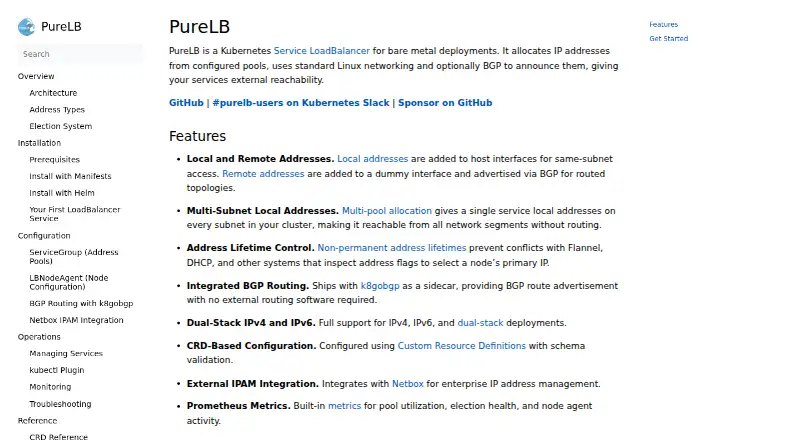
What PureLB is
PureLB provides Kubernetes LoadBalancer services with external IP addresses on bare-metal Linux clusters. It allocates addresses from configured pools and announces them through Linux networking, with optional BGP for remote addresses. Each ServiceGroup uses one pool type: local, remote, or Netbox. For local addresses, a Kubernetes Lease election selects a node to announce each address, and another node can take over if the selected node fails. Remote addresses are placed on a dummy interface on every node and advertised through BGP; an upstream router can distribute traffic across nodes using ECMP. ServiceGroups can combine IPv4 and IPv6 pools for dual-stack operation. Kubernetes Custom Resource Definitions configure pools and node agents. Installation is available through kubectl manifests or Helm, which the project recommends for production. The Allocator and LBNodeAgent expose Prometheus metrics on port 7472 at /metrics. PureLB is free and open source under Apache License 2.0. It requires a Kubernetes cluster with an operational CNI and Linux nodes; Netbox integration is documented but currently unsupported and may not work with recent versions.
Good
- Free and open source under Apache License 2.0
- Supports IPv4, IPv6, and dual-stack deployments
- Local address takeover if the announcing node fails
- Prometheus metrics available for allocator and node agent
Watch out
- Requires Kubernetes with an operational CNI
- Requires Linux nodes using the netlink API
- Netbox integration is unsupported and may fail with recent versions
Who it suits
PureLB is for operators running Kubernetes on bare-metal Linux who need external reachability for LoadBalancer services. It is relevant if you need local or BGP-announced address pools and can meet its cluster requirements.
Verdict
PureLB offers several address-pool approaches and optional BGP for bare-metal Kubernetes services. The documented Netbox integration is a caveat, and Linux nodes with an operational CNI are required.
The facts
Each one read from PureLB's own pages, with the date it was checked.
What it does
- Address pools
- PureLB supports local, remote, and Netbox address pools, with each ServiceGroup configured for exactly one type.checked 4 Oct 2026
- Address types
- Local addresses are added to host interfaces, while remote addresses use a dummy interface and can be advertised through BGP.checked 11 Oct 2026
- BGP
- The default installation includes a k8gobgp sidecar for advertising remote addresses to upstream BGP routers; BGP can be disabled during installation.checked 11 Oct 2026
- Configuration
- PureLB uses Kubernetes Custom Resource Definitions with schema validation to configure address pools, node agents, and BGP peering.checked 11 Oct 2026
- Installation
- PureLB can be installed using kubectl manifests or Helm, and its documentation recommends Helm for production installations.checked 11 Oct 2026
- Integration
- PureLB can request IP addresses from Netbox, but its documentation says this integration is currently unsupported and may not work with recent Netbox versions.checked 4 Oct 2026
- Intended users
- PureLB is designed for operators running Kubernetes clusters on bare-metal Linux nodes who need external reachability for LoadBalancer services.checked 11 Oct 2026
- IP support
- PureLB supports IPv4, IPv6, and dual-stack deployments.checked 11 Oct 2026
- IPv4 and IPv6
- ServiceGroups can include both IPv4 and IPv6 pools, and PureLB supports dual-stack deployments.checked 4 Oct 2026
- License
- PureLB is licensed under the Apache License, Version 2.0.checked 11 Oct 2026
- Local addresses
- For local addresses, a Kubernetes Lease based election chooses one node to announce each address, and a new node can take over if the winner fails.checked 4 Oct 2026
- Monitoring
- PureLB exposes Prometheus metrics for the allocator and node agent and documents Prometheus Operator ServiceMonitors, alert rules, and a Grafana dashboard.checked 11 Oct 2026
- NetBox integration
- PureLB documents NetBox IP address management integration, but says the integration is currently unsupported, untested against recent NetBox versions, and may not work correctly.checked 11 Oct 2026
- Operations
- The optional kubectl-purelb plugin provides commands for pool utilization, service status, election state, BGP sessions, data-plane health, and configuration validation.checked 11 Oct 2026
- Purpose
- PureLB provides Kubernetes LoadBalancer services for bare-metal deployments by allocating IP addresses from configured pools and announcing them through Linux networking or optional BGP.checked 11 Oct 2026
- Remote addresses
- Remote addresses are added to a dummy interface on every node and advertised through BGP; an upstream router can distribute traffic across nodes using ECMP.checked 4 Oct 2026
- Requirements
- PureLB requires a Kubernetes cluster with a working CNI and Linux nodes; BGP use also requires TCP port 179 connectivity to an upstream router.checked 11 Oct 2026
- Security
- The allocator runs as non-root UID 65534 with a read-only filesystem, while the node agent and k8gobgp run as root with networking capabilities and host networking.checked 11 Oct 2026
- Support
- The project lists its Kubernetes Slack #purelb-users channel and GitHub Issues as ways to get help.checked 4 Oct 2026
Alternatives to PureLB
- 1
HAProxy Community Edition
Free planOpen sourceAPILinuxmacOSSelf-hosted7.4Free plan - 2

AWS Elastic Load Balancing
Free planWebAPILinuxmacOS7.2Free plan - 3

Loadbalancer.org Enterprise
WebAPILinuxSelf-hosted7.0From $150 a month - 4
A10 Thunder ADC
APILinuxSelf-hosted6.2 - 5

Oracle Cloud Infrastructure DNS
WebAPILinux6.1 - 6
Progress Kemp LoadMaster
WebAPILinuxSelf-hosted6.0