pocketOne idGuard
pocketOne idGuard is an identity-protection service that uses email aliases and AI-powered monitoring to help protect personal information from breaches, phi…
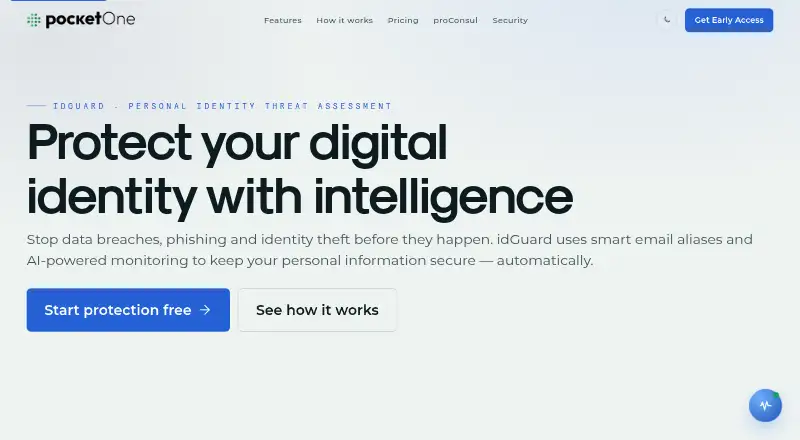
What pocketOne idGuard is
pocketOne idGuard is an identity-protection service that uses email aliases and AI-powered monitoring to help protect personal information from breaches, phishing, and identity theft. Users can set up a unique alias for each website, monitor threats tied to each address, and isolate or archive an affected alias. Messages sent to those aliases arrive in the user's normal inbox. The service says it checks dark-web markets, paste sites, breach databases, and threat feeds, then alerts users to suspicious exposures and updates a personal threat score in real time. The Free Forever plan costs nothing and provides three email aliases. Centurion costs €6.71 a month and includes unlimited aliases, AI threat detection, dark-web monitoring, priority support, and a password generator. Praetorian costs €8.63 a month and adds unlimited signatures, family protection for five users, and white-glove support. The service supports iPhone, Android, tablets, Windows, macOS, Linux, and a browser-accessible web dashboard, and is available in the EU and GCC. The maker is headquartered in Amsterdam, Netherlands. Support is available by email and through an on-site AI assistant; Premium subscribers can use live chat during business hours and emergency support 24/7.
Good
- Unique aliases can be tracked separately by website.
- Alias messages arrive in the user's normal inbox.
- Monitoring covers dark-web markets, paste sites, breach databases, and threat feeds.
- Alerts and a personal threat score update in real time.
- A free plan includes three email aliases.
Watch out
- The free plan is limited to three aliases.
- Praetorian costs €8.63 a month.
- Praetorian’s family protection is specified for five users.
- The Sentry plan has no stated price.
Who it suits
idGuard suits people who want separate email aliases for websites and alerts about possible personal-data exposures. Centurion fits those needing unlimited aliases and the listed monitoring tools, while Praetorian is designed for family protection across five users.
Verdict
Choose idGuard if you want aliases combined with monitoring and exposure alerts across supported devices. Look elsewhere if three free aliases are insufficient and the paid plan options do not fit your needs.
Plans and prices
From pocketOne idGuard's own pricing page, checked 21 Sep 2026.
| Plan | Price | What it gives you |
|---|---|---|
| Free Forever | Free | 3 email aliases · billed monthly |
| Centurion | €6.71 a month | Unlimited email aliases · AI threat detection · Dark-web monitoring · Priority support · Password generator |
| Praetorian | €8.63 a month | Everything in Centurion · Unlimited signatures · Family protection (5 users) · White-glove support |
| Sentry | — | 3 email aliases · Basic breach monitoring · End-to-end encryption · Mobile app access · Free forever |
The facts
Each one read from pocketOne idGuard's own pages, with the date it was checked.
What it does
- Alerts and threat score
- idGuard says it alerts users to suspicious exposures and updates their personal threat score in real time.checked 5 Oct 2026
- Alias protection
- Users can create a unique email alias for each website, track threats per alias, and isolate or archive an affected alias.checked 5 Oct 2026
- Availability
- The product page says idGuard serves the EU and GCC.checked 5 Oct 2026
- Dark-web monitoring
- Yeschecked 21 Sep 2026
- Email delivery
- Messages sent to idGuard aliases arrive in the user's normal inbox.checked 5 Oct 2026
- Encryption
- The maker says encryption protects data in transit and at rest, and lists end-to-end encryption as a Sentry plan feature.checked 5 Oct 2026
- Integrations
- The maker describes proConsul as middleware connecting issuers, holders, and verifiers and as an integration and trust layer behind idGuard and myID.checked 5 Oct 2026
- Premium support
- The contact page says Premium subscribers can access live chat during business hours and emergency support 24/7.checked 5 Oct 2026
- Purpose
- idGuard uses email aliases and AI-powered monitoring to help protect personal information from breaches, phishing, and identity theft.checked 5 Oct 2026
- Standards
- The maker says idGuard is engineered to align with ISO/IEC 18013-5, eIDAS 2.0, W3C DID/VC, and OpenID4VP/VCI, with interoperability depending on deployment and participating parties.checked 5 Oct 2026
- Support
- The contact page lists support by email at [email protected] and says an AI assistant is available on the website 24/7.checked 5 Oct 2026
- Threat monitoring
- The service says it scans dark-web markets, paste sites, breach databases, and threat feeds for personal data.checked 5 Oct 2026
Money
- Free plan
- Yeschecked 21 Sep 2026
The company
- Headquarters
- Amsterdam, Netherlandschecked 28 Sep 2026
Where it runs
- Supported devices
- The support page says idGuard supports iPhone, Android, tablets, Windows, macOS, and Linux, with a web dashboard accessible through a browser.checked 5 Oct 2026
The full review of pocketOne idGuard
Overview
pocketOne idGuard pairs email aliases with monitoring for exposed personal information, aiming to help users limit phishing and identity-theft risks. It suits people who want to manage email exposure across desktop and mobile devices. Its free tier is tightly capped, while the paid plans make more sense for regular alias use.
Each alias can be assigned to a website, with threats tracked per address; an affected alias can be isolated or archived. Messages still arrive in the user's normal inbox, so aliases add separation without requiring a second mailbox. idGuard says it scans dark-web markets, paste sites, breach databases, and threat feeds, then alerts users to suspicious exposures and updates a personal threat score in real time. This is a focused email-exposure tool, not a stated package of identity restoration or credit monitoring.
Key features
Aliases and monitoring
A distinct address for each website can help identify which account may be exposed and retire that alias without changing unrelated sign-ups. Three aliases are enough to try this approach on a few important accounts, but they are unlikely to cover a large number of services. Centurion removes the alias cap and adds AI threat detection and dark-web monitoring.
Alerts, encryption, and support
Exposure alerts and a real-time threat score give users a way to respond when idGuard flags suspicious activity. The maker says encryption protects data in transit and at rest; end-to-end encryption is included with Sentry. Support is available by email, and an AI assistant is offered on the website around the clock. Premium subscribers can also access live chat during business hours and emergency support 24/7.
Standards and integration
idGuard is engineered to align with ISO/IEC 18013-5, eIDAS 2.0, W3C DID/VC, and OpenID4VP/VCI, though interoperability depends on deployment and participating parties. pocketOne describes proConsul as middleware connecting issuers, holders, and verifiers, and as an integration and trust layer behind idGuard and myID. These standards and infrastructure matter most to readers evaluating identity ecosystems; they do not change the practical appeal of aliases for someone mainly managing sign-ups.
Pricing
idGuard uses a freemium model, with a free option and paid plans from €6.71/mo. The plans differ in alias limits, monitoring, support, and family access, so the right tier depends on how many addresses and users need protection.
- Free Forever — free, billed monthly: Three email aliases. A useful no-cost starting point for a few accounts, but the cap rules it out for users who want an alias per service.
- Centurion — €6.71 a month: Unlimited email aliases, AI threat detection, dark-web monitoring, priority support, and a password generator. This is the clearest fit for an individual who expects to use aliases broadly.
- Praetorian — €8.63 a month: Everything in Centurion, plus unlimited signatures, family protection for five users, and white-glove support. The five-user allowance makes it the family option; a solo user may have little reason to pay more than Centurion.
- Sentry — custom pricing: Three email aliases, basic breach monitoring, end-to-end encryption, and mobile app access. Its stated alias cap matches Free Forever, so it is worth considering for those who specifically need its encryption or mobile access rather than unlimited aliases.
The free plans do not provide Centurion's unlimited aliases and AI threat detection. The paid prices are monthly; no trial or renewal terms are stated.
Platforms
idGuard supports Android, iOS, Linux, macOS, Windows, and web, with a browser-accessible dashboard. The product serves the EU and GCC. Broad device support is useful for people moving between phones and computers, while Sentry specifically includes mobile app access.
Who it's for
Choose idGuard if you want to separate website sign-ups with aliases, receive exposure alerts, and manage the service across supported devices. Free Forever is best for trying the approach or protecting a handful of accounts; Centurion is more practical for regular, high-volume alias use. Praetorian fits households of up to five users who value its added support and signature allowance. Look elsewhere if you need more than three aliases but cannot use the paid tiers, or if your priority is a stated restoration or credit-monitoring package.
Pros and cons
- Pros: Per-website aliases can help isolate an exposed address without disrupting other accounts.
- Pros: Centurion combines unlimited aliases with AI threat detection, dark-web monitoring, and a password generator.
- Pros: Android, iOS, desktop operating systems, and web access support use across a range of devices.
- Cons: Free Forever and Sentry both cap users at three aliases, limiting broader use.
- Cons: Sentry has custom pricing, making its cost harder to weigh against the free option.
- Cons: The stated features focus on email exposure and monitoring rather than identity restoration or credit monitoring.
Alternatives
For more options, browse Identity Theft Protection Services. Consider these listed alternatives for different priorities:
- Desjardins Identity Protection is a free option with Android, iOS, and web support and up to $50,000 reimbursement.
- TransUnion Credit Premium offers a free web plan with a TransUnion credit report, making it a consideration for readers focused on credit information.
- Allstate Identity Protection has a paid individual plan at $3 a month with identity restoration tracking, U.S.-based 24/7 support, and $25,000 identity-theft coverage.
- ID Assist is another paid alternative with a free trial.
- ClearScore Protect Plus offers daily dark-web monitoring, dedicated fraud case management, and potential identity-loss protection.
- Homebody is another paid alternative.
- Norton Identity Advisor Plus costs A$99.99 a year for the first year and then automatically renews annually at A$119.99 unless cancelled; it is a paid option with a free trial.
- Norton LifeLock offers Core at $12.49 a month and Advanced at $19.99 a month for readers comparing paid identity-protection tiers.
Verdict
idGuard is a strong fit for people who want email aliases tied to breach and dark-web monitoring, especially if Centurion's unlimited aliases suit their usage. Its broad platform support and inbox delivery keep that workflow practical. The main reason to look elsewhere is the free-tier ceiling: three aliases are restrictive, and the paid plans may not fit readers seeking a broader identity-protection package or a different price point.
Getting started
- Visit https://www.pocket.one/idguard.
- Choose the Free Forever plan or a paid plan.
- Create a unique alias for each website you want to separate.
- Check alerts and threat information through the web dashboard or supported device apps.
Limits worth knowing
Free Forever includes three email aliases. Sentry is described as having three aliases and basic breach monitoring; Centurion costs €6.71 a month for unlimited aliases.
Questions
Is there a free plan?
Yes. Free Forever costs nothing and includes three email aliases. Sentry is also described as free forever, with three aliases and basic breach monitoring.
How much do the paid plans cost?
Centurion costs €6.71 a month and Praetorian costs €8.63 a month.
What devices and platforms are supported?
idGuard supports iPhone, Android, tablets, Windows, macOS, and Linux, as well as a browser-accessible web dashboard.
What does Centurion include?
Centurion includes unlimited aliases, AI threat detection, dark-web monitoring, priority support, and a password generator.
What does Praetorian add?
Praetorian includes everything in Centurion, plus unlimited signatures, family protection for five users, and white-glove support.
How can users contact support?
Support is available by email and through an AI assistant on the website 24/7. Premium subscribers can access live chat during business hours and emergency support 24/7.
Alternatives to pocketOne idGuard
- 1
Allstate Identity Protection
AndroidiOSWebAPI7.8From $3 a month - 2
Norton Identity Advisor Plus
AndroidiOSWebExtension7.5From A$99.99 a year - 3
Zander Identity Theft Protection
AndroidiOSWebmacOS7.4From $75 a year - 4
ClearScore Protect Plus
AndroidiOSWebAPI7.3 - 5
TransUnion Credit Premium
Free planWeb7.3From $29.95 a month - 6

Norton LifeLock
AndroidiOSWeb7.2From $124.99 a year