PlexMix
PlexMix creates personalized playlists from a Plex music library using natural-language mood descriptions.
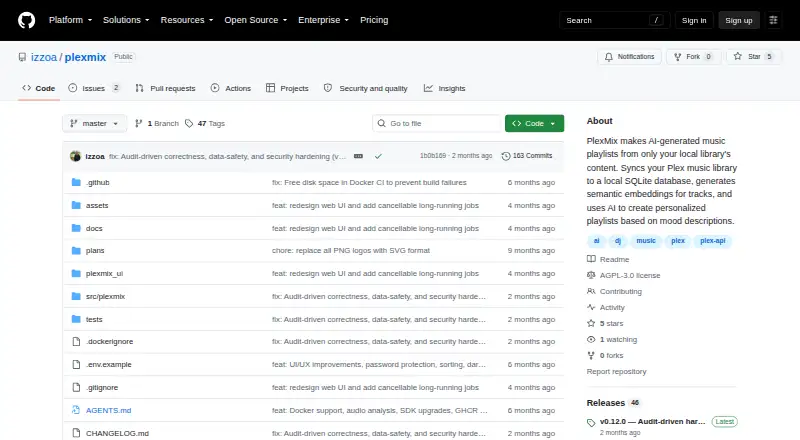
What PlexMix is
PlexMix creates personalized playlists from a Plex music library using natural-language mood descriptions. It syncs music metadata to a local SQLite database and generates semantic embeddings for tracks. Playlist generation can use filters for genre, year, rating, artist, environment, instrument, tempo, energy, key, and danceability, with similarity, random, alternating-artist, or energy-curve ordering. Optional Essentia analysis extracts audio features such as tempo, key, energy, danceability, and loudness; optional MusicBrainz enrichment adds community-curated genres, canonical artist IDs, and recording-type detection. Playlists can be exported as JSON or M3U, or imported from files with track matching. PlexMix supports multiple cloud AI providers and local models; cloud providers require an API key and internet access, while local embedding models run offline. It can create Plex playlists when enabled and does not modify or delete tracks, albums, or artists. The project is free, open source under GNU AGPL v3, and available for Linux, self-hosted use, and the web. Its web UI is alpha; the README recommends the CLI for production use.
Good
- Natural-language playlist prompts
- Multiple track filters and ordering modes
- JSON and M3U import and export
- Local embedding models run offline
- Open source under GNU AGPL v3
Watch out
- Web interface is alpha
- Project recommends CLI for production use
- Currently supports one music library at a time
- Cloud AI requires an API key and internet
Who it suits
PlexMix suits music lovers who use Plex and want to build playlists from mood prompts and detailed filters. It may also fit users who prefer local models or a command-line workflow.
Verdict
PlexMix offers detailed controls for creating playlists from a Plex library, with optional audio analysis and metadata enrichment. The alpha web UI and one-library limit are important constraints; the project recommends the CLI for production use.
The facts
Each one read from PlexMix's own pages, with the date it was checked.
What it does
- AI providers
- Supported providers include Google Gemini, OpenAI, Anthropic, Cohere, local models, and OpenAI-compatible endpoints.checked 9 Oct 2026
- Audio analysis
- Optional Essentia analysis extracts features including tempo, key, energy, danceability, loudness, and spectral measures.checked 9 Oct 2026
- Credential storage
- Credentials can be stored in the system keyring or passed as environment variables.checked 8 Oct 2026
- Deployment
- The project can be installed from PyPI or source and deployed with Docker Compose; it publishes amd64 and arm64 Docker images.checked 9 Oct 2026
- Export and import
- Playlists can be exported as JSON or M3U and imported from files with track matching.checked 8 Oct 2026
- Interfaces
- PlexMix provides a command-line interface and an alpha web UI; the README recommends the CLI for production use.checked 8 Oct 2026
- Library limit
- The README says PlexMix currently supports one music library at a time; multi-library support is on its roadmap.checked 9 Oct 2026
- License
- The project is licensed under the GNU Affero General Public License v3.0.checked 9 Oct 2026
- License and audience
- The project is licensed under GNU AGPL v3 and describes itself as made for music lovers.checked 8 Oct 2026
- Local library data
- It syncs Plex music metadata to a local SQLite database and generates semantic embeddings for tracks.checked 8 Oct 2026
- Local storage
- It syncs Plex music metadata to a local SQLite database and stores semantic embeddings for search.checked 9 Oct 2026
- Music metadata
- Optional MusicBrainz enrichment provides community-curated genres, canonical artist IDs, and recording type detection.checked 9 Oct 2026
- Network requirements
- Cloud AI providers require an API key and internet access, while the README documents local models for offline playlist and tag generation.checked 9 Oct 2026
- Ordering
- It offers similarity, random, alternating-artist, and energy-curve track ordering modes.checked 8 Oct 2026
- Playlist controls
- Playlist generation supports filters including genre, year, rating, artist, environment, instrument, tempo, energy, key, and danceability.checked 8 Oct 2026
- Playlist tools
- Playlist generation supports filters, four ordering modes, saved templates, and JSON or M3U import and export.checked 9 Oct 2026
- Plex access
- PlexMix reads Plex metadata and can create Plex playlists when enabled; it says it does not modify or delete tracks, albums, or artists.checked 9 Oct 2026
- Privacy option
- Local embedding models run on the user's machine, and the README says their embedding calls run offline and privately.checked 9 Oct 2026
- Purpose
- PlexMix creates AI-generated playlists from a user's Plex music library using mood descriptions.checked 9 Oct 2026
- Security
- The web UI can be password-protected with PLEXMIX_UI_PASSWORD, which the README recommends when exposing it on a network.checked 8 Oct 2026
- Web interface
- The README describes the web UI as Alpha and recommends the CLI for production use.checked 9 Oct 2026
Money
- Cost note
- The README estimates default Gemini playlist creation at ~$0.01 per playlist and local embeddings as completely free.checked 9 Oct 2026
Alternatives to PlexMix
- 1

Amazon Music
Free planAndroidiOSWebAPI8.2From $5.99 a month - 2
MoodTrue
Free planAndroidiOSWebAPI7.9From $3.99 a month - 3

YouTube
AndroidiOSWebAPI7.8From $9.99 a month - 4
Playlistable
AndroidiOSWeb7.4From $49.99 a year - 5

MagicPlayer
Free planWeb7.3$9 one-time - 6

Spotify Prompted Playlists
Free planAndroidiOS7.3Free plan