
PhoneValidationAPI
PhoneValidationAPI is a REST API that checks a phone number's format and returns details such as country, region, line type, carrier, and disposable or burne…
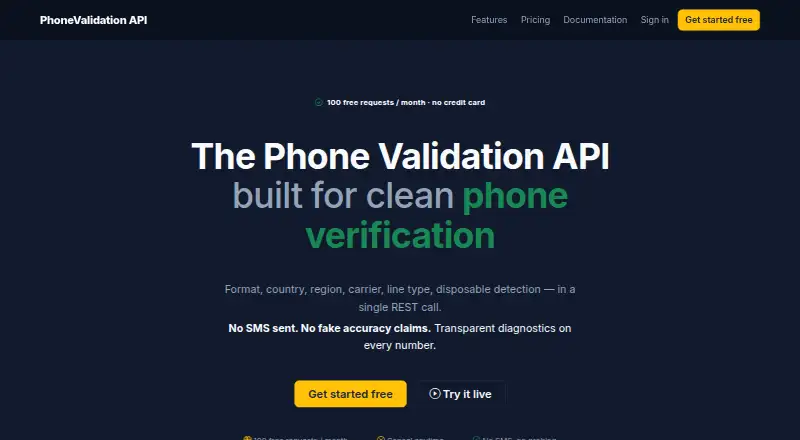
What PhoneValidationAPI is
PhoneValidationAPI is a REST API that checks a phone number's format and returns details such as country, region, line type, carrier, and disposable or burner status in one HTTP request. It accepts E.164 numbers or national-format numbers paired with a country parameter, and uses Google's libphonenumber for parsing. Line categories include mobile, fixed line, VoIP, toll-free, premium-rate, shared-cost, and other types. Responses include a confidence label, but confidence varies by country and some numbering plans make line classification ambiguous. The service checks formats and metadata without sending SMS messages or placing calls. Developers use HTTP requests and Bearer-token authentication; documentation links an OpenAPI 3.0 specification and a Postman collection. The Free plan allows 100 API requests per month. Basic costs $14.99 a month for 6,000 requests, while Professional costs $59.99 a month for 60,000 requests and batch processing up to 10,000 numbers per batch. The operator is based in France and states that it complies with the EU GDPR and French Data Protection Act.
Good
- Checks format, carrier, region, and line type in one request.
- Does not send SMS messages or place calls.
- Free plan includes 100 API requests per month.
- Professional plan supports batches up to 10,000 numbers.
- Links OpenAPI documentation and a Postman collection.
Watch out
- Free plan is limited to 100 API requests monthly.
- Confidence varies by country and numbering plan.
- Basic costs $14.99 a month.
Who it suits
It suits developers who need phone-number metadata or disposable-number checks in an HTTP-based workflow. It may also suit teams processing batches, though the listed batch endpoint is part of the Professional plan.
Verdict
PhoneValidationAPI returns several kinds of phone-number metadata through a single HTTP request, with confidence labels to qualify its results. Its plan limits and country-dependent ambiguity are worth considering before relying on the output.
Plans and prices
From PhoneValidationAPI's own pricing page, checked 30 Sep 2001.
| Plan | Price | What it gives you |
|---|---|---|
| Basic | $14.99 a month | 6,000 API requests / month · standard email support · $14.99 /month |
| Professional | $59.99 a month | 60,000 API requests / month · async batch endpoint up to 10k / batch · $59.99 /month |
| Enterprise | $129.99 a month | 300,000 API requests / month · priority email support (24h) · custom rate-limit on request · $129.99 /month |
| Free | — | 100 API requests / month · real-time validation · country and line-type detection · carrier identification · disposable/VoIP filtering · HTTPS + Bearer auth · $0 /month |
| Custom plan | Priced on request | More than 300,000 lookups / month · dedicated support or volume discount · Bespoke pricing for high-volume usage |
The facts
Each one read from PhoneValidationAPI's own pages, with the date it was checked.
What it does
- Batch processing
- An asynchronous batch endpoint is available, with the Professional plan listing up to 10,000 numbers per batch.checked 30 Sep 2001
- Confidence reporting
- Responses include a confidence label such as verified, likely, uncertain, low, or invalid to indicate the strength of the validation signals.checked 30 Sep 2001
- Developer tools
- The documentation links an OpenAPI 3.0 specification and a Postman collection.checked 30 Sep 2001
- Disposable detection
- The API cross-checks carriers and known prefix ranges against a maintained list of VoIP and burner numbers.checked 30 Sep 2001
- GDPR
- The operator states it is based in France and complies with the EU GDPR and French Data Protection Act.checked 30 Sep 2001
- Integration
- The API uses HTTP requests and Bearer-token authentication; the site says any HTTP client works and no SDK is required.checked 30 Sep 2001
- Limits
- The service says validation confidence varies by country and some numbering plans make line types ambiguous; it does not claim a universal accuracy percentage.checked 30 Sep 2001
- Line classification
- It classifies line types including mobile, fixed line, VoIP, toll-free, premium-rate, shared-cost, and other listed categories.checked 30 Sep 2001
- No phone contact
- The service performs format and metadata validation without sending SMS messages or placing PSTN calls.checked 30 Sep 2001
- Number parsing
- It parses formats using Google's libphonenumber and accepts E.164 numbers or national-format numbers with a country parameter.checked 30 Sep 2001
- Privacy
- The privacy policy says submitted phone numbers are stored in validation logs as SHA-256 hashes, while plain numbers are not stored beyond the immediate request except when batch processing requires it.checked 30 Sep 2001
- Security
- The privacy policy says communications use HTTPS/TLS, passwords are hashed with Argon2id, and API keys are hashed at rest with SHA-256.checked 30 Sep 2001
- Support
- The contact page says it typically replies within 24 hours on business days.checked 30 Sep 2001
- What it does
- The REST API checks phone-number format, country, region, line type, carrier, and disposable or burner status in one HTTP call.checked 30 Sep 2001
The company
- Headquarters
- Francechecked 28 Sep 2001
The full review of PhoneValidationAPI
Overview
PhoneValidationAPI is a REST API for checking a phone number’s format and returning country, region, line type, carrier, and disposable-number signals in one request. It suits developers who need phone metadata without contacting the number. Its confidence labels help qualify results, but monthly quotas and country-dependent ambiguity matter if validation drives important decisions.
Key features
Numbers can be supplied in E.164 format or national format with a country parameter; parsing uses Google’s libphonenumber. The API classifies mobile, fixed-line, VoIP, toll-free, premium-rate, shared-cost, and other line categories, and checks carriers and known number ranges for disposable or burner numbers. That breadth makes one call useful for signup screening and routing workflows, though the service does not claim a universal accuracy rate.
Responses label confidence as verified, likely, uncertain, low, or invalid. Those labels are valuable when downstream systems need to distinguish stronger signals from ambiguous ones, but they are not a guarantee: confidence can vary by country, and some numbering plans make line types difficult to determine. Validation is metadata-based; the service does not send an SMS or place a call, so it does not establish that a person currently controls or answers a number.
Integration uses HTTP requests and Bearer-token authentication, with no SDK requirement. OpenAPI 3.0 documentation and a Postman collection support implementation. An asynchronous batch endpoint is available on Professional, handling up to 10,000 numbers per batch.
The privacy policy says communications use HTTPS/TLS, passwords are hashed with Argon2id, and API keys are stored as SHA-256 hashes. Submitted numbers are recorded in validation logs as SHA-256 hashes rather than plain numbers; plain numbers are retained beyond the immediate request only when batch processing requires it. The France-based operator states that it complies with the EU GDPR and French Data Protection Act.
Pricing
The free plan costs $0 per month and allows 100 API requests monthly. It includes real-time validation, country and line-type detection, carrier identification, disposable/VoIP filtering, HTTPS, and Bearer authentication. That is enough to evaluate a small integration, but the cap is too tight for sustained production traffic.
Basic costs $14.99 a month, billed $14.99 /month, for 6,000 API requests monthly and standard email support. It is the entry paid tier for modest workloads, but offers no listed batch endpoint. Professional costs $59.99 a month, billed $59.99 /month, and raises the allowance to 60,000 requests monthly while adding asynchronous batches of up to 10,000 numbers. It is the sensible step up for recurring bulk jobs.
Enterprise costs $129.99 a month, billed $129.99 /month, for 300,000 monthly requests, priority email support (24h), and a custom rate limit on request. It fits higher-volume services that need priority support; usage above 300,000 lookups per month can use the custom plan, with bespoke pricing, dedicated support or volume discounts.
Across the paid tiers, the higher quota and operational provisions are the main reasons to spend more; the free tier’s 100-request ceiling is its key tradeoff. The contact page says replies typically arrive within 24 hours on business days. No trial or renewal terms are stated.
Platforms
PhoneValidationAPI is available through an API and the web. Its HTTP-client approach makes it broadly usable from software that can make authenticated requests, rather than tying integration to a particular SDK.
Who it's for
This is a good fit for developers and product teams that need format, carrier, line-type, and disposable-number signals in a single request, especially when batch processing is useful. It is less suitable as the sole proof of reachability or ownership: it does not contact the phone, and country-level ambiguity means its confidence should be treated as a signal rather than certainty.
Pros and cons
- Pros: A broad set of phone metadata and disposable-number checks arrives in one HTTP call, reducing the need to assemble separate checks.
- Pros: Confidence labels and explicit uncertainty categories help teams avoid treating every result as equally reliable.
- Pros: Professional adds batches up to 10,000 numbers, while Enterprise includes priority email support and a custom rate limit on request.
- Cons: Free usage is capped at 100 requests per month, limiting ongoing use without a paid plan.
- Cons: The API neither calls nor texts numbers, so it cannot confirm live reachability or user control.
- Cons: Confidence varies by country and line type can be ambiguous under some numbering plans, making universal assumptions unsafe.
Alternatives
Phone Number Validation Software is the broader category directory for comparing options. Choose Neutrino Phone Validate if its free account’s limited daily requests, around 10–25 depending on API, and no-expiry access better suit a low-volume API evaluation. IPQualityScore Phone Validation API is worth considering for its free trial, 1,000 free monthly lookups, and tiered flat-rate monthly pricing without monthly contracts.
Veriphone is another freemium option with a web platform. Consider APIFreaks Phone Validation API if its $50/month monthly plan for 600K API credits is a better match for very high monthly volume. HLR Lookup offers prepaid lookup bundles, including 2,500 lookups for $16.55 once. Twilio Lookup is another freemium alternative, while numlookupapi.com and FoneSwift Bulk Phone Validator are freemium options with web platforms.
Verdict
PhoneValidationAPI is a strong choice for developers who want multiple phone-number metadata checks through one HTTP endpoint, with confidence labels and a batch option at Professional. The main reason to choose elsewhere is a need to verify actual reachability or control, or to avoid relying on signals that can be ambiguous by country. For teams whose needs match metadata validation and whose volume fits the quotas, it is a practical, clearly tiered API.
Alternatives to PhoneValidationAPI
- 1

IPQualityScore Phone Validation API
Free planAndroidiOSWebAPI7.3Free plan - 2

Veriphone
Free planWebAPISelf-hosted7.3From $10.83 a month - 3
Vonage SMS API
AndroidiOSWebAPI7.1 - 4
Accessibility Test Framework for Android
Free planAndroidLinuxmacOSWindows6.8Free plan - 5

numlookupapi.com
Free planWebAPI6.7From $9.99 a month - 6

Abstract Email Validation API
Free planWebAPI6.6From $17 a month