PGSpider
PGSpider is a SQL cluster engine for querying distributed data through Foreign Data Wrappers.
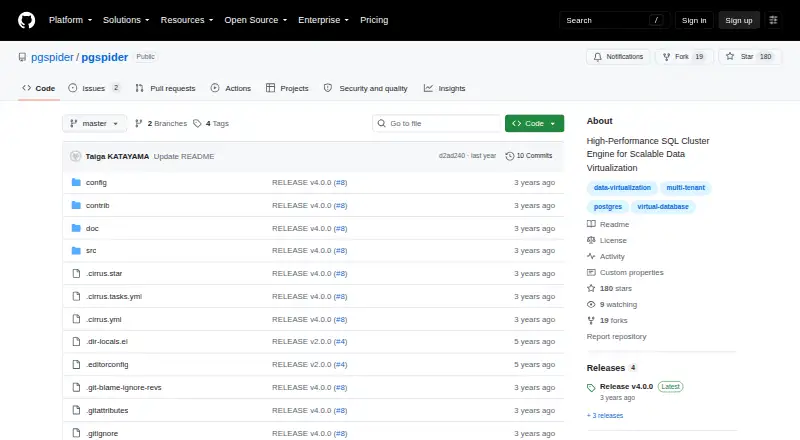
What PGSpider is
PGSpider is a SQL cluster engine for querying distributed data through Foreign Data Wrappers. It can combine similarly structured tables from multiple sources into a Multi-Tenant virtual table that is queried with a single SQL statement. Queries and result fetching run in parallel across child nodes. PGSpider can push WHERE clauses and aggregation functions down to those nodes; Multi-Tenant tables support AVG, STDDEV and VARIANCE. They also support INSERT, UPDATE and DELETE, along with bulk INSERT using a batch_size option. The README demonstrates PostgreSQL and SQLite, and names PostgreSQL, MySQL, Oracle, GridDB, PGSpider, InfluxDB v2.0 and Amazon S3 Parquet storage in its migration list. The engine follows PostgreSQL-like operation and documents use with libpq and psql. It is free, open-source software for Linux and self-hosted deployment; the documented installation process builds from source. Its license allows use, copying, modification and distribution without a fee, but disclaims warranties and any obligation to provide support or updates. Some modification features are unsupported, and the project recommends auto-commit for modifications.
Good
- Combines similarly structured sources in one virtual table.
- Runs queries across child nodes in parallel.
- Supports several aggregate functions and data modifications.
- Free license permits use, copying and modification.
Watch out
- Requires a source build for documented deployment.
- RETURNING, WITH CHECK OPTION and ON CONFLICT are unsupported with modification.
- The README recommends auto-commit for modifications.
- Tree-structure feature is still in beta.
Who it suits
PGSpider may suit Linux users who want to query data across multiple sources through SQL and can build and self-host software. It is relevant to teams that need parallel queries or Multi-Tenant virtual tables.
Verdict
PGSpider offers SQL access across distributed sources with parallel queries and pushdown. Its documented modification limits and self-hosted Linux deployment are important considerations.
Plans and prices
From PGSpider's own pricing page, checked 4 Oct 2026.
| Plan | Price | What it gives you |
|---|---|---|
| PGSpider | Free | Use, copy, modify, and distribute under the included license |
The facts
Each one read from PGSpider's own pages, with the date it was checked.
What it does
- Client compatibility
- PGSpider uses PostgreSQL-like operation and documents use with client applications such as libpq and psql.checked 4 Oct 2026
- Cloud transfer
- Data Compression Transfer sends compressed data through a Cloud Function and requires a pgspider_fdw relay server with endpoint and relay options.checked 4 Oct 2026
- Data modification
- Multi-Tenant tables support INSERT, UPDATE, and DELETE, as well as bulk INSERT using a batch_size option.checked 4 Oct 2026
- Data sources
- The README demonstrates PostgreSQL and SQLite and lists PostgreSQL, MySQL, Oracle, GridDB, PGSpider, InfluxDB v2.0, and Amazon S3 Parquet storage for migration.checked 4 Oct 2026
- Deployment
- The README documents building from source and installing to /usr/local/pgspider.checked 4 Oct 2026
- License
- The included license permits use, copying, modification, and distribution without a fee, and disclaims warranties and an obligation to provide support or updates.checked 4 Oct 2026
- Modification limitation
- RETURNING, WITH CHECK OPTION, and ON CONFLICT are unsupported with modification, and foreign-partition COPY and modification are unsupported.checked 4 Oct 2026
- Parallel queries
- PGSpider runs queries and fetches results from child nodes in parallel.checked 4 Oct 2026
- Purpose
- PGSpider is a SQL cluster engine for distributed big data that accesses data sources through Foreign Data Wrappers.checked 4 Oct 2026
- Pushdown
- It pushes WHERE clauses and aggregation functions down to child nodes, and supports AVG, STDDEV, and VARIANCE on Multi-Tenant tables.checked 4 Oct 2026
- Transaction limitation
- The README recommends running modifications in auto-commit mode because modified data may not be readable within a transaction and non-auto-commit changes may be inconsistent.checked 4 Oct 2026
- Tree feature status
- The README says the tree-structure feature is not tested enough and is in beta.checked 4 Oct 2026
- Virtual tables
- It can present similarly structured tables from multiple data sources as one Multi-Tenant virtual table queried with a single SQL statement.checked 4 Oct 2026
Alternatives to PGSpider
- 1

Stardog
Free planAndroidiOSWebAPI7.7Free plan - 2

Starburst Galaxy
Free planWebAPILinux7.1Free plan - 3
Apache Drill
Free planAPILinuxmacOSSelf-hosted6.7Free plan - 4
Denodo Platform
Free planWebAPILinuxSelf-hosted6.7Free plan - 5
Enterprise Enabler
WebAPILinuxmacOS6.7From $2.17 a month - 6
QoreDB
Free planLinuxmacOSWindows6.7From €99 a year