
PayQuicker
PayQuicker provides businesses with a platform for making global mass payouts in local currencies.
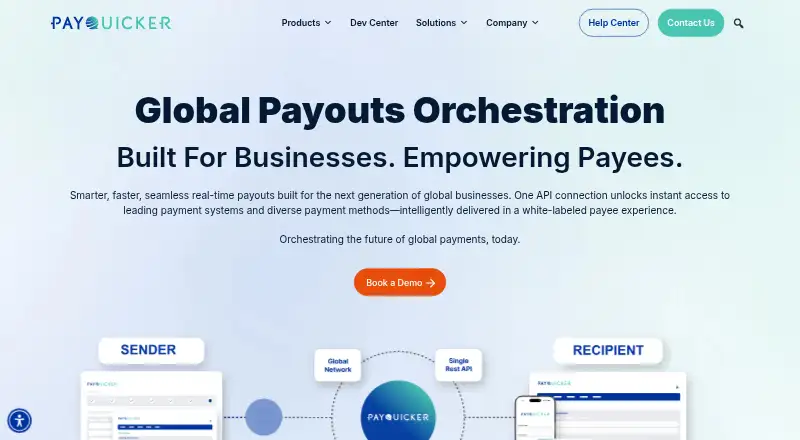
What PayQuicker is
PayQuicker provides businesses with a platform for making global mass payouts in local currencies. The company says it supports payouts to more than 210 countries and territories in more than 80 currencies. Payment and spending options include branded debit cards, virtual cards, ATM cash, bank transfers, Apple Pay, Google Pay, and transfers between payees. Businesses can connect through a RESTful API or batch file upload; the API supports sending invitations and payments, spendback debits, and retrieving balances and reports. The platform offers client-branded portals and a white-label gateway that can integrate with a client’s own portal. Listed use cases include corporate, affiliate, influencer, clinical-trial, gaming, gig-work, insurance, survey, and NIL payouts. PayQuicker offers iOS and Android apps alongside web and API access. Its support team provides phone, live chat, and email assistance in more than 18 languages. Pricing is available by request. PayQuicker says data is encrypted in transit with TLS 1.2 or higher and at rest with AES-256, and that it uses role-based access and requires multi-factor authentication. Payee-to-payee transfers are limited to users in the same resident country.
Good
- Payouts cover more than 210 countries and territories
- Supports more than 80 currencies
- Offers REST API and batch-file integration
- Branded portals and white-label gateway available
- Phone, chat, and email support in 18+ languages
Watch out
- Pricing is available by request
- Card-order fees may apply
- Payee transfers are limited to the same resident country
Who it suits
PayQuicker is aimed at businesses that distribute payouts across countries, including enterprise, small-to-medium, and startup customers. It may fit organizations that need branded payout experiences or API and batch-file integration.
Verdict
PayQuicker supports varied payout methods and business integrations across a broad stated geographic reach. Prospective customers will need to request pricing, and card-order arrangements may affect costs.
Plans and prices
From PayQuicker's own pricing page, checked 30 Sep 2026.
| Plan | Price | What it gives you |
|---|---|---|
| PayQuicker | Priced on request | Starting price: Connect with an advisor for pricing |
The facts
Each one read from PayQuicker's own pages, with the date it was checked.
What it does
- API
- PayQuicker offers a RESTful API for tasks including sending invitations and payments, spendback debits, and retrieving balances and reports.checked 30 Sep 2026
- Branding
- The platform offers client-branded portals and experiences, including a white-label gateway that can integrate with a client’s own portal.checked 30 Sep 2026
- Card-order fees
- Card ordering capability and any associated cost depend on the arrangements in the company’s PayQuicker contract, and a fee may apply.checked 30 Sep 2026
- Compliance
- The company lists SOC 1, SOC 2, PCI DSS, GDPR, CPRA/CCPA and EU-U.S. Data Privacy Framework compliance or certifications.checked 30 Sep 2026
- Coverage
- The platform supports payouts to more than 210 countries and territories in more than 80 currencies.checked 30 Sep 2026
- Global reach
- The site says PayQuicker supports payouts to 210+ countries and territories in 80+ currencies.checked 30 Sep 2026
- Industries
- The site lists use cases including corporate payouts, affiliate and influencer payouts, clinical trials, direct selling, gaming rewards, gig work, insurance claims, surveys, and NIL payouts.checked 30 Sep 2026
- Integration
- The site says businesses can integrate through its API or batch file upload to a back office or integrated wallet solution.checked 30 Sep 2026
- Launch
- PayQuicker launched its payout platform in 2007.checked 30 Sep 2026
- Payout frequency
- Clients can make payouts as frequently as desired with no charge per transaction.checked 30 Sep 2026
- Payout methods
- Listed payout and spending options include branded debit cards, virtual cards, ATM cash, bank transfers, Apple Pay, Google Pay, and payee-to-payee transfers.checked 30 Sep 2026
- Pricing
- The customer-facing site directs prospective clients to request a demo and does not state a standard plan price on that page.checked 30 Sep 2026
- Purpose
- PayQuicker provides businesses with a platform for making instant global mass payouts in local currencies.checked 30 Sep 2026
- Routing
- PayQuicker says its single API connects to banks and global payment rails and that intelligent routing optimizes transactions for speed or cost.checked 30 Sep 2026
- Security
- The Trust Center describes TLS 1.2+ encryption in transit, AES-256 encryption at rest, role-based access controls, and multi-factor authentication for all accounts.checked 30 Sep 2026
- Security controls
- PayQuicker encrypts data in transit with TLS 1.2 or higher, encrypts databases at rest with AES-256, uses role-based access and requires multi-factor authentication.checked 30 Sep 2026
- Support
- PayQuicker says its in-house support team provides phone, live chat, and email assistance in 18+ languages.checked 30 Sep 2026
- Target customers
- PayQuicker serves enterprise, small-to-medium business and startup customers across industries including affiliate, gig, gaming, insurance and corporate payouts.checked 30 Sep 2026
- Tax services
- Tax services include W-9 issuance and collection, TIN verification, electronic 1099 issuance and tax withholding transfers.checked 30 Sep 2026
- Transfer limitation
- Payees can send payments to another platform user only within the same resident country.checked 30 Sep 2026
The company
- Founded
- 2007checked 28 Sep 2026
- Headquarters
- Rochester, New York, United States; Draper, Utah, United Stateschecked 28 Sep 2026
Where it runs
- Mobile app
- The Help Center says the MyPayQuicker Mobile app is available for iOS and Android.checked 30 Sep 2026
The full review of PayQuicker
PayQuicker is a business platform for sending mass payouts to recipients around the world. It is best suited to organizations that need multiple delivery methods, API or batch-file connections, and branded payee experiences. Its reach is broad, but custom pricing and contract-dependent card costs make it important to weigh the full arrangement before committing.
Overview
Launched in 2007, PayQuicker serves enterprise, small-to-medium business, and startup customers. Its use cases include corporate and contractor payments, marketplace disbursements, affiliate and influencer payouts, clinical trials, direct selling, gaming rewards, gig work, insurance claims, surveys, and NIL payouts. That breadth suits organizations paying different kinds of recipients; it is less clearly tailored to a single, narrow payment workflow.
Clients can make payouts as frequently as they want, with no charge per transaction. This is useful for irregular schedules or programs that send funds often, though it does not settle the overall cost: card-order fees may apply under the client’s contract. Payees can transfer funds to another PayQuicker user only if both live in the same country.
Browse payout software to compare options in this category.
Key features
Global delivery and integrations
PayQuicker supports payouts to more than 210 countries and territories in over 80 currencies. Recipients can access funds through branded debit cards, virtual cards, ATM cash, bank transfers, Apple Pay, Google Pay, and transfers to other PayQuicker users. This range gives payout programs flexibility in how recipients receive or spend funds, although peer transfers have a same-country restriction.
Businesses can connect through a RESTful API or batch-file uploads to a back office or integrated wallet. API tasks include sending invitations and payments, making spendback debits, and retrieving balances and reports. The API and batch options are relevant for operations integrating payouts into existing systems; the service also supports mass payouts, marketplace disbursements, contractor payments, and seller settlements.
Branding, routing, and tax services
Client-branded portals and experiences, including a white-label gateway that can connect to a client’s own portal, help businesses maintain a branded recipient experience. PayQuicker says its single API connects to banks and global payment rails, with intelligent routing intended to optimize transactions for speed or cost. Those capabilities are aimed at businesses coordinating payouts across markets rather than sending occasional one-off transfers.
Tax services include W-9 issuance and collection, TIN verification, electronic 1099 issuance, and tax-withholding transfers. These tools can consolidate parts of recipient tax administration alongside payouts.
Security and support
PayQuicker encrypts data in transit using TLS 1.2 or higher and at rest using AES-256, and uses role-based access controls and multi-factor authentication for all accounts. Its compliance and privacy areas include SOC 1 and 2, PCI, CPRA/CCPA, GDPR, and the EU-US Data Privacy Framework. An in-house support team provides phone, live chat, and email assistance in more than 18 languages.
Pricing
PayQuicker is a paid service with custom pricing. The PayQuicker plan has no published starting price; prospective customers are directed to connect with an advisor and request a demo. That leaves businesses needing a quote to assess fit against their payment volume and operating requirements.
Clients can pay out as frequently as they want without a per-transaction charge. Card-order capability and its associated cost depend on the company’s contract, and a fee may apply. Businesses should account for those contract terms when comparing the total cost of delivery methods.
Platforms
PayQuicker supports Android, iOS, web, and API access. The MyPayQuicker Mobile app is available on iOS and Android, while the API and web access support business-side integration and administration.
Who it's for
PayQuicker is a strong fit for enterprises, small-to-medium businesses, and startups that manage payouts across markets and need a choice of recipient delivery methods. Its API and batch-file integration, branded portals, and tax services are especially relevant to payout programs spanning affiliates, contractors, sellers, gig workers, claims, rewards, or research participants.
It is a less straightforward choice for a business seeking a self-serve, published-price plan or one that needs peer transfers across national borders. Contract terms also matter for businesses that expect to issue cards to recipients.
Pros and cons
- Pros: Payout reach across more than 210 countries and territories in over 80 currencies supports programs with geographically dispersed recipients.
- Pros: Cards, bank transfers, ATM cash, mobile wallets, and other delivery options let recipients access funds in different ways.
- Pros: API and batch-file integration, branded experiences, and tax services cover several needs around payout operations.
- Pros: No per-transaction charge for payout frequency gives clients latitude to set their schedules.
- Cons: Custom pricing requires a quote, making costs harder to assess before contacting an advisor.
- Cons: Card ordering and any related fee depend on the contract, so card costs may vary by arrangement.
- Cons: Transfers between PayQuicker users are limited to users in the same resident country.
Alternatives
Consider Wise if you want a freemium personal account and transfers model with free registration and pay-as-you-use sending, rather than a business payout platform with custom pricing. Payouts.com offers a free-to-start option with no contract to get started, white-glove migration, and usage-based pricing as a business scales; it may suit a company that prefers that entry arrangement.
Payoneer Payer is another paid business option with custom pricing for higher payment volumes and fees that vary by method and location. Plane Contractor Management has a free HRIS Platform plan with hiring and onboarding tasks, a contractor and employee directory, custom reports, holidays, and time tracking, making it relevant when those workforce tools are the priority.
Tremendous offers free platform access with no subscription or platform fees, gift cards, prepaid cards, and donations at face value; some monetary payout methods may incur 4–6% fees. Ontop includes a $14.90 a month Ontop Reserve plan, with benefits subject to category eligibility and monthly caps. Arbonum charges from 5.0% per payout on a pay-as-you-go basis, with no per-seat or setup fees and no minimums. IRIS Practice Engine is another paid API- and web-based option.
Verdict
Choose PayQuicker if your organization needs to send frequent, varied payouts across countries and values a choice of integrations, branded recipient experiences, and delivery methods. Its broad reach and lack of a per-transaction payout charge are the main reasons to consider it. Look elsewhere if a published price is essential before engaging a vendor, or if recipient-to-recipient transfers must cross borders.
Alternatives to PayQuicker
- 1

Plane Contractor Management
Free planWebAPI7.6From $19 a month - 2

Ontop
AndroidiOSWebAPI7.4 - 3

Wise
Free planAndroidiOSWeb7.4Free plan - 4
RazorpayX Payouts
AndroidiOSWebAPI7.3₹5 one-time - 5

Trolley
WebAPI7.0From $699 a year - 6
Gusto
AndroidiOSWebAPI6.9From $49 a month