
Osprey
Osprey is an IEP planning and documentation platform that connects activity planning, session data collection, and progress monitoring.
What Osprey is
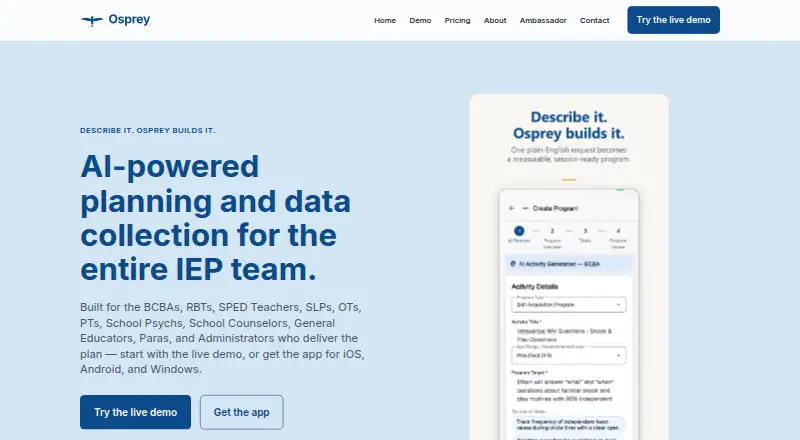
Osprey is an IEP planning and documentation platform that connects activity planning, session data collection, and progress monitoring. Its AI can turn a plain-language goal or lesson description into an IEP-aligned activity for a practitioner to accept or edit. Session tools cover DTT trials, interval recording, frequency observation, articulation probes, and rubric scoring. Progress views show independence over successive sessions, curriculum-based measurement against an aimline, and combined progress across active IEP goals. Teams can share learner records, with supervisor oversight and visibility across disciplines. School workflows include IDEA-aligned documentation, generalization tracking across settings, and a connected FBA/BIP process. Osprey supports Android, iOS, web, and Windows; the individual practitioner app is described as offline-capable. A free plan and free trial are available. Paid pricing is on request, and formal plan names and prices are not published. Integration with other systems is on the roadmap, with no current integrations named.
Good
- AI generates activities from goals or lesson descriptions.
- Session data tools cover several measurement approaches.
- Progress views include aimlines and active IEP goals.
- Individual practitioner app is offline-capable.
- Free plan and free trial are available.
Watch out
- Paid pricing is available only on request.
- Broader system integrations are still on the roadmap.
- AI processing identifiable learner data requires recorded learner-level consent.
- PHI processing requires a written BAA first.
Who it suits
Osprey suits practitioners such as BCBAs, special education teachers, therapists, counselors, and paraprofessionals who need IEP planning and session documentation. It also serves schools, districts, practices, and centers coordinating learner records across roles or sites.
Verdict
Osprey brings planning, session measurement, and progress documentation into one IEP-focused workflow. Its free option and offline-capable practitioner app are useful, while paid pricing requires direct inquiry and broader integrations are not yet listed.
Plans and prices
From Osprey's own pricing page, checked 30 Sep 2001.
| Plan | Price | What it gives you |
|---|---|---|
| Individuals | Free | Live web demo · app for iOS, Android, and Windows · no waitlist |
| Schools and districts | Priced on request | IEP-team coordination across roles and sites · rollout, privacy agreements, and admin needs discussed directly |
| Practices and centers | Priced on request | Shared team visibility · tailored onboarding · formal plan and invoice amounts provided during onboarding |
The facts
Each one read from Osprey's own pages, with the date it was checked.
What it does
- AI activity generation
- The demo describes generating an IEP-aligned activity from a plain-language goal or lesson description, which the practitioner can accept or edit.checked 30 Sep 2001
- Availability and limits
- The About page says Osprey v1.0 is available with planning, session-running, and documentation for individual practitioners and small coordinated teams; formal plan names and prices are not published on the pricing page.checked 30 Sep 2001
- Data protection
- The product privacy policy says service workloads are hosted in U.S. Azure regions and that Nisana does not train generative-AI models on learner records or facilitator content.checked 30 Sep 2001
- HIPAA
- Nisana acts as a HIPAA business associate only under a written BAA, and the policy says a BAA must be in place before facilitators process PHI in the service.checked 30 Sep 2001
- Integrations
- The About page says broader integration with other systems is on the roadmap; it does not name current integrations.checked 30 Sep 2001
- Offline use
- The individual practitioner page says the app is offline-capable for buildings with spotty Wi-Fi.checked 30 Sep 2001
- Privacy and access
- The product privacy policy says learner-record access is controlled by organization, team, and care-team permissions, and AI processing of identifiable learner data requires recorded learner-level consent.checked 30 Sep 2001
- Progress monitoring
- Osprey presents session-over-session independence, curriculum-based measurement against an aimline, and roll-up progress across active IEP goals.checked 30 Sep 2001
- Purpose
- Osprey provides AI-powered planning and data collection for IEP teams, connecting session planning, data collection, and progress documentation.checked 30 Sep 2001
- School workflows
- For schools and districts, Osprey describes IDEA-aligned documentation, generalization tracking across settings, and a connected FBA/BIP workflow.checked 30 Sep 2001
- Session data
- The demo includes DTT trials, interval recording, frequency observation, articulation probes, and rubric scoring.checked 30 Sep 2001
- Support
- The product privacy policy lists security vulnerability and incident reporting at [email protected] and privacy requests at [email protected].checked 30 Sep 2001
- Who it serves
- Osprey is built for practitioners including BCBAs, RBTs, special education teachers, SLPs, OTs, PTs, school psychologists, counselors, general educators, paraprofessionals, and administrators.checked 30 Sep 2001
The company
- Team coordination
- Practices and centers can use shared learner records, supervisor oversight, and cross-discipline visibility, according to the product site.checked 30 Sep 2001
The full review of Osprey
Overview
Osprey is an IEP-focused planning and documentation tool for practitioners and coordinated education teams. It suits professionals who need to connect session activities with learner data and goal progress. Its strongest case is a joined-up workflow for planning, measurement, and reporting; its main trade-off is custom pricing for team use.
Osprey v1.0 supports planning, running sessions, and documentation for individual practitioners and small coordinated teams. Its scope includes IEP support, accommodation tracking, service logging, goal progress monitoring, compliance reporting, and data import and export. For a wider view of the category, see Special Education Software.
Key features
Planning and session data
Practitioners can start with a plain-language goal or lesson description and receive an IEP-aligned activity to accept or edit. That keeps professional judgment in the workflow rather than treating generated plans as final. Session measures include DTT trials, interval recording, frequency observation, articulation probes, and rubric scoring, giving teams several ways to capture performance across different kinds of work.
Progress monitoring
Osprey presents independence across sessions, curriculum-based measurement against an aimline, and progress rolled up across active IEP goals. These views connect day-to-day observations to broader progress review, which is useful when practitioners need both session-level evidence and a summary across goals.
Team and school workflows
Practices and centers can use shared learner records, supervisor oversight, and cross-discipline visibility. School and district workflows add IDEA-aligned documentation, generalization tracking across settings, and a connected FBA/BIP workflow. These capabilities make Osprey more compelling for teams coordinating services than for users seeking only a standalone activity planner.
Privacy and access
Learner-record access is controlled through organization, team, and care-team permissions. Processing identifiable learner data with AI requires recorded consent at the learner level. Service workloads are hosted in U.S. Azure regions, and Nisana says it does not train generative-AI models on learner records or facilitator content. Nisana acts as a HIPAA business associate only under a written BAA; one must be in place before facilitators process protected health information in the service.
Pricing
Individuals can start with the free plan at no cost. It includes a live web demo and apps for iOS, Android, and Windows, with no waitlist. That is the clearest fit for an individual exploring the workflow or working without shared team administration.
Practices and centers use custom pricing, with shared team visibility, tailored onboarding, and formal plan and invoice amounts provided during onboarding. Schools and districts also use custom pricing; coordination across roles and sites is discussed alongside rollout, privacy agreements, and administrative needs. The free individual option does not establish what paid team plans cost, so organizations should seek a quote before committing.
A free trial is offered.
Platforms
Osprey supports web, Android, iOS, and Windows, with web-and-mobile deployment. The individual practitioner app is described as offline-capable, a practical advantage in buildings with unreliable Wi-Fi. Broader integrations with other systems are on the roadmap, so teams needing an established connection to another platform should confirm fit before choosing it.
Who it's for
Osprey is intended for BCBAs, RBTs, special education teachers, SLPs, OTs, PTs, school psychologists, counselors, general educators, paraprofessionals, and administrators. It is best suited to practitioners or organizations that want activity planning, structured session measurement, and IEP progress documentation in one workflow. It is less suitable for buyers who require published team pricing or broader system integrations as a current capability.
Pros and cons
Pros
- Planning connects to measurement. IEP-aligned activity generation leads into several session-data methods, reducing the gap between a goal and its documented work.
- Progress has multiple levels of view. Session independence, aimline measurement, and roll-ups across active goals support both focused review and broader monitoring.
- Useful for coordinated teams. Shared records, oversight, cross-discipline visibility, and school workflows address collaboration beyond an individual practitioner's caseload.
- Free entry point and offline-capable app. Individuals can start without a fee, while offline capability can help in low-connectivity school buildings.
Cons
- Team costs require a direct conversation. Practices and districts have custom pricing, making budget comparison harder before onboarding discussions.
- Integration breadth is limited for now. Broader integration is a roadmap item, which may be a drawback for teams relying on connected systems.
- AI use with identifiable records has a consent condition. Teams must record learner-level consent before that processing, and PHI use requires a written BAA in advance.
Alternatives
- PowerSchool Behavior Support is another paid option for Android, iOS, and web; its price is not published.
- FrenalyticsEDU may suit a small web-based setup: its free tier allows 10 student profiles, 1 staff account, and 1 daily Learning Session per student.
- Adaptive XI Intelligence is worth considering for a single-student workflow with AI lesson planning and assessments; its Solo plan is $588 a year for 12 months of access.
- SameGoal Special Education is another paid option with a free trial and per-student school-year pricing.
- GoIDEA is a web-based alternative with custom quotes based on district needs and the number of schools or students managed.
- Progress Desk may fit users seeking a one-time purchase for iPad or Mac rather than a team-priced service.
- Polaris offers a 10-student license pack at $514.99 a year, with unlimited access for service providers.
- Spiro is another paid option.
Verdict
Choose Osprey if you are an IEP practitioner or coordinated team looking to connect planning, session measurement, and progress documentation, especially where offline-capable individual use matters. Its free individual option lowers the barrier to starting, while team workflows broaden its appeal to practices and schools. Look elsewhere if you need a clear team price before engaging with a provider or depend on broader integrations today.
Getting started
- Open https://osprey.education/.
- Start with the free Individuals plan and its live web demo.
- Use the app on iOS, Android, or Windows; Osprey is also available on web.
- For a school, district, practice, or center rollout, discuss coordination and onboarding directly.
- Before processing PHI, put a written BAA in place; obtain recorded learner-level consent before AI processing of identifiable learner data.
Limits worth knowing
The Individuals plan is free. Schools and districts, and practices and centers, have no published price in these facts; their rollout and plan details are discussed directly.
Questions
Is Osprey free?
The Individuals plan is listed as free and includes a live web demo and apps for iOS, Android, and Windows. Osprey also describes its pricing model as paid, with pricing on request.
Which platforms does Osprey support?
The listed platforms are Android, iOS, web, and Windows. The Individuals plan description specifically names iOS, Android, and Windows apps plus a live web demo.
Who is Osprey for?
It serves practitioners across behavioral, special education, therapy, and school roles, as well as administrators. Plans also address practices and centers, schools, and districts.
What does Osprey do for IEP teams?
It connects session planning, data collection, and progress documentation. Features include IEP-aligned activity generation, session data methods, progress views, and team coordination.
Does Osprey integrate with other systems?
Broader integration with other systems is on the roadmap. No current integrations are named in these facts.
What privacy conditions apply to learner data?
AI processing of identifiable learner data requires recorded learner-level consent. Processing PHI requires a written BAA to be in place first.
Alternatives to Osprey
- 1
IEP Progress
AndroidiOSWeb7.5From $4.92 a month - 2

PowerSchool SIS
AndroidiOSWebAPI7.3 - 3

SameGoal Special Education
AndroidiOSWeb6.9From $1.08 a month - 4
BanqO
Web6.7From $75 a month - 5

Adaptive XI Intelligence
AndroidiOSWeb6.6From $49 a month - 6

Class Charts
AndroidiOSWeb6.6