
Optiply
Optiply automates inventory management and replenishment for e-commerce, wholesale, and retail businesses.
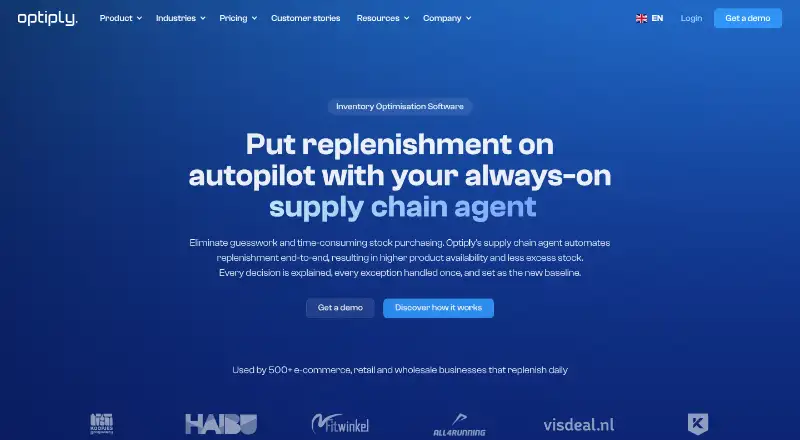
What Optiply is
Optiply automates inventory management and replenishment for e-commerce, wholesale, and retail businesses. Its supply chain agent monitors demand, supplier performance, and stock levels, then places or adjusts orders and explains the changes. The purchasing algorithm draws on more than 40 forecasting calculations, including sales, ABC categorization, seasonality, trends, peaks, and delivery times. Optiply advertises more than 50 integrations across ERP, WMS, fulfillment, retail POS, database, data provider, e-commerce, and marketplace categories. Examples include Exact Online, Shopify, Picqer, WooCommerce, BigCommerce, and Bol.com. The Lite plan costs €79/mo and covers up to 1,000 sales orders per month and 1,000 SKUs. It includes a free 14-day trial without a credit card for online stores using a standard integration. Optiply is available on web and through an API; custom system connections may incur a one-time fee.
Good
- Automates order placement and adjustment.
- More than 40 forecasting calculations.
- Advertises more than 50 integrations.
- Lite includes up to 1,000 SKUs.
- 14-day trial requires no credit card.
Watch out
- No free plan.
- Lite is limited to 1,000 SKUs.
- Custom integrations may incur a one-time fee.
Who it suits
Optiply suits e-commerce, wholesale, and retail businesses seeking automated replenishment and demand forecasting. The Lite plan is sized for up to 1,000 monthly sales orders and 1,000 SKUs.
Verdict
Optiply combines replenishment automation, forecasting, and integrations for businesses managing inventory. Check whether the Lite limits and standard integrations fit your operation before choosing a plan.
Plans and prices
From Optiply's own pricing page, checked 4 Oct 2026.
| Plan | Price | What it gives you |
|---|---|---|
| Optiply Lite | €79 a month | Up to 1,000 sales orders per month · Up to 1,000 SKUs · From €79 p/m |
| Starter | €490 a month | From 1,000 orders · Purchase Planner · ABC Categorization · Supplier Performance · Advanced Purchase Module · Product Analytics · From €490 · yearly option |
| Enterprise | Priced on request | End-to-end automation · Designed for large-scale operations · 3 standard workflows and 1 custom workflow · Get a quote |
| Professional | Priced on request | Purchase Planner · ABC Categorization · Supplier Performance · Multi-Supplier · Dynamic Agenda · Custom Dashboarding · Promotions · Multiple Workflows · Get a quote |
The facts
Each one read from Optiply's own pages, with the date it was checked.
What it does
- Automation
- Its supply chain agent monitors demand, supplier performance and stock levels, places and adjusts orders, and explains changes.checked 4 Oct 2026
- Custom connections
- The product can connect a customer’s own system through its API, and the site says custom integrations may incur a one-time connection fee.checked 4 Oct 2026
- Forecasting
- The purchasing algorithm uses more than 40 forecasting calculations and considers sales, ABC categorization, seasonality, trends, peaks and delivery times.checked 4 Oct 2026
- Integrations
- Optiply advertises more than 50 integrations across ERP, WMS, fulfillment, retail POS, database, data provider, e-commerce and marketplace categories.checked 4 Oct 2026
- Intended customers
- The company describes serving e-commerce, wholesale and retail businesses, and says the best pricing package is calculated from purchasing rules and SKU counts.checked 4 Oct 2026
- Named integrations
- Examples listed include Exact Online, Shopify, Picqer, WooCommerce, BigCommerce and Bol.com.checked 4 Oct 2026
- Privacy
- Optiply’s privacy policy identifies Optiply BV as the data controller and says people can request access, correction, erasure or restriction of their personal data.checked 4 Oct 2026
- Purpose
- Optiply automates inventory management and replenishment by recommending what, when and how much to order.checked 4 Oct 2026
- Security and data use
- The terms say information stored or exchanged through the service may be used anonymously to improve the Optiply algorithm and that Optiply will not process GDPR-scope data traceable to persons.checked 4 Oct 2026
- Standard integration fees
- The pricing page says several standard integrations, including Picqer, Lightspeed, Exact Online for ecommerce, Magento 2, WooCommerce, Logic4, Shopify and Shopware, do not require additional fees.checked 4 Oct 2026
- Support
- The pricing page lists chat and email support for Starter, with higher tiers listing a call or priority call.checked 4 Oct 2026
The company
- Company history
- Optiply says its origins date to 2015, when two founders set out to solve their own e-commerce purchasing challenges.checked 4 Oct 2026
- Founded
- 2015checked 28 Sep 2026
- Headquarters
- Eindhoven, Netherlandschecked 28 Sep 2026
Money
- Trial
- Optiply Lite offers a free 14-day trial without requiring a credit card.checked 4 Oct 2026
- Trial eligibility
- The site says online stores using a standard integration can sign up for the trial; custom integrations may incur a one-time connection fee.checked 4 Oct 2026
The full review of Optiply
Optiply is inventory and replenishment software that recommends what to order, when to order it and in what quantity. It is best suited to e-commerce, wholesale and retail businesses seeking to automate purchasing across their stock. Its forecasting and integrations are compelling, but the Lite caps and custom-priced upper tiers make plan fit a key part of the decision.
Overview
Optiply combines demand forecasting with purchasing automation. Its supply chain agent monitors demand, supplier performance and stock levels, then places or adjusts orders and explains its changes. That scope can reduce repetitive purchasing work, while giving teams a view into why recommendations shift.
The forecasting algorithm uses more than 40 calculations, accounting for sales, ABC categorization, seasonality, trends, peaks and delivery times. Reorder point automation, safety stock planning and multi-location planning are also supported. These capabilities suit businesses whose purchasing decisions must reflect more than recent sales alone.
Key features
- Automated replenishment: The agent monitors stock, demand and supplier performance and can place or adjust orders. This is useful for teams aiming to reduce manual reorder work; businesses wanting to retain control should weigh that automation against their preferred purchasing process.
- Forecasting: More than 40 forecasting calculations consider multiple demand and supply factors, including seasonality and delivery times. That breadth is relevant to businesses with variable demand, though the feature count alone does not establish forecast accuracy for a particular operation.
- Integrations: Optiply advertises more than 50 integrations across ERP, WMS, fulfillment, retail POS, databases, data providers, e-commerce and marketplaces. Examples include Exact Online, Shopify, Picqer, WooCommerce, BigCommerce and Bol.com. Several standard integrations, including Picqer, Lightspeed, Exact Online for ecommerce, Magento 2, WooCommerce, Logic4, Shopify and Shopware, carry no additional fee.
- Custom connections: Customers can connect their own system through the API, but custom integrations may incur a one-time connection fee. Businesses with non-standard systems should factor that possible cost into their choice.
Pricing
Optiply is paid software, with a free 14-day Optiply Lite trial that does not require a credit card. Online stores using a standard integration can sign up; custom integrations may incur a one-time connection fee. The Lite plan itself has no free tier.
- Optiply Lite — €79 a month (billed From €79 p/m): Includes up to 1,000 sales orders per month and up to 1,000 SKUs. It is the entry point for smaller catalogs and order volumes, but those caps may rule it out for growing operations. The stated SKU limit is 1,000.
- Starter — €490 a month (billed From €490 · yearly option): Starts from 1,000 orders and includes Purchase Planner, ABC Categorization, Supplier Performance, Advanced Purchase Module and Product Analytics. It adds purchasing and supplier tools beyond Lite, but the yearly option is a meaningful commitment. Chat and email support are listed for Starter.
- Professional — custom pricing: Includes Purchase Planner, ABC Categorization, Supplier Performance, Multi-Supplier, Dynamic Agenda, Custom Dashboarding, Promotions and Multiple Workflows. It is aimed at teams needing more workflows and supplier planning than Starter provides; a quote is required to judge its cost.
- Enterprise — custom pricing: Includes end-to-end automation, is designed for large-scale operations, and provides three standard workflows plus one custom workflow. Its custom price means larger businesses will need a quote to assess fit.
Pricing is calculated from purchasing rules and SKU counts, so businesses should evaluate the plan against both their catalog and ordering needs. Support rises to a call or priority call on higher tiers.
Platforms
Optiply is available on the web and through an API. That suits browser-based use and system connections, but the supported platforms do not include a listed mobile app.
Who it's for
Optiply is a strong candidate for e-commerce, wholesale and retail businesses that manage replenishment across multiple stock locations and want forecasting to inform purchasing. Lite is best aligned with an online store at or below its order and SKU caps. Larger or more complex operations may need Starter, Professional or Enterprise, depending on their need for analytics, multi-supplier planning, workflows and automation.
It is less suited to a business seeking a free ongoing plan, one needing more than 1,000 SKUs on Lite, or one that cannot accept a possible one-time fee for a custom integration. Optiply BV is the data controller for personal data; its policy allows people to request access, correction, erasure or restriction. Its terms also say information stored or exchanged through the service may be used anonymously to improve the algorithm and that it will not process GDPR-scope data traceable to persons.
Pros and cons
Pros
- Broad forecasting inputs: The algorithm considers seasonality, trends, peaks, delivery times and other factors, useful when simple sales-based replenishment is insufficient.
- Meaningful automation: Monitoring, order placement and adjustments can reduce manual replenishment work.
- Many integration options: More than 50 advertised integrations span several business-system categories, with several named standard connections carrying no extra fee.
- Clear entry plan and trial: Lite has a published starting price and a 14-day trial without a credit card.
Cons
- Lite is capped: Its 1,000 monthly sales orders and 1,000 SKUs limit its usefulness as an operation grows.
- Higher tiers require a quote: Professional and Enterprise have no published price, making budget comparisons harder.
- Custom integration costs may apply: Businesses relying on their own system may face a one-time connection fee.
- Starter has a yearly option: The stated billing option requires more commitment than a purely month-to-month choice.
Alternatives
Replenishment Software is a useful category starting point for comparing tools. Consider GMDH Streamline instead if a free plan matters: its Free Edition covers up to US$ 1M in Annual Revenue, up to 1000 Planning Items (SKUs × Locations) and up to 10,000 Annual Sales Quantity, and it supports macOS, Windows, web and self-hosted use.
Slimstock Slim4 is another paid, web-based alternative. LEAFIO AI Replenishment Software is paid and supports API and web. StockIQ may suit mid-market distributors or manufacturers seeking unlimited users: its Core plan targets single sites or small site networks, typically at $25M–$250M revenue, and supports API, self-hosted and web deployment.
Blue Ridge Replenishment Optimization is a paid, web-based option for readers willing to contact the vendor to book a demo. eTurns TrackStock is worth considering for Android or iOS alongside web access; its Replenish — stockroom plan costs $40 a month, billed semi-annually, with unlimited users, items and suppliers. EazyStock is another paid, web-based alternative. Prediko may suit a store seeking a lower entry price: its Starter plan is $49 a month, with recurring charges billed every 30 days, for stores up to $100K in revenue; it also offers a free trial and supports API and web.
Verdict
Choose Optiply if your business needs replenishment automation backed by forecasting that accounts for suppliers, seasonality and delivery times, and its integrations fit your systems. Lite gives smaller stores a defined starting point, while larger plans extend into multi-supplier planning and workflow automation. Look elsewhere if you need a free ongoing plan, exceed Lite's caps, or require firm pricing before discussing a quote.
Alternatives to Optiply
- 1

GMDH Streamline
Free planAndroidiOSWebAPI7.6Free plan - 2
Stockagile Replenishment
AndroidiOSWebAPI7.5From €49 a month - 3

eTurns TrackStock
AndroidiOSWeb7.0From $40 a month - 4

Inventory Planner
Free planWebAPI7.0Free plan - 5

Prediko
WebAPI7.0From $49 a month - 6

Flowlity
WebAPI6.9From €249 a month