OpenVoiceChanger
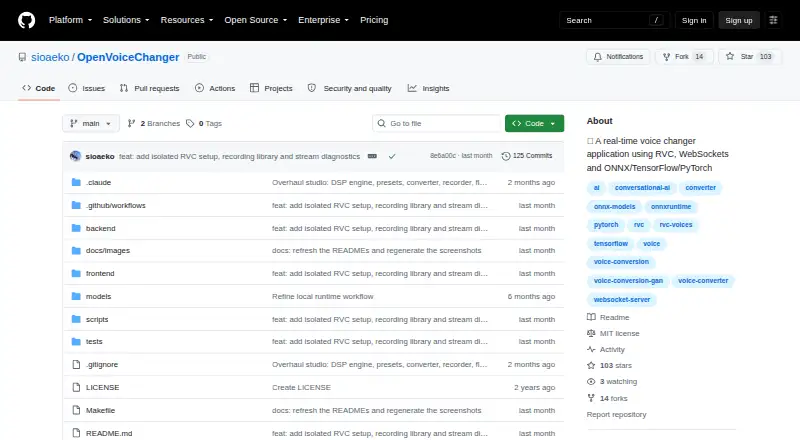
OpenVoiceChanger is a free, open-source, self-hosted web application for real-time voice conversion with ONNX or RVC models, as well as model-free DSP effects.
What OpenVoiceChanger is
OpenVoiceChanger is a free, open-source, self-hosted web application for real-time voice conversion with ONNX or RVC models, as well as model-free DSP effects. It streams microphone audio over WebSockets. Its studio offers pitch and formant shifting, 16 F0 methods, 12 DSP effects, and 16 built-in voice presets; users can save custom presets with the full Voice Lab settings. For offline conversion, it accepts WAV, MP3, FLAC, OGG, and M4A input and renders WAV output, up to a configured maximum of 600 seconds. It supports ONNX models and RVC PyTorch .pth or .pt models, with RVC requiring a HuBERT content encoder. The backend provides HTTP endpoints for health, models, presets, and conversion, plus a WebSocket endpoint for live audio. Recorded takes are stored in browser IndexedDB on the same origin and may be cleared or evicted by the browser. The app supports Linux, Windows, and self-hosted use. Listed requirements include Python 3.10 or later, Node.js 20.19 or later, and npm.
Good
- Free and open source under the MIT license.
- Supports real-time and offline voice conversion.
- Offers 16 built-in voice presets.
- Accepts five listed audio input formats.
- Backend binds to localhost by default.
Watch out
- Offline conversion is limited to 600 seconds.
- RVC models require a HuBERT content encoder.
- Recorded takes may be cleared or evicted by the browser.
- Requires Python, Node.js, and npm.
Who it suits
OpenVoiceChanger suits people who want to run voice conversion locally through a self-hosted browser application, with either live microphone audio or recorded files. It also fits users who want to configure models, DSP effects, and custom voice presets.
Verdict
OpenVoiceChanger offers live and offline voice conversion with model and DSP options in a self-hosted web app. Users should account for its listed runtime requirements, RVC encoder dependency, and browser-managed recording storage.
The facts
Each one read from OpenVoiceChanger's own pages, with the date it was checked.
What it does
- API
- The backend exposes HTTP endpoints for health, models, presets, conversion, and updates, plus a WebSocket endpoint for real-time audio.checked 9 Oct 2026
- Checkpoint security
- Uploaded RVC checkpoints use PyTorch safe weights-only loading by default; unsafe loading requires an explicit deployment setting.checked 9 Oct 2026
- Custom presets
- Users can save custom presets containing the complete Voice Lab settings.checked 4 Oct 2026
- Deployment
- The app runs a local backend and browser UI, with the backend bound to 127.0.0.1 by default.checked 9 Oct 2026
- Effects
- Its server-side DSP rack includes 12 effects, including noise gate, distortion, chorus, echo, reverb, EQ, and compression.checked 9 Oct 2026
- File conversion
- Users can upload WAV, MP3, FLAC, OGG, or M4A files for conversion to downloadable WAV, with a configurable maximum length of 600 seconds.checked 9 Oct 2026
- Integrations
- The README documents ONNX Runtime, PyTorch, RVC, and GitHub Releases for updates; it does not list third-party conferencing integrations.checked 4 Oct 2026
- License
- The repository is distributed under the MIT License.checked 9 Oct 2026
- Live conversion
- It streams microphone audio over WebSockets and also supports model-free DSP voice effects.checked 4 Oct 2026
- Local storage
- Recorded takes are stored in browser IndexedDB on the same origin and may be cleared or evicted by the browser.checked 4 Oct 2026
- Model formats
- The app supports ONNX models and RVC PyTorch .pth or .pt models, with RVC requiring a HuBERT content encoder.checked 4 Oct 2026
- Models
- It accepts ONNX and RVC .pth or .pt models, and RVC models require a HuBERT content encoder file.checked 9 Oct 2026
- Network security
- Cross-origin HTTP and WebSocket requests are checked against an origin allowlist, and the README recommends HTTPS for LAN microphone access.checked 9 Oct 2026
- Product
- OpenVoiceChanger is a self-hosted web application for real-time AI voice conversion using ONNX or RVC models.checked 4 Oct 2026
- Purpose
- OpenVoiceChanger is a real-time AI voice changer web application that routes a microphone through ONNX or RVC models.checked 9 Oct 2026
- Realtime conversion
- It streams audio over WebSockets and supports ONNX, RVC, and model-free DSP modes.checked 9 Oct 2026
- Requirements
- The documented requirements include Python 3.10 or later, Node.js 20.19 or later, and npm.checked 9 Oct 2026
- Security
- The backend binds to localhost by default, checks browser origins for HTTP and WebSocket requests, and loads RVC checkpoints in safe weights-only mode by default.checked 4 Oct 2026
- Updates
- The app checks public GitHub releases but installs an update only after a user action through the managed launcher.checked 9 Oct 2026
- Voice controls
- The studio offers live pitch and formant shifting, 16 F0 methods, RVC controls, and 16 built-in voice presets.checked 9 Oct 2026
Where it runs
- Platforms
- The README documents Windows setup and says other platforms use manual setup; its Makefile supports POSIX shells or WSL.checked 9 Oct 2026
Alternatives to OpenVoiceChanger
- 1
Voice.ai
Free planAndroidiOSWebAPI8.3From $5 a month - 2
BadloVoice
Free planOpen sourceAndroidiOSWebAPI7.9Free plan - 3

FineVoice AI Voice Changer
Free planWebAPImacOSWindows7.8Free plan - 4
EaseUS VoiceWave
Free planAndroidiOSWebWindows7.6From $24.97 a year - 5
iMyFone MagicMic
Free planAndroidiOSmacOSWindows7.5From $45.99 a year - 6
FineShare VoiceTrans
Free planiOSWebmacOSWindows7.4$5.99 one-time