Open-Unmix
Open-Unmix is a free PyTorch reference implementation for music source separation aimed at researchers, audio engineers, and artists.
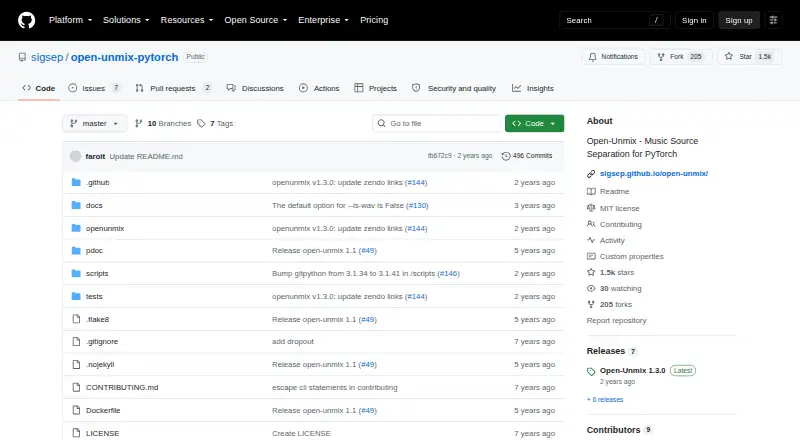
What Open-Unmix is
Open-Unmix is a free PyTorch reference implementation for music source separation aimed at researchers, audio engineers, and artists. Its ready-to-use models separate pop music into vocals, drums, bass, and other instruments. It also includes umxse, a speech enhancement model trained on the 28-speaker Voicebank+DEMAND corpus. Pre-trained choices include umxl, umxhq, umx, and umxse, along with spectrogram variants. The code is intended for reproducing results, developing architectures, and adding data. Each source model uses a three-layer bidirectional LSTM; the project states that this architecture cannot run online or in real time. The Python package installs with pip, and a Docker container is available. Models can be loaded from Python or torch.hub, and a Google Colab notebook supports online experimentation without local setup. The command line accepts WAV, FLAC, and OGG, but not MP3; stempeg can expand supported formats, including STEMS export. The software is MIT-licensed, but umxl weights are non-commercial under CC BY-NC-SA 4.0. Technical help is offered through GitHub issues, Gitter, and Google Groups.
Good
- Separates vocals, drums, bass, and other instruments.
- Includes a speech enhancement model and multiple pretrained options.
- Installable with pip, with a Docker container available.
- Supports WAV, FLAC, and OGG command-line input.
Watch out
- The project states its model design cannot run online or in real time.
- Command line does not support MP3 input.
- umxl weights are licensed for non-commercial use.
Who it suits
Open-Unmix suits researchers, audio engineers, and artists who want source-separation models or a codebase to extend. It is less suited to workflows requiring real-time separation or direct command-line MP3 input.
Verdict
Open-Unmix is a research-oriented separation implementation with ready-to-use models and room for extending the code. Check the real-time limitation, input formats, and separate umxl weights license against your workflow.
Plans and prices
From Open-Unmix's own pricing page, checked 8 Oct 2026.
| Plan | Price | What it gives you |
|---|---|---|
| Open-Unmix | Free | MIT-licensed software · umxl model weights are licensed for non-commercial use |
The facts
Each one read from Open-Unmix's own pages, with the date it was checked.
What it does
- Audio formats
- The command line supports WAV, FLAC, and OGG files but not MP3; stempeg can expand supported input and output formats, including STEMS export.checked 8 Oct 2026
- Installation
- The Python package can be installed with pip, and the project also provides a Docker container.checked 8 Oct 2026
- Integrations
- Pre-trained models can be loaded from Python or through torch.hub, and a Google Colab notebook offers online experimentation without local setup.checked 8 Oct 2026
- Model architecture
- Each source model uses a three-layer bidirectional LSTM, and the project states that this design cannot run online or in real time.checked 8 Oct 2026
- Model options
- Pre-trained options include umxl, umxhq, umx, and umxse, with spectrogram variants also available.checked 8 Oct 2026
- Model weights license
- The umxl weights are licensed for non-commercial use under CC BY-NC-SA 4.0.checked 8 Oct 2026
- Music stems
- Its ready-to-use models separate pop music into vocals, drums, bass, and other instruments.checked 8 Oct 2026
- Purpose
- Open-Unmix is a PyTorch reference implementation for music source separation aimed at researchers, audio engineers, and artists.checked 8 Oct 2026
- Security and compliance
- The opened project pages state an MIT license but do not describe security controls or compliance certifications.checked 8 Oct 2026
- Software license
- The repository lists the software license as MIT.checked 8 Oct 2026
- Speech enhancement
- The project provides an umxse speech enhancement model trained on the 28-speaker Voicebank+DEMAND corpus.checked 8 Oct 2026
- Support
- The project directs users to GitHub issues, Gitter chat, and Google Groups for technical help and support.checked 8 Oct 2026
- Training and extensibility
- The code is designed to let researchers reproduce results, develop architectures, and add their own data, while model training is documented separately from the package.checked 8 Oct 2026
The company
- Maker
- The SigSep GitHub organization describes itself as providing open resources for audio source separation.checked 8 Oct 2026
Alternatives to Open-Unmix
- 1

LALAL.AI
Free planAndroidiOSWebAPI8.3From €6.75 a month - 2

AudioShake
Free planAndroidiOSWebAPI8.1From $20 a month - 3

Fadr
Free planAndroidiOSWebAPI8.1From $100 a year - 4

MVSEP
Free planAndroidiOSWebAPI8.1Free plan - 5

Pymss
Free planOpen sourceAndroidiOSWebAPI7.8Free plan - 6
Sonura
Free planWebmacOSWindows7.3From $10 a month