NextJudge
NextJudge is a free, open-source platform for hosting and joining competitive programming contests.
What NextJudge is
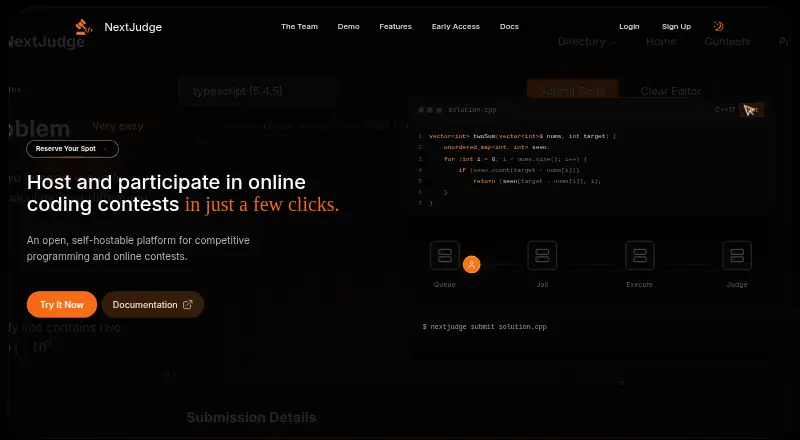
NextJudge is a free, open-source platform for hosting and joining competitive programming contests. Timed contests can include scheduled problems, registration, clarifications, standings, live leaderboards, Q&A, and live submissions with real-time feedback. Its browser workspace brings together a problem statement, sample tests, a language selector, and a Monaco editor with syntax highlighting and multiple themes. Submitted code is queued for a Python judge worker and compiled and evaluated in nsjail; the documentation describes network-disabled runs with CPU, memory, and filesystem restrictions. Operators can use a REST API and CLI, and configure optional GitHub OAuth or Elasticsearch problem search. Participant data, problems, and submissions are stored in PostgreSQL on infrastructure controlled by the operator. NextJudge is MIT-licensed, with no seat limits or feature tiers. Local setup requires Docker and Docker Compose, at least 4 GB RAM (8 GB with web and judge together), and ports 5000, 5432, 5672, and 8080 available. The homepage invites visitors to join a waitlist for early access.
Good
- Free and MIT-licensed, without seat limits or feature tiers
- Contest registration, clarifications, standings, and live feedback
- REST API and CLI for access and automation
- PostgreSQL data remains on infrastructure the operator controls
Watch out
- Local setup requires Docker, Docker Compose, RAM, and four ports
- Self-hosters operate databases, queues, backups, and monitoring
- New users are invited to join a waitlist for early access
- Problem timeout and memory settings do not change judge defaults
Who it suits
NextJudge suits contest organizers and participants who want an open-source platform they can self-host. It is most appropriate for operators prepared to maintain its database, queue, judge images, backups, monitoring, and network isolation.
Verdict
NextJudge offers contest hosting, an in-browser solving workspace, and automated judging in a self-hosted package. Its infrastructure requirements and ongoing operating responsibilities make it a better fit for teams able to manage the deployment.
The facts
Each one read from NextJudge's own pages, with the date it was checked.
What it does
- API and CLI
- The project documents a REST API and a CLI for automation, downloading problems, local testing, and submitting solutions.checked 7 Oct 2026
- Authentication
- The getting-started guide supports email/password registration and GitHub sign-in when OAuth is configured.checked 7 Oct 2026
- Availability
- The landing page invites visitors to join a waitlist for early access and says new users will be onboarded when the team is ready.checked 7 Oct 2026
- Code editor
- Its code editor uses Monaco and provides syntax highlighting and multiple themes.checked 4 Oct 2026
- Contests
- Timed contests include scheduled problems, registration, clarifications, and standings.checked 7 Oct 2026
- Contest tools
- The platform includes live leaderboards, contest Q&A, live submissions, real-time submission feedback and activity overviews.checked 4 Oct 2026
- Data control
- The maker says participant data, problems and submissions are stored in PostgreSQL on infrastructure the operator controls.checked 4 Oct 2026
- Deployment requirements
- The getting-started guide requires Docker and Docker Compose, at least 4 GB RAM (8 GB with web and judge together), and available ports 5000, 5432, 5672, and 8080.checked 7 Oct 2026
- Execution
- Judge workers compile and run submitted code in nsjail sandboxes.checked 4 Oct 2026
- Integrations
- The configuration documentation describes optional GitHub OAuth and optional Elasticsearch for problem search.checked 7 Oct 2026
- Isolation
- The documentation says compile and run use nsjail with no network, capped CPU and memory, and a restricted filesystem.checked 7 Oct 2026
- Judge limit caveat
- Problem timeout and memory settings are stored and exposed, but the judge currently uses fixed nsjail defaults instead of applying those settings.checked 7 Oct 2026
- Judging
- Submissions are queued through RabbitMQ, then compiled and evaluated by a Python judge worker in nsjail.checked 7 Oct 2026
- Languages
- The landing page lists Python, JavaScript, C++, Go, Haskell, Kotlin, C#, Java, TypeScript, PHP, Swift, Rust, C, Lua, and Ruby.checked 7 Oct 2026
- Language support
- The maker’s homepage lists Python, JavaScript, C++, Go, Haskell, Kotlin, C#, Java, TypeScript, PHP, Swift, Rust, C, Lua and Ruby.checked 4 Oct 2026
- License
- The documentation identifies NextJudge as MIT-licensed and says the license has no seat limits or feature tiers.checked 7 Oct 2026
- Operational responsibility
- Self-hosters operate the database, message queue, judge images, backups, monitoring, and network isolation.checked 7 Oct 2026
- Operational tradeoff
- Self-hosters are responsible for operating the database, message queue, judge images, backups, monitoring and network isolation.checked 4 Oct 2026
- Purpose
- NextJudge is an open-source, self-hosted platform for competitive programming, practice problems, and online contests.checked 7 Oct 2026
- Requirements
- A local deployment requires Docker and Docker Compose, at least 4 GB RAM (8 GB with web and judge together), and ports 5000, 5432, 5672 and 8080 free.checked 4 Oct 2026
- Security operations
- The deployment guide recommends keeping judge workers network-separated from internal admin tools and rate-limiting authentication and password-reset routes at the proxy.checked 4 Oct 2026
- Support
- The product landing page lists [email protected] for questions and bug reports.checked 7 Oct 2026
Where it runs
- Browser workspace
- The solving workspace combines a problem statement, sample tests, a language selector, and a Monaco editor, with separate run and submit actions.checked 7 Oct 2026
Alternatives to NextJudge
- 1

CodeSignal
Free planAndroidiOSWebAPI8.2From $24.99 a month - 2

HackerEarth Assessments
Free planAndroidiOSWebAPI8.2From $99 a month - 3
CodeChef IDE
Free planWebAPI7.4From $124 a year - 4

HackerRank
WebAPImacOSWindows7.4From $165 a month - 5

Codility
WebAPImacOSWindows7.3From $1,200 a year - 6
CSSBattle
Free planWeb6.7From $4.90 a month