
mod.io
- Android app
- Yes
- Free plan
- No
- Runs on
- Android, api, iOS, Linux, Mac, Web, Windows
Summary
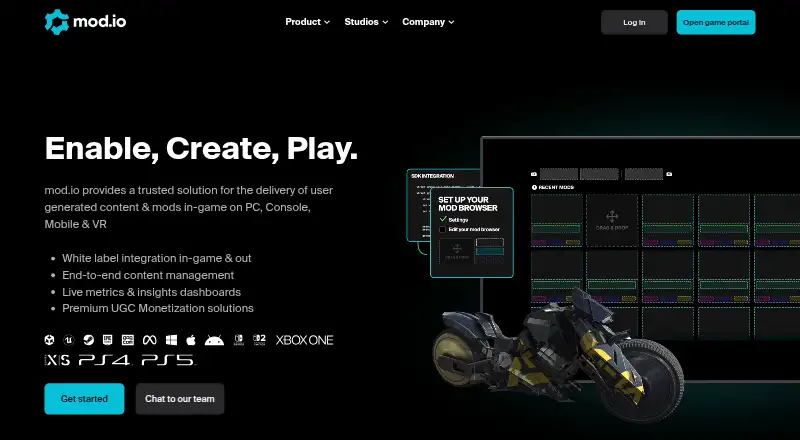
mod.io is UGC middleware that helps game studios add mods and other user-generated content to games. Its features include cross-platform support, an in-game interface, multiplayer support, a marketplace, collections, metrics, dependencies, moderation, custom SSO, Cloud Cooking, an embedded hub, and a Discord bot. Studios can integrate through Unreal Engine or Unity plugins, a C++ SDK for custom builds, or a REST API. The SDK lists support for Windows, Linux, macOS, iOS, and Android; integration targets also include PC storefronts, PlayStation, Xbox, Nintendo Switch, and Meta Quest. Moderation options include automated scanning, rules, optional content approval, and user reporting. Uploaded files receive virus and malware checks, while text and files undergo validation. Image moderation does not currently use AI or machine learning to detect inappropriate content, though studios can connect third-party tools through webhooks. Studios can enable premium UGC sales in virtual currency or USD and configure creator revenue shares. The marketplace guide lists a $0.0012 charge per virtual currency, while its web payment partner charges 5% plus $0.20 per transaction. Pricing is on request; console support requires an advanced service tier and approval from the relevant platform.
Who it is for
mod.io suits game studios that want to add user-generated content and moderation options to their games. Studios considering console integration should account for the advanced-tier and platform-approval requirements.
What is good
- Unreal Engine and Unity plugins available
- C++ SDK and REST API offered
- Moderation includes scanning, rules, and reporting
- Marketplace supports virtual currency or USD sales
What to know first
- Pricing is available on request
- Console support requires advanced tier and platform approval
- Image moderation lacks AI or machine-learning detection
Everything Xiaomi review
mod.io: the full review
mod.io provides integration tools, UGC features, and moderation options for studios building user-generated content into games. Consider its image-moderation limitation, marketplace transaction charges, and console requirements when assessing fit.
Overview
mod.io is middleware for game studios that want to build mods and other user-generated content into their games. It suits teams seeking cross-platform integration, publishing tools, and moderation in one service. Its breadth is compelling, but studios must weigh the limits on image moderation, marketplace fees, and the approval requirements for console support.
Key features
Studios can connect mod.io through Unreal Engine and Unity plugins, a C++ SDK for custom builds, or a REST API. The SDK supports Windows, Linux, macOS, iOS, and Android; documented integration targets also include PC storefronts, PlayStation, Xbox, Nintendo Switch, and Meta Quest. That range makes mod.io a fit for games that need UGC across device families, though console access requires an advanced service tier and approval from the relevant platform.
In-game UI, an embedded hub, collections, dependency tracking, version history, multiplayer support, metrics, and a Discord bot cover the workflow around finding and managing content. The directory spans 384 games, and uploads can be as large as 20 GB. Custom SSO is available for studios that need to connect their own sign-in experience.
Moderation combines automated scanning for viruses and malware with validation checks, rules-based moderation, optional approval, and user reports. The significant gap is image review: mod.io does not use AI or machine learning to detect inappropriate images. Studios can connect third-party tools through webhooks, but that adds another system to their moderation setup.
The optional marketplace lets studios sell premium UGC using virtual currency or USD pricing and set revenue shares between creators and the studio. The marketplace guide puts mod.io's charge at $0.0012 per virtual currency; its web payment partner charges 5% plus $0.20 per transaction. Thunes processes transactions, with annual third-party penetration tests, quarterly internal scans, FDIC-insured funds held in Thunes wallets, and SSL and PCI requirements described for marketplace security. Those safeguards do not remove the need to account for transaction costs when setting prices and creator shares.
Pricing
mod.io uses paid, custom service tiers, with custom pricing. Console support is tied to an advanced tier and platform approval, so studios should confirm both eligibility and cost before planning around console integration. Marketplace charges are separate considerations: $0.0012 per virtual currency and 5% plus $0.20 per transaction through the web payment partner.
There is no free plan or trial described for mod.io. Teams evaluating a smaller-scale UGC setup should compare services with a stated free offering, while studios that need mod.io's integration breadth should request pricing against their platform and marketplace requirements.
Platforms
mod.io's platform coverage includes Android, iOS, Linux, macOS, web, and Windows, alongside its API. Documentation names PC storefronts, PlayStation, Xbox, Nintendo Switch, and Meta Quest as integration targets. Console coverage is conditional rather than automatic: studios need an advanced tier and approval from the relevant platform.
Who it's for
mod.io is best suited to game studios building a substantial UGC program across multiple platforms, especially those that want integrated discovery, creator sales, dependency management, and moderation. It is less suitable for teams that require automated image-content detection out of the box, cannot accommodate custom-tier pricing, or need guaranteed console access without platform approval.
Pros and cons
- Pro: Multiple integration routes—engine plugins, C++ SDK, and REST API—give studios options for different development stacks.
- Pro: Moderation combines malware scanning, validation, rules, optional approval, and user reports rather than relying on a single control.
- Pro: Marketplace pricing and creator revenue shares are configurable, supporting different approaches to premium UGC.
- Con: Inappropriate images are not detected with AI or machine learning, leaving studios to add a third-party tool if that capability matters.
- Con: Marketplace transactions carry per-currency and payment-partner charges that studios need to include in their economics.
- Con: Console support depends on an advanced tier and separate platform approval.
- Con: Custom pricing makes costs harder to assess before contacting mod.io.
Alternatives
For studios comparing repositories and publishing services, start with the Game Mod Repositories category. Pick Thunderstore instead when a free starting point and a large catalog matter more than mod.io's broader platform reach: its free plan covers over 110,000 mods across 300+ games, with API, web, and Windows platforms.
Factorio Mods is a focused alternative for Factorio users: its free Mod Portal plan requires a licensed Factorio copy and Factorio.com account to upload, and a verified purchase for portal functionality. GameBanana is a free, web-based alternative. BeamNG.drive Repository is another free option, with Linux, web, and Windows platforms.
FICSIT.app is a free alternative with API, Linux, macOS, web, and Windows support. Hive Workshop offers a free plan and a $5 USD per month Hero plan that adds rank icons and banner, a Patron title, a unique EXP bar, a Discord role, and removal of third-party ads. Farming Simulator ModHub is a free choice for user-generated, creator-owned content on macOS, web, and Windows. ModWorkshop is a free web-based alternative.
Verdict
Choose mod.io if you are a game studio that needs flexible UGC integration, moderation tools, and optional creator sales across a broad set of platforms. Its strongest case is the combination of SDKs, discovery features, and configurable marketplace support; look elsewhere if automated image moderation, predictable published pricing, or assured console access is essential.
mod.io plans and pricing
All plansCompared on game mod repositories
Facts
- Product
- mod.io is UGC middleware that helps game studios add mods and other user-generated content to games.docs.mod.io · 29 Sept 2026
- Features
- Features include cross-platform support, in-game UI, multiplayer support, a marketplace, collections, metrics, dependencies, moderation, custom SSO, Cloud Cooking, an embedded hub, and a Discord bot.docs.mod.io · 29 Sept 2026
- Game engine integrations
- The service offers Unreal Engine and Unity plugins, a C++ SDK for custom builds, and a REST API.docs.mod.io · 29 Sept 2026
- Desktop and mobile
- The C++ SDK lists support for Windows, Linux, macOS, iOS, and Android.docs.mod.io · 29 Sept 2026
- Cross-platform reach
- The documentation lists PC storefronts, PlayStation, Xbox, Nintendo Switch, Meta Quest, iOS, and Android as supported integration targets.docs.mod.io · 29 Sept 2026
- Moderation
- UGC moderation includes automated scanning, rules-based moderation, optional content approval, and user reporting.docs.mod.io · 29 Sept 2026
- Security scanning
- Uploaded UGC files are checked for viruses and malware, while text and files also undergo validation checks.docs.mod.io · 29 Sept 2026
- Image moderation limit
- The documentation says mod.io does not currently apply AI or machine learning to detect inappropriate content in images; studios can connect third-party tools through webhooks.docs.mod.io · 29 Sept 2026
- Marketplace
- Studios can enable premium UGC sales using virtual currency or USD pricing and configure revenue shares between creators and the studio.docs.mod.io · 29 Sept 2026
- Marketplace fees
- The marketplace guide states that mod.io charges $0.0012 per virtual currency and that its web payment partner charges 5% plus $0.20 per transaction.docs.mod.io · 29 Sept 2026
- Marketplace security
- The support page says Thunes processes marketplace transactions and describes annual third-party penetration tests, quarterly internal scans, FDIC-insured funds held in Thunes wallets, and SSL and PCI requirements.support.mod.io · 29 Sept 2026
- Console access
- Console support is described as a premium feature requiring an advanced service tier and approval from the relevant platform.docs.mod.io · 29 Sept 2026
- Support
- The Unreal plugin installation guide directs users with questions to mod.io's Discord server.docs.mod.io · 29 Sept 2026
Company
- Headquarters
- Prahran, Victoria, Australiamod.io · 23 Sept 2026
Best mod.io alternatives
See all 20

Where it ranks on Everything Xiaomi
Is mod.io yours?
Claim it for free: prove the domain, then correct facts, plans and screenshots. An editor reviews every change.
Sources
- docs.mod.io· checked 29 Sept 2026
- docs.mod.io/features· checked 29 Sept 2026
- docs.mod.io/getting-started· checked 29 Sept 2026
- docs.mod.io/cppsdk· checked 29 Sept 2026
- docs.mod.io/moderation· checked 29 Sept 2026
- docs.mod.io/moderation/automated-scanning/· checked 29 Sept 2026
- docs.mod.io/monetization/onboarding/· checked 29 Sept 2026
- docs.mod.io/monetization/how-it-works· checked 29 Sept 2026
- support.mod.io/hc/en-us/articles/9860342342543-How-sec· checked 29 Sept 2026
- docs.mod.io/platforms/console· checked 29 Sept 2026
- docs.mod.io/unreal/installation· checked 29 Sept 2026
- mod.io· checked 23 Sept 2026