MindsDB Query Engine
MindsDB Query Engine is an open-source query engine for connecting data sources through SQL and running semantic search.
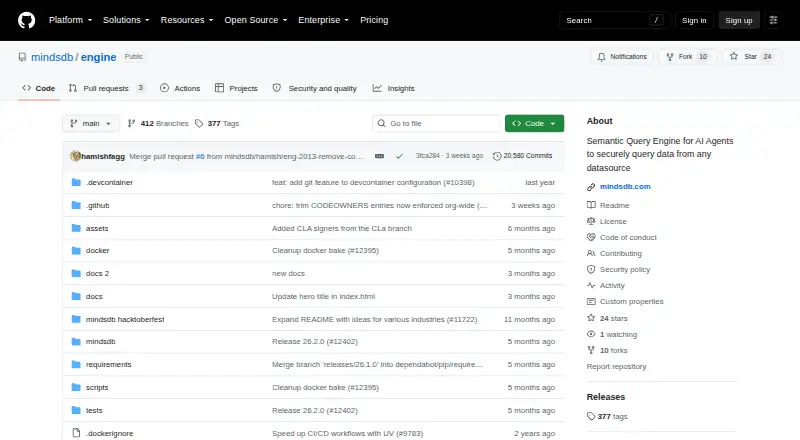
What MindsDB Query Engine is
MindsDB Query Engine is an open-source query engine for connecting data sources through SQL and running semantic search. It queries connected sources live through one SQL dialect rather than copying data or using ETL pipelines, and the project says it connects to more than 200 sources. Examples include PostgreSQL, MySQL, MongoDB, Snowflake, BigQuery, S3, and Slack. Users can work in its HTTP SQL editor or connect clients such as DBeaver and SQLAlchemy using MySQL or PostgreSQL wire protocols. Knowledge bases combine an embedding model, an optional reranking model, and a vector store to index and retrieve unstructured content. Hybrid search pairs vector similarity with BM25 keyword matching and merges the results. Projects namespace work, views preserve cross-source transformations, and jobs schedule SQL runs. Deployment options include Docker and PyPI installation. The project presents the engine as a way to give AI agents live SQL access and semantic search. MindsDB Core uses the Elastic License 2.0, and the repository notes that some directories have separate licenses.
Good
- Connects to more than 200 data sources.
- Queries data in place without ETL pipelines.
- Supports MySQL and PostgreSQL wire protocols.
- Jobs can schedule SQL runs.
Watch out
- MindsDB Core uses Elastic License 2.0.
- Some repository directories have separate licenses.
Who it suits
It suits teams or developers who want to query connected data sources with SQL or add semantic search to data workflows. The project also describes use by AI agents needing live, queryable data access.
Verdict
MindsDB Query Engine brings live federated SQL queries and semantic search into one engine. Review the license details for the components you plan to use.
Plans and prices
From MindsDB Query Engine's own pricing page, checked 8 Oct 2026.
| Plan | Price | What it gives you |
|---|---|---|
| Open-source Query Engine | Free | Standalone open-source project · MindsDB Core is licensed under Elastic License 2.0 |
The facts
Each one read from MindsDB Query Engine's own pages, with the date it was checked.
What it does
- Audience
- The project describes itself as a standalone open-source query engine that can give AI agents live, SQL-queryable access to data and semantic search.checked 8 Oct 2026
- Deployment
- The project documents running the engine with Docker or installing it from PyPI.checked 8 Oct 2026
- Federated queries
- It queries connected sources live through one SQL dialect without copying the data or using ETL pipelines.checked 8 Oct 2026
- Hybrid search
- Hybrid search runs vector similarity and BM25 keyword matching in parallel and merges the results.checked 8 Oct 2026
- Integrations
- The README names databases, warehouses, applications, and files as source categories and gives PostgreSQL, MySQL, MongoDB, Snowflake, BigQuery, S3, and Slack as examples.checked 8 Oct 2026
- Interfaces
- The engine includes an HTTP SQL editor and supports MySQL and PostgreSQL wire protocols for clients such as DBeaver and SQLAlchemy.checked 8 Oct 2026
- Knowledge bases
- Knowledge bases combine an embedding model, an optional reranking model, and a vector store to index and retrieve unstructured content.checked 8 Oct 2026
- License
- MindsDB Core is licensed under Elastic License 2.0, and the repository notes that some directories have their own licenses.checked 8 Oct 2026
- Organization and automation
- Projects namespace work, views save cross-source transformations, and jobs schedule SQL to run on an interval.checked 8 Oct 2026
- Purpose
- MindsDB Query Engine provides semantic search over data through SQL and connects to more than 200 data sources.checked 8 Oct 2026
- Security and data handling
- The README says connected source data is queried in place and is never copied, and directs vulnerability reports to its security policy instead of public issues.checked 8 Oct 2026
- Support
- The project points users to Discord for questions, GitHub Issues for bugs, and team contact for commercial support.checked 8 Oct 2026
The company
- Founded
- 2018checked 28 Sep 2026
- Headquarters
- Berkeley, California, United Stateschecked 28 Sep 2026
- Maker history
- MindsDB's about page says Jorge Torres and Adam Carrigan released the first MindsDB version in Berkeley in 2018.checked 8 Oct 2026
The full review of MindsDB Query Engine
MindsDB Query Engine is a self-hosted SQL layer that reaches across live data sources while also searching unstructured content semantically. It suits teams building AI-agent data access or unifying queries across many systems without an ETL copy. The combination is compelling, but commercial adoption requires a close reading of its licensing.
Overview
The engine connects to more than 200 data sources and queries them through one SQL dialect, leaving information in the systems where it already lives. That makes it useful when databases, warehouses, applications, and files are fragmented across an organisation, and avoids building a separate ingestion pipeline for every connection. Live federation does not remove the need to secure, monitor, and maintain those underlying systems, and query performance will still depend on them.
MindsDB presents the project as a standalone engine that gives AI agents current, SQL-queryable data alongside semantic search. Jorge Torres and Adam Carrigan released the first version in Berkeley in 2018.
Key features
Federated SQL and client access
An HTTP SQL editor provides a direct browser-facing interface. MySQL and PostgreSQL wire-protocol support lets established clients such as DBeaver and SQLAlchemy connect, which is a practical advantage for teams that want to preserve existing SQL workflows. Named integration examples include PostgreSQL, MySQL, MongoDB, Snowflake, BigQuery, S3, and Slack, spanning structured stores, cloud warehouses, files, and applications.
Semantic and hybrid search
Knowledge bases combine an embedding model, an optional reranking model, and a vector store to index and retrieve unstructured material. Hybrid search runs vector similarity and BM25 keyword matching in parallel before merging the results. That combination is better suited to queries where meaning and exact terms both matter than a vector-only approach, while the embedding, reranking, and storage components still need to be selected and operated.
Projects, views, and jobs
Projects provide namespaces for organising work. Views can preserve transformations that combine data from different sources, and scheduled jobs run SQL at an interval. Together, these features turn one-off federation into repeatable data preparation and automation, although they also create routines that need ownership and monitoring.
Deployment and data handling
The project documents Docker deployment and installation from PyPI, giving self-hosting teams two familiar ways to run it. Connected data is queried in place rather than copied into the engine. Vulnerability reports are directed to a security policy instead of public issues, while questions go to Discord, bugs to GitHub Issues, and commercial support to the team.
Pricing
The Open-source Query Engine plan costs free. It is a standalone open-source project with self-hosted SQL querying, API access, and scheduled queries. There is no paid tier or separate hosted allowance stated for this engine, so teams should budget for their own deployment and operations. MindsDB Core uses the Elastic License 2.0, and some repository directories have their own licenses; organisations distributing or commercialising the software should review those terms rather than treating “free” as unrestricted commercial licensing.
Platforms
MindsDB Query Engine is offered through an API and web interface, runs on Linux, and supports self-hosted deployment. Docker and PyPI installation documentation make it a fit for teams controlling their runtime rather than seeking a managed service.
Who it's for
This is a strong match for data and platform teams that need AI agents to reach current information through SQL, or that must query several databases and services without first copying everything into a warehouse. It also suits organisations that want semantic retrieval over internal documents alongside federated structured queries, and developers who rely on DBeaver, SQLAlchemy, or compatible MySQL and PostgreSQL clients.
It is less suitable for buyers seeking a fully managed product, a single-vendor support contract by default, or licensing with no Elastic License review. Teams unwilling to operate self-hosted infrastructure should look at hosted alternatives instead.
Pros and cons
- Pro: Live federation across more than 200 sources avoids a central ETL copy and keeps source data in place.
- Pro: MySQL and PostgreSQL protocols, plus an HTTP editor, preserve familiar SQL access patterns.
- Pro: Knowledge bases and hybrid vector/BM25 search cover unstructured retrieval as well as relational queries.
- Pro: Projects, reusable views, and scheduled SQL support repeatable cross-source workflows.
- Con: Self-hosting leaves deployment, upgrades, security, and source-system operations to the customer.
- Con: Elastic License 2.0 for MindsDB Core and separate directory licenses require commercial due diligence.
- Con: Support is split among community channels, issue tracking, and team contact rather than included as a conventional service plan.
Alternatives
Choose Denodo Platform instead when you need a paid data-virtualisation product with a free Developer plan, a Windows option, and stated limits of one server, four cores, 50 data products, and 2.5 TB per year.
Stardog is the alternative when a renewable free one-year license, up to one million stored edges, three databases, and community support fit your knowledge-graph project.
Pick Apache Drill for an Apache-licensed downloadable engine that can run embedded or in a cluster.
QoreDB is another free-tier option combining SQL and NoSQL engines with a read-only MCP server and database editors.
Consider Teradata VantageCloud when you want Teradata Database and ClearScape Analytics with a free plan and trial, subject to custom pricing.
Presto is the straightforward choice for an open-source SQL query engine deployed on-premises or in any cloud.
Choose Starburst Galaxy for a hosted freemium service whose free tier allows three clusters and ad hoc queries.
Teiid is a neutral alternative as a free, open-source data-virtualisation project with no commercial plans listed.
For a broader category view, see Data Federation Software.
Verdict
MindsDB Query Engine is a strong choice for technically capable teams that need live federated SQL and semantic search in the same self-hosted engine, especially for AI-agent access to changing data. Its main reasons to look elsewhere are the operational burden of running it yourself and the Elastic License 2.0, which may not fit every commercial deployment.
Alternatives to MindsDB Query Engine
- 1

Stardog
Free planAndroidiOSWebAPI7.7Free plan - 2

Starburst Galaxy
Free planWebAPILinux7.1Free plan - 3
Apache Drill
Free planAPILinuxmacOSSelf-hosted6.7Free plan - 4
Denodo Platform
Free planWebAPILinuxSelf-hosted6.7Free plan - 5
Enterprise Enabler
WebAPILinuxmacOS6.7From $2.17 a month - 6
QoreDB
Free planLinuxmacOSWindows6.7From €99 a year