
Microsoft Fabric Notebooks
Microsoft Fabric Notebooks is a web-based interactive coding environment for Apache Spark jobs and machine learning experiments, intended for data engineers …
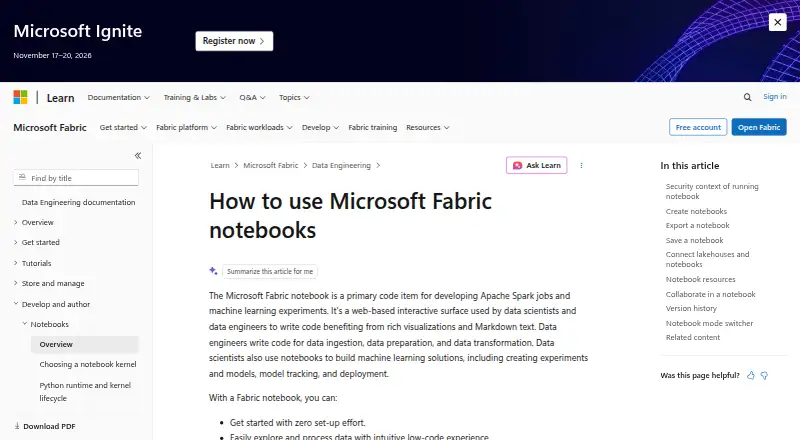
What Microsoft Fabric Notebooks is
Microsoft Fabric Notebooks is a web-based interactive coding environment for Apache Spark jobs and machine learning experiments, intended for data engineers and data scientists. Users can import Jupyter .ipynb notebooks and source files in .py, .scala, and .sql formats. Spark can work with CSV, TXT, JSON, Parquet, and Delta Lake data, while notebooks can attach multiple lakehouses, pin a default, and read or write through local paths. The Job Scheduler API supports parameterized runs, session and environment configuration, runtime and lakehouse selection, monitoring, and cancellation. NotebookUtils handles files in ADLS Gen2, Azure Blob Storage, and Lakehouse storage, and can retrieve secrets from Azure Key Vault. Multiple users can co-edit, see collaborators’ cursors and output, and comment on cells. Copilot can generate, refactor, summarize, and validate code, suggest fixes, and apply changes with approval. Microsoft describes encrypted, authenticated interactions using Microsoft Entra ID and encryption at rest, along with other workspace and outbound protections.
Good
- Imports Jupyter notebooks and common source-file formats.
- Supports multiple attached lakehouses.
- Job Scheduler API supports monitoring and cancellation.
- Multiple users can co-edit and comment on cells.
- Copilot can suggest fixes with approval-based changes.
Watch out
- The free trial is limited to 60 days.
- Built-in and environment storage are each limited to 500 MB.
- Each file is limited to 100 MB.
- Some downstream services require a user principal for unattended automation.
Who it suits
Fabric Notebooks suits data engineers and data scientists building Spark jobs or machine learning experiments in notebooks. It may also fit teams that need shared editing, scheduled runs, or lakehouse and cloud-storage workflows.
Verdict
Fabric Notebooks combines Spark development, lakehouse access, scheduled execution, and collaboration in a web-based environment. The trial is time-limited, and users should account for the stated file and storage caps when planning notebook workflows.
Plans and prices
From Microsoft Fabric Notebooks's own pricing page, checked 12 Oct 2026.
| Plan | Price | What it gives you |
|---|---|---|
| Fabric trial capacity | Free | Use across Fabric workloads · trial capacity only · 60-day free trial; each user receives a fixed 64 CU trial capacity |
| Fabric capacity (pay-as-you-go or reservation) | Priced on request | F2–F8192 capacity SKUs · Notebook use is covered by Fabric capacity · storage may be billed separately · Usage-based shared capacity; pay-as-you-go or 1- or 3-year reservation; regional prices shown by selecting pricing options |
The facts
Each one read from Microsoft Fabric Notebooks's own pages, with the date it was checked.
What it does
- Automation
- The Job Scheduler API supports parameterized notebook runs, session configuration, environment and runtime selection, lakehouse selection, run monitoring, and cancellation.checked 12 Oct 2026
- Collaboration
- Multiple users can co-edit a notebook, see collaborators’ cursors and run output, and add cell-level comments.checked 12 Oct 2026
- Copilot
- Copilot can generate, refactor, summarize, and validate notebook code and suggest fixes for failed cells or Spark jobs, with approval-based code changes.checked 12 Oct 2026
- Data formats
- Notebooks use Spark to analyze raw formats such as CSV, TXT, and JSON, as well as Parquet and Delta Lake files.checked 12 Oct 2026
- Execution identity
- Interactive runs use the current user identity, pipeline runs use the pipeline’s last modified user, and scheduled runs use the user who created or last updated the schedule.checked 12 Oct 2026
- Lakehouse integration
- Users can attach multiple lakehouses, pin a default lakehouse, and read or write to it using local paths.checked 12 Oct 2026
- Languages and formats
- Notebooks can import Jupyter .ipynb files and source files including .py, .scala, and .sql.checked 12 Oct 2026
- Purpose
- Fabric notebooks are a web-based interactive code surface for Apache Spark jobs and machine learning experiments, used by data engineers and data scientists.checked 12 Oct 2026
- Resource limits
- Notebook built-in and environment resource storage is limited to 500 MB each, with a maximum 100 MB per file and 100 total file or folder instances each.checked 12 Oct 2026
- Security
- Microsoft says Fabric interactions are encrypted and authenticated with Microsoft Entra ID, data at rest is encrypted, and Notebook items support workspace private links, customer-managed keys, and outbound access protection.checked 12 Oct 2026
- Storage integrations
- NotebookUtils provides file operations across ADLS Gen2, Azure Blob Storage, and Lakehouse storage, and can retrieve secrets from Azure Key Vault.checked 12 Oct 2026
- Support
- Eligible Fabric users can create Fabric support tickets from the in-product Help Pane; ticket access depends on the user’s role and license.checked 12 Oct 2026
- Unattended automation
- Service principal authentication is supported for notebook Items REST API operations and Job Scheduler API execution, monitoring, and cancellation, though some downstream services require a user principal.checked 12 Oct 2026
Money
- Free plan
- Yeschecked 20 Sep 2026
Alternatives to Microsoft Fabric Notebooks
- 1

Informatica Intelligent Data Management Cloud
Free planWebAPIExtensionLinux8.0From £26,550 a year - 2
Google Cloud Lakehouse for Apache Iceberg
Free planWebAPILinuxSelf-hosted7.5From $0.12 a month - 3

Starburst Galaxy
Free planWebAPILinux7.1Free plan - 4
Denodo Platform
Free planWebAPILinuxSelf-hosted6.7Free plan - 5

Qubole
WebAPI6.3 - 6
Apache Hudi
Free planLinuxSelf-hosted6.0Free plan