Mainfolk
Mainfolk is a website builder for organizations, including churches, that creates an AI-generated first draft.
What Mainfolk is
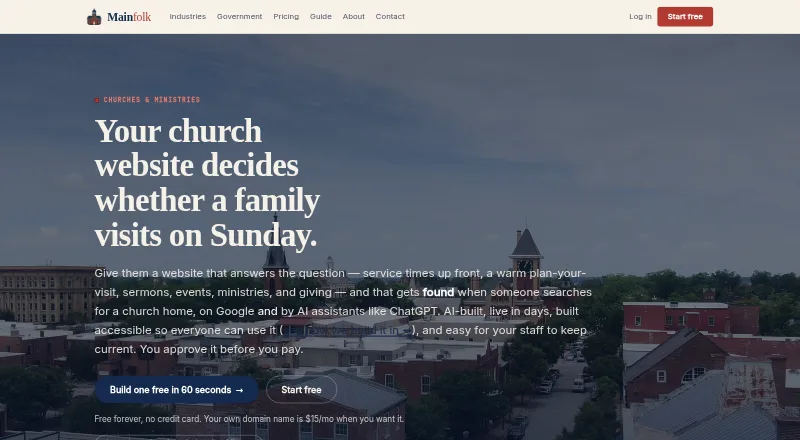
Mainfolk is a website builder for organizations, including churches, that creates an AI-generated first draft. Church sites can present service times, visitor information, sermons and media, events, groups, ministries, and giving. Staff can edit page content directly, and Mainfolk says published changes go live worldwide in under a minute. Giving pages can link to an existing provider such as Tithe.ly, Pushpay, or PayPal, leaving the church with its processor. Mainfolk says sites include structured data, semantic HTML, and a per-site llms.txt for discovery in search engines and AI answers. Hosting, SSL, updates, security patching, and global delivery are included on all tiers. It says it builds to WCAG 2.1 Level AA, while noting uploaded documents and third-party embeds can cause accessibility issues outside its rendering engine. Mainfolk says users can export pages, images, submissions, and subscribers on any plan, and sites continue on Free after cancellation. Access is available on Android, iOS, and web.
Good
- Starts with an AI-generated first draft.
- Church pages can include sermons, events, groups, and giving.
- Includes hosting, SSL, updates, and security patching on all tiers.
- Users can export site content on any plan.
Watch out
- Customer-authored documents and third-party embeds can affect accessibility.
- Free plan uses a yourname.mainfolk.com address and includes a footer note.
- Free plan includes about 10 AI assists per month.
Who it suits
Mainfolk suits small churches seeking a website without an agency or a volunteer maintaining WordPress. It also fits organizations that want editable pages, giving links, and church-specific content sections.
Verdict
Mainfolk combines a church-oriented site structure with direct editing and built-in hosting. Its accessibility note is important for sites using uploaded documents or third-party embeds.
Plans and prices
From Mainfolk's own pricing page, checked 15 Oct 2026.
| Plan | Price | What it gives you |
|---|---|---|
| Free | Free | 1 website · yourname.mainfolk.com address · about 10 AI assists/month · unlimited edits · community help · footer note · free forever; no card needed |
| Launch | $15 a month | own domain · up to 3 websites · 2 additional editors · more AI help · email support · $15/month or $150/year, 2 months free |
| Pro | $29 a month | up to 10 websites · visitor analytics · news and blog posts · 9 additional editors · priority support · $29/month or $290/year, 2 months free |
| Civic | $149 a month | up to 25 websites · unlimited staff editors · emergency alert banner · accessibility statement page · free site migration · written quote, W-9 and PO · $149/month or $1,490/year, 2 months free |
| White-Glove Design | $199, paid once | team designs site pages, words and photos · one-time $199; ordinary plan price still applies |
The facts
Each one read from Mainfolk's own pages, with the date it was checked.
What it does
- Accessibility
- Mainfolk says it builds to WCAG 2.1 Level AA and lists semantic structure, keyboard operation, editable AI-generated image alt text, reduced-motion support, and labeled forms.checked 29 Sep 2026
- Accessibility limit
- Mainfolk says customer-authored content such as uploaded documents and third-party embeds can introduce accessibility issues outside its rendering engine.checked 29 Sep 2026
- Accessibility limitation
- Mainfolk warns that customer-uploaded documents and third-party embeds can create accessibility issues outside its rendering engine.checked 15 Oct 2026
- Accessibility standard
- Mainfolk states that its platform is built to WCAG 2.1 Level AA with semantic HTML, keyboard operation, visible focus, editable alt text, reduced-motion support and labeled forms.checked 15 Oct 2026
- Account login
- Accounts use one-click magic links sent by email instead of passwords.checked 15 Oct 2026
- AI-content limitation
- Terms warn that AI drafts can contain mistakes and require review before publication.checked 15 Oct 2026
- AI generation
- The AI plans pages, writes copy, selects a palette and typography, and places imagery for a complete first draft.checked 15 Oct 2026
- Analytics
- Pro and Civic provide plain-language visitor counts, referral sources, popular pages and form-message reporting without a separate analytics account.checked 15 Oct 2026
- Announcement banner
- Civic sites include an emergency or announcement banner that staff can publish quickly for urgent notices or events.checked 15 Oct 2026
- Availability limitation
- Terms state that uninterrupted service is not promised and describe the service as provided as-is and as-available.checked 15 Oct 2026
- Church content
- Church sites can publish service times, plan-your-visit information, sermons, media, events, groups, ministries and giving.checked 15 Oct 2026
- Data portability
- Mainfolk says users can export pages, images, submissions, and subscribers at any time on any plan, and sites continue on Free after cancellation.checked 29 Sep 2026
- Direct editing
- Staff edit page blocks directly and published changes are stated to go live worldwide in under a minute.checked 15 Oct 2026
- Editing
- Staff can edit by clicking page content and publish changes that Mainfolk says go live worldwide in under a minute.checked 29 Sep 2026
- Giving integrations
- Giving pages can link to an existing processor such as Tithe.ly, Pushpay or PayPal, while the church keeps that processor.checked 15 Oct 2026
- Hosting
- All plans include hosting, an SSL security certificate, updates, security and global edge delivery.checked 15 Oct 2026
- Intended users
- Mainfolk describes its church offering as suited to small churches that want a website without an agency or a volunteer maintaining WordPress.checked 29 Sep 2026
- Licence
- The Mainfolk platform, software, design system and templates are identified as property of Champlin Enterprises, LLC.checked 15 Oct 2026
- LinkedIn data integrations
- The LinkedIn profile describes Chamber Culture integrations with Bureau of Labor Statistics and U.S. Census data through APIs.checked 15 Oct 2026
- LinkedIn flagship
- The company describes Chamber Culture as its flagship product and says it includes Mainfolk-powered member websites.checked 15 Oct 2026
The company
- Headquarters
- Gurnee, Illinois, United Stateschecked 23 Sep 2026
- LinkedIn company focus
- The LinkedIn profile says the firm builds SaaS intelligence tools aimed at local economic development.checked 15 Oct 2026
- LinkedIn company size
- LinkedIn lists Champlin Enterprises, LLC as having one employee.checked 15 Oct 2026
- LinkedIn founded
- LinkedIn lists the company as founded in 2026.checked 15 Oct 2026
The full review of Mainfolk
Overview
Mainfolk is a website builder for churches and other organizations, aimed especially at small congregations that want staff to manage their own site. Its church-specific content and direct editing make it a practical alternative to hiring an agency or depending on a WordPress volunteer, though larger teams will need a higher-tier plan.
Key features
Church content and editing
An AI-generated first draft gives a church a starting structure for service times, visitor information, sermons and media, events, groups, ministries, and giving. Staff can edit by clicking the page content, and Mainfolk says published changes go live worldwide in under a minute. That combination suits congregations that need to keep routine information current without handing every change to an outside designer.
For donations, a church can link to an existing processor such as Tithe.ly, Pushpay, or PayPal, retaining its processor rather than replacing it. Mainfolk says every site includes structured data, semantic HTML, and a site-specific llms.txt to support discovery in search engines and AI answers. Pro adds plain-language analytics about visitor activity, referral sources, popular pages, and form messages; smaller churches that do not need those insights can avoid paying for them.
Accessibility, hosting, and control
Mainfolk says its sites are built to WCAG 2.1 Level AA, with semantic structure, keyboard operation, editable alt text for AI-generated images, reduced-motion support, and labeled forms. That is a useful baseline, but it does not guarantee every page remains accessible: uploaded documents and third-party embeds can introduce issues outside Mainfolk's rendering engine, so churches should review the material they add.
All tiers include hosting, SSL, platform updates, security patching, and global delivery, reducing the maintenance work a church must handle itself. Mainfolk says it does not sell personal information and names Stripe, Mailgun, Cloudflare, and its hosting provider among service vendors. Users can export pages, images, submissions, and subscribers on any plan, and a site stays on Free after cancellation. Those provisions make it easier to leave without losing the site's core material.
Pricing
Mainfolk is freemium, with no free trial. Free costs $0/month and includes a yourname.mainfolk.com address, unlimited edits, about 10 AI assists per month, community help, and a footer note. It is suitable for a church establishing a basic presence, but the platform address and footer note make it less polished than a custom-domain site, and the AI-assist allowance is modest.
Launch costs $15/month or $150/year, with two months free on annual billing. It adds an own domain, two editors, more AI help, and email support. This is the sensible starting paid plan for a small staff, but the two-editor ceiling can constrain a church with several people maintaining pages.
Pro costs $29/month or $290/year, with two months free on annual billing. It includes Launch features plus visitor analytics, nine editors, more AI help, and priority support. Choose it when several staff members need access or visitor insights matter; a small congregation with one or two editors may not need the upgrade.
Civic costs $149/month or $1,490/year, with two months free on annual billing. It includes Pro features, unlimited staff editors, up to 25 websites, an emergency alert banner, and free site migration. Those capabilities fit organizations overseeing multiple sites or needing broad staff access, but are more than a single small church is likely to need.
White-Glove Design is a one-time $199 for a team to design site pages, words, and photos; the ordinary plan price still applies. It offers help with the initial presentation rather than replacing the ongoing subscription. Mainfolk also offers customer contact with the engineers who built the platform, alongside community help on Free, email support on Launch, and priority support on Pro.
Platforms
Mainfolk supports Android, iOS, and web. Churches can choose it across those platforms, while hosting and security services are included at every plan level.
Who it's for
Mainfolk is best suited to a small church that wants a purpose-oriented site, needs to publish sermons or events, and prefers staff-led edits over agency work or volunteer WordPress maintenance. It is less compelling for a single church needing little more than a static page on a custom domain if Free's platform address and footer note are unacceptable, or for a large organization that does not need Civic's multi-site capacity.
Pros and cons
- Church-specific page needs: Service information, sermons, events, groups, ministries, and giving fit common congregational publishing needs.
- Low-maintenance operation: Hosting, SSL, updates, and security patching are included across all tiers.
- Portable content: Export is available on any plan, and sites continue on Free after cancellation.
- Free plan trade-offs: The Mainfolk subdomain, footer note, and roughly 10 monthly AI assists limit how finished or AI-assisted a free site can be.
- Accessibility requires care: Uploaded documents and third-party embeds can create problems beyond Mainfolk's rendering engine.
- Editor counts vary by plan: Launch allows two editors and Pro nine; unlimited staff editing requires Civic.
Alternatives
For more options focused on church sites, browse Church Website Builders. Mainfolk is also grouped among Legal Marketing Software, Law Firm Website Builders, and Dental Website Builders.
Law Firm Central is a web-based freemium option with a free hosted firm page, lead form, and basic SEO; consider it instead when those law-firm basics are the priority. Avago offers AI website generation, device previews, an AI content assistant, free stock images, and logo generation, with a paid Go live plan at £34.99 a month; it may suit a general website project rather than a church-specific one. GoBoom is a paid web alternative.
Birdeye is a paid web option. Lawmatics is a paid service without a free plan, with a free trial and an Essential plan that includes 500 contacts, client intake, lead management, calendaring, forms, e-signature, SMS, and task management; choose it when legal intake and lead management are the main need. Legalfit is a paid web service without a free plan, with an Optimizer Base offering a website, SEO and AI optimization, ADA technology and compliance, payments, and one content piece per month, plus a build fee; it is a more relevant direction for law firms seeking those services.
LexGrow is a paid web option without a free plan, starting at $599/month for solo attorneys building local search presence and $1,499/month for firms competing for broader visibility. ReferDesk is free and supports web, Windows, and macOS.
Verdict
Choose Mainfolk if a small church wants a manageable, church-oriented site with direct staff editing, included hosting, and a path from a free plan to custom-domain publishing. Its strongest reason to buy is the combination of church content needs and low-maintenance operation; look elsewhere if uploaded content and embeds make accessibility assurance especially important, or if you need capabilities beyond its editor and site limits without stepping up to Civic.
Getting started
- Visit Mainfolk's church websites page.
- Choose the Free plan or a paid plan; Launch, Pro, and Civic are available.
- Use the AI-generated first draft as the starting point for the site.
- Edit page content by clicking it, then publish changes.
- Link the giving page to an existing processor such as Tithe.ly, Pushpay, or PayPal, if applicable.
Limits worth knowing
Free includes about 10 AI assists per month, a mainfolk.com address, community help, and a footer note. Accessibility issues can arise from customer-uploaded documents and third-party embeds.
Questions
Is there a free plan or free trial?
There is a Free plan, but no free trial is offered.
How much do the plans cost?
Free is free. Launch is $15 a month, Pro is $29 a month, and Civic is $149 a month; annual billing is also listed for those paid plans. White-Glove Design costs 199.00 USD once, and the ordinary plan price still applies.
Which platforms can I use?
Mainfolk lists Android, iOS, and web.
Can a church use its existing giving processor?
Yes. The giving page can link to an existing processor such as Tithe.ly, Pushpay, or PayPal, and the church keeps its processor.
What can churches publish with Mainfolk?
Church sites can include service times, plan-your-visit information, sermons and media, events, groups, ministries, and giving.
Who is Mainfolk designed for?
Mainfolk describes its church offering as suited to small churches that want a website without an agency or a volunteer maintaining WordPress.
Alternatives to Mainfolk
- 1
ReferDesk
Free planWebmacOSWindows6.9Free plan - 2

Avago
Free planWeb6.8From £34.99 a month - 3

Birdeye
AndroidiOSWebAPI6.8 - 4

Law Firm Central
Free planWeb6.7From $497 a month - 5
Pantora
AndroidiOSWeb6.7From $499 a month - 6

AgencyAnalytics
WebAPI6.6From $20 a month