Livegrep
Livegrep is open-source software for interactive regular-expression searches across source repositories, including repositories around gigabyte scale.
What Livegrep is
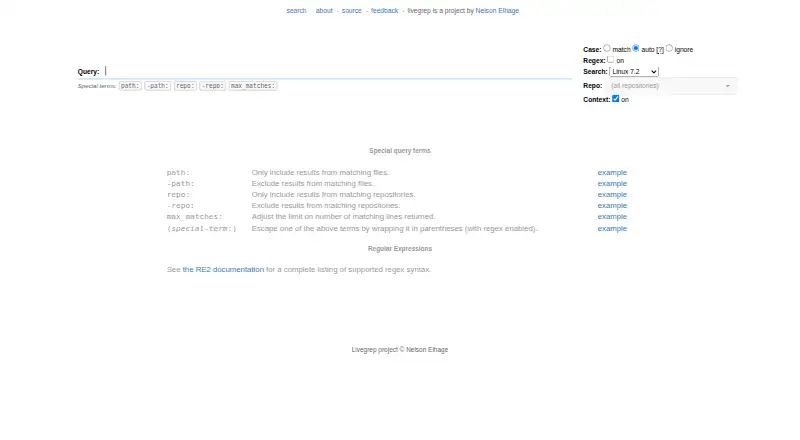
Livegrep is open-source software for interactive regular-expression searches across source repositories, including repositories around gigabyte scale. It combines a codesearch indexing and search backend with a web interface connected over TCP. Searches use Google’s RE2 syntax and support terms such as path:, -path:, repo:, -repo:, and max_matches:. After indexing, searches run from the index without further access to original Git repositories. Codesearch can keep an in-memory index or save a standalone file for reuse, including indexes too large for RAM. The index is usually three to five times the indexed text size; Livegrep memory-maps it and recommends fast SSDs when it does not fit in memory. A helper can update selected GitHub repositories, and the interface can show source files when local paths are configured. Docker deployment is documented. By default, the frontend uses backend port 9999 and serves HTTP on port 8910.
Good
- Open-source repository search
- RE2 regular-expression syntax
- Reusable standalone index files
- GitHub indexing helper
- Docker deployment documented
Watch out
- Index may require three to five times text size
- Fast SSDs recommended when index exceeds RAM
- Requires separate indexer, backend, and frontend
Who it suits
It suits developers and teams searching large source repositories with regular expressions. Self-hosting users comfortable with Bazel, C++, Go, or Docker can deploy its components.
Verdict
Livegrep provides focused, self-hosted code search with reusable indexes and repository filtering. Its resource requirements and multi-component setup are important considerations for deployment.
The facts
Each one read from Livegrep's own pages, with the date it was checked.
What it does
- Architecture
- The backend index and search process is written in C++ and the web frontend is implemented in Go.checked 10 Oct 2026
- Build requirements
- The project builds with Bazel and requires a relatively recent C++ compiler; the initial build downloads around 100 MB of dependencies.checked 10 Oct 2026
- Deployment
- The project documents Docker images and example commands for running its indexer, backend, and web frontend.checked 10 Oct 2026
- Docker
- Livegrep's CI builds Docker images on every merge to main, and the repository documents running its indexer, backend, and frontend in containers.checked 4 Oct 2026
- File browsing
- Livegrep can display source files directly in its interface when configured with local source paths.checked 10 Oct 2026
- GitHub integration
- A helper called livegrep-github-reindex can automatically update and index selected GitHub repositories.checked 10 Oct 2026
- Index files
- The backend can save and reuse standalone index files, including indexes too large to fit in RAM.checked 4 Oct 2026
- Indexing
- Codesearch can build an in-memory index or save an index file that can be reused for later runs.checked 10 Oct 2026
- Intended users
- The project describes itself as a tool for interactively searching source code, including large repositories.checked 4 Oct 2026
- Local deployment
- By default, the frontend connects to a local codesearch instance on port 9999 and serves HTTP on port 8910.checked 4 Oct 2026
- Open source
- Livegrep is open source and is written and run by Nelson Elhage.checked 4 Oct 2026
- Purpose
- Livegrep is an open-source tool for interactive regex search of source repositories around gigabyte scale.checked 10 Oct 2026
- Regex engine
- Livegrep uses RE2 and inherits its supported syntax.checked 10 Oct 2026
- Repository access
- After an index is built, Livegrep works from that index without further access to the original Git repositories.checked 10 Oct 2026
- Resource requirements
- An index is usually 3–5 times the size of indexed text; memory-mapping allows indexes larger than available RAM, while faster SSDs are recommended for performance.checked 10 Oct 2026
- Search syntax
- The web search supports regular expressions and special terms including path:, repo:, and max_matches:.checked 10 Oct 2026
- Self-hosting
- To run Livegrep, users invoke both the codesearch backend and the web interface.checked 10 Oct 2026
- Support
- The about page lists [email protected] as the feedback contact.checked 4 Oct 2026
The company
- Maker
- Livegrep is written and run by Nelson Elhage.checked 10 Oct 2026
Where it runs
- Repository browser
- Livegrep can display source files directly in its interface when configured with local source paths.checked 4 Oct 2026
Alternatives to Livegrep
- 1
Avidemux
Free planOpen sourceWebLinuxmacOSWindows7.3Free plan - 2

Understand
APIExtensionLinuxmacOS7.2From $100 a month - 3

ast-grep
Free planWebAPIExtensionLinux7.0Free plan - 4

Chromium
Open sourceAndroidiOSExtensionLinux6.9 - 5
Semantic Designs Source Code Search Engine
Free planAPILinuxSelf-hostedWindows6.7Free plan - 6

Code Fundi
Free planWebAPIExtension6.6From $21 a month