KW Clusterized
KW Clusterized organizes raw keyword lists into topical groups to help structure search intent.
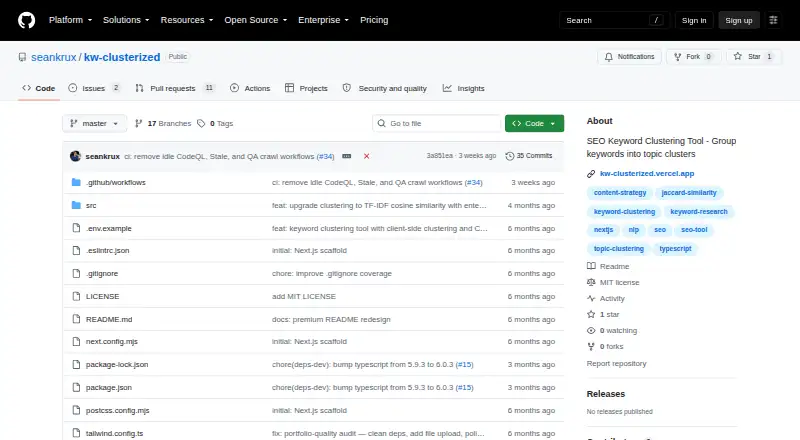
What KW Clusterized is
KW Clusterized organizes raw keyword lists into topical groups to help structure search intent. It is aimed at SEOs, content strategists, and growth teams. Keywords can be pasted as comma-separated or newline-delimited text, or supplied through CSV, TXT, and TSV uploads. The app deduplicates entries and processes large sets in one pass, using word overlap, Jaccard similarity, and greedy single-linkage agglomerative clustering. Results are shown in color-coded cards with automatically generated labels, and assignments can be exported to CSV with cluster ID, label, and keyword columns. Similarity thresholds are configurable in the clustering engine’s code rather than described as an in-app control. The README says analysis runs in the browser, keeps keywords there, and makes no server round-trips or API calls. The repository provides the software under the MIT License with an as-is warranty disclaimer. Local use requires Node.js 18.17 or later and npm 9 or later; the project can also be deployed on Vercel and has a linked live demo.
Good
- Accepts pasted terms and CSV, TXT, or TSV files.
- Deduplicates and processes large keyword sets in one pass.
- Exports cluster assignments as CSV.
- Keywords remain in the browser during analysis.
Watch out
- Similarity thresholds are adjusted in code.
- Local setup requires Node.js 18.17 or later.
- SERP analysis is not included.
Who it suits
This tool is suited to SEO, content, and growth teams that need to organize keyword lists into reviewable clusters. It also fits users comfortable with local setup or code-level threshold changes.
Verdict
KW Clusterized provides a focused workflow for turning keyword lists into labeled clusters and CSV exports. Its code-configurable thresholds and documented local setup make it more suitable for users comfortable with a technical workflow.
The facts
Each one read from KW Clusterized's own pages, with the date it was checked.
What it does
- API use
- The README says the app makes no API calls and returns immediate output.checked 9 Oct 2026
- Batch handling
- The app handles large keyword sets in one pass, deduplicates entries, and groups them into clusters.checked 8 Oct 2026
- Batch processing
- The tool handles large keyword sets in one pass, deduplicates entries, and groups them into reviewable clusters.checked 9 Oct 2026
- Cluster display
- Clusters appear as color-coded cards with auto-generated labels.checked 9 Oct 2026
- Clustering method
- It uses Jaccard similarity, word overlap analysis, and greedy single-linkage agglomerative clustering.checked 9 Oct 2026
- Cluster review
- Cluster cards are color-coded and receive automatically generated labels.checked 8 Oct 2026
- Data handling
- The README says analysis runs in the browser with zero server round-trips and keywords stay in the browser.checked 9 Oct 2026
- Deployment
- The README says the application can be deployed on Vercel and links to a live demo.checked 9 Oct 2026
- Export
- Users can download cluster assignments as CSV with cluster ID, label, and keyword columns.checked 9 Oct 2026
- Input formats
- Users can paste comma-separated or newline-delimited keywords, or upload CSV, TXT, and TSV files.checked 9 Oct 2026
- Intended users
- The README identifies SEOs, content strategists, and growth teams as users.checked 8 Oct 2026
- License
- The repository lists an MIT license.checked 9 Oct 2026
- Local setup
- The project can be run locally with Node.js 18.17 or later and npm 9 or later.checked 9 Oct 2026
- Purpose
- KW Clusterized is a client-side keyword clustering tool that groups raw keyword lists into topical clusters for SEOs, content strategists, and growth teams.checked 9 Oct 2026
- Similarity threshold
- The clustering engine supports configurable similarity thresholds, which the README says can be adjusted in code.checked 8 Oct 2026
- Technology
- The listed stack includes Next.js 14, TypeScript 5, React 18, Tailwind CSS 3, and the browser FileReader API.checked 9 Oct 2026
- Thresholds
- The clustering engine supports configurable similarity thresholds in code.checked 9 Oct 2026
The company
- Maker
- The README credits the project as built by Sean G.checked 9 Oct 2026
The full review of KW Clusterized
KW Clusterized is a browser-based tool for turning raw keyword lists into topical clusters and downloadable CSVs. It suits SEO and content teams that want a private, no-API workflow and can work with a code-configurable similarity threshold. Its narrow, free workflow is useful for organizing keywords, but less suited to teams seeking SERP analysis or adjustable settings through a user-facing interface.
Overview
Paste comma-separated or newline-delimited keywords, or upload a CSV, TXT, or TSV file. KW Clusterized deduplicates entries and groups large keyword sets in one pass, then presents the results as color-coded cluster cards with automatically generated labels. That gives users a direct route from an unstructured list to something they can review and export, without a separate API step.
The clustering combines word overlap, Jaccard similarity, and greedy single-linkage agglomerative clustering. Similarity thresholds can be changed in code, not through a documented in-app control. That is a meaningful distinction: the default workflow is straightforward for organizing lists, while tuning the clustering requires technical access.
Key features
Clustering and review
Deduplication and batch processing reduce repetitive cleanup before users assess the clusters. Color-coded cards and generated labels make the output easier to scan, though labels and groupings should be treated as an organizational starting point rather than an SEO analysis: the tool does not perform SERP analysis.
CSV export and data handling
Users can download cluster assignments as CSV with cluster ID, label, and keyword columns. Analysis runs in the browser, and keywords remain there without server round-trips or API calls. That is a practical advantage for users who prefer not to send keyword lists to a remote service.
Technical setup
The app can be deployed on Vercel or run locally with Node.js 18.17 or later and npm 9 or later. Its documented stack includes Next.js 14, TypeScript 5, React 18, Tailwind CSS 3, and the browser FileReader API. The MIT License permits use with an as-is warranty disclaimer; this is open-source software, not a managed service with a stated support commitment.
Pricing
KW Clusterized is free and open source. There are no paid tiers, quotas, seat counts, trial periods, or renewal terms in its pricing model. The trade-off is that users who want to change similarity thresholds need to adjust code, and local operation or deployment calls for the documented Node.js and npm versions.
Platforms
The listed platforms are Android, API, extension, iOS, Linux, macOS, self-hosted, web, and Windows. The documented usage paths are browser-based analysis, local setup, and deployment on Vercel. API access is not provided, despite API appearing in the platform list.
Who it's for
SEOs, content strategists, and growth teams can use KW Clusterized to turn keyword research into reviewable groups and export the assignments for other workflows. It is a good fit for technically comfortable users who value browser-local processing and a free, open-source tool. Teams that need SERP-based grouping, a user-facing threshold control, or a managed workflow should look elsewhere.
Pros and cons
- Pros: Free and MIT-licensed, with no paid plan or renewal to manage.
- Pros: Browser-local processing keeps keywords in the browser and avoids API calls.
- Pros: Accepts pasted lists and CSV, TXT, or TSV uploads, and exports labeled cluster assignments as CSV.
- Cons: Similarity thresholds are configurable in code, making tuning less accessible to nontechnical users.
- Cons: No SERP analysis, so it cannot provide SERP-based evidence for its groupings.
- Cons: Local setup requires Node.js 18.17 or later and npm 9 or later; users wanting a managed service may prefer another tool.
Alternatives
For a broader comparison, see Keyword Clustering Tools.
- SEOcluster.ai is a web-based freemium option whose free plan includes one Google Search Console site, datasets of up to 1,500 keywords, and three clustering runs per month.
- Seonio Keyword Clustering is a web-based paid option with a free plan that includes 10 credits per month and all tools.
- Absolute Cluster offers a free web plan with SERP-based clustering, a project limit, and up to 1,000 keywords, making it a better fit when SERP evidence matters.
- beserp Keyword Clustering has a free web signup allowance of 500 credits that never expire and requires no card.
- SEO Algorithm Keyword Clustering offers free stem-based clustering for up to 200 keywords without signup or credits.
- Topvisor is a web, API, and extension option with a free XS plan listing unlimited projects and keywords.
- Cluster Army Keyword Clusterizer is another free web keyword clustering tool.
- ContentGecko Keyword Clustering has a free web version for clustering up to 200 keywords with its standard algorithm.
Verdict
Choose KW Clusterized if you want a free, open-source way to deduplicate and group keyword lists, keep processing in the browser, and export labeled clusters as CSV. Its technical setup and code-only threshold adjustment are the main costs of that simplicity. If SERP-based analysis is central to your workflow, Absolute Cluster is the clearer alternative.
Getting started
- Open the project website and its linked live demo.
- Paste comma-separated or newline-delimited keywords, or upload a CSV, TXT, or TSV file.
- Review the color-coded clusters and their generated labels.
- Download cluster assignments as a CSV.
- For local use, run the app with Node.js 18.17 or later and npm 9 or later, or deploy it on Vercel.
Questions
Is KW Clusterized free?
Yes. It is free and open source under the MIT License, with an as-is warranty disclaimer.
What input formats does it accept?
You can paste comma-separated or newline-delimited keywords, or upload CSV, TXT, and TSV files.
What does the export contain?
The CSV export contains cluster ID, label, and keyword columns.
Does it make API calls or send keywords to a server?
Analysis runs in the browser, keywords stay there, and the app makes no API calls or server round-trips.
Can I change the similarity threshold?
The clustering engine supports configurable thresholds, which can be adjusted in code.
Who built it?
The repository credits Sean G as the builder.
Alternatives to KW Clusterized
- 1
SEOcluster.ai
Free planWeb7.4From $29 a month - 2
Seonio Keyword Clustering
Free planWebAPIExtension7.3Free plan - 3

Topvisor
Free planWebAPIExtension6.9From $29 a month - 4
SEO Clusterizer
Free planWebAPI6.7From $29 a month - 5

100 SEO Tools Keyword Clustering Tool
Free planWeb6.6Free plan - 6

Absolute Cluster
Free planWeb6.6From $19 a month