Kerf
Kerf is a free, open-source CAD workspace that runs on a user's own machine and supports work across 37 engineering domains.
What Kerf is
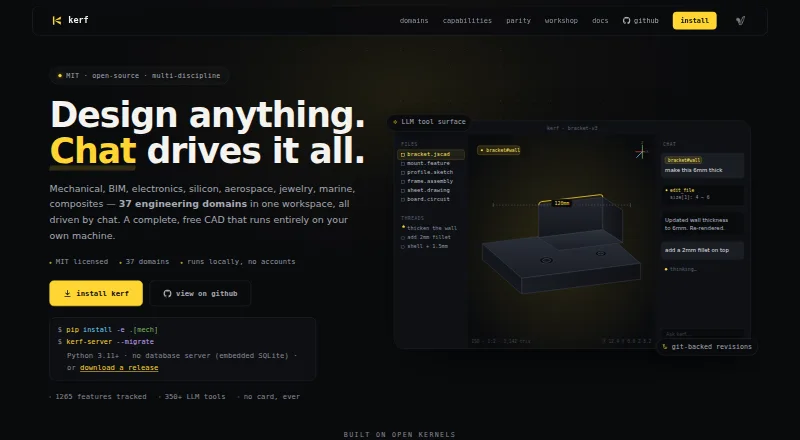
Kerf is a free, open-source CAD workspace that runs on a user's own machine and supports work across 37 engineering domains. Users can request design changes in plain language or work through the same tool surface using the Python kerf-sdk and JSON-RPC API. Mechanical design capabilities include constraint-based sketching, parametric feature history, validated B-rep geometry, drawings, and persistent face references. The workspace also covers FEM analysis, topology optimization, SPICE and RF analysis, CAM toolpaths, and G-code output. It supports many output types, including STEP, STL, 3MF, IFC4, Gerber, PDF, DXF, and firmware binaries. Kerf's site describes use by mechanical and electronics engineers, BIM architects, jewelry designers, and other engineering users. The app runs locally without accounts and maintains Git history for file revisions. Workshop content can be used offline after it is pinned. Installation is available from source or Docker, with release archives for macOS arm64, macOS x64, and Linux x64; source setup requires Python 3.11 or later. The chat workflow can use a user's own LLM; no bundled model or paid hosted plan is listed.
Good
- Free and open-source under the MIT license.
- Runs locally without accounts or billing.
- Supports Python and JSON-RPC scripting.
- Includes simulation, analysis, and CAM tools.
- Offers STEP, STL, 3MF, DXF, and G-code exports.
Watch out
- Chat workflow requires a bring-your-own LLM.
- Source installation requires Python 3.11 or later.
- No paid hosted plan is listed.
Who it suits
Kerf is aimed at mechanical and electronics engineers, BIM architects, jewelry designers, and other engineering users who want local CAD tools. It may suit users comfortable installing software from source or Docker and supplying their own LLM for chat workflows.
Verdict
Kerf brings CAD, analysis, simulation, and manufacturing workflows into a local, scriptable workspace. Its no-billing model and local history are useful, but chat depends on an LLM the user supplies.
Plans and prices
From Kerf's own pricing page, checked 29 Sep 2026.
| Plan | Price | What it gives you |
|---|---|---|
| Free | Free | Runs locally · no accounts · no billing · Free; MIT licensed |
| Kerf | Free | complete CAD workspace · MIT licensed · no account · no cloud billing |
The facts
Each one read from Kerf's own pages, with the date it was checked.
What it does
- API
- Kerf exposes a JSON-RPC interface at /v1/rpc for automation.checked 14 Oct 2026
- BIM and AEC
- BIM features include parametric building elements, MEP families, schedules, IFC round-trip, civil corridors and structural design.checked 14 Oct 2026
- CAD features
- Mechanical design includes a constraint-based sketcher, parametric feature history, validated B-rep geometry, drawings, and persistent face references.checked 29 Sep 2026
- Chat and scripting
- Users can describe design changes in plain language or script the same tool surface with the Python kerf-sdk and JSON-RPC API.checked 29 Sep 2026
- Chat editing
- An LLM can read and edit project source files through a registry of more than 3,000 purpose-built tools, with changes recorded as reviewable diffs.checked 14 Oct 2026
- Deployment
- Kerf can be installed from source or Docker, and the site lists release archives for macOS arm64, macOS x64, and Linux x64.checked 29 Sep 2026
- Desktop builds
- The 0.1.9 release lists one-file desktop binaries for macOS Apple Silicon, Windows x64 and Linux x64.checked 14 Oct 2026
- Documentation
- The documentation site contains getting-started, installation, configuration, architecture, file-format, domain, API, SDK, plugin and deployment sections.checked 14 Oct 2026
- Drawings
- Kerf provides multi-sheet technical drawings with GD&T callouts and drawing export.checked 14 Oct 2026
- Electronics
- Electronics functions cover tscircuit JSX, schematic and PCB work, ngspice simulation, RF analysis, autorouting, signal integrity and power integrity.checked 14 Oct 2026
- Engineering domains
- The product advertises 37 engineering domains, including mechanical, electronics, architecture, jewelry, aerospace, marine and textiles.checked 14 Oct 2026
- Feature comparison limit
- Kerf's parity matrix says its comparisons measure only how much of Kerf's listed capability set competitors cover, not whether Kerf replaces those products.checked 14 Oct 2026
- File outputs
- Listed outputs include STEP, STL, 3MF, IFC4, Gerber, G-code, PDF, DXF, BOM CSV, Touchstone, GDS-II, and firmware binaries.checked 29 Sep 2026
- Geometry kernels
- Kerf supports JSCAD, OpenCascade B-rep, analytic NURBS, Catmull-Clark subdivision and SDF/F-rep geometry kernels.checked 14 Oct 2026
- Integrations and kernels
- The site lists JSCAD, OpenCascade, tscircuit, planegcs, FEniCSx, OpenCAMlib, IfcOpenShell, FreeRouting, and KiCad among its open kernels and tools.checked 29 Sep 2026
- License
- Kerf's own source code is released under the MIT license.checked 14 Oct 2026
- Limit: desktop feature coverage
- The desktop binaries are lean builds and omit pythonOCC-based B-rep modeling and FEniCSx/dolfinx FEM, which require conda-based installation or Docker.checked 14 Oct 2026
- Limit: development dependency resolution
- The repository states that uv sync currently fails because workspace extras require conda-forge-only packages; its development install helper is the workaround.checked 14 Oct 2026
- Limit: geometry implementation
- The geometry roadmap says the pure-Python B-rep model is not yet wired into production surfacing operations, which still delegate solids and booleans to OCCT.checked 14 Oct 2026
- Limit: unfinished tests
- The repository describes kernel and engineering-domain test tiers as having known failures, with domain tests marked experimental and red.checked 14 Oct 2026
- Limit: Workshop browsing
- Offline browsing of followed Workshop feeds is not implemented; pinned part bytes remain available locally but the catalog requires a reachable feed.checked 14 Oct 2026
- Local data and history
- Kerf keeps local Git history, with revisions recorded for file edits; the site says the app runs locally without accounts.checked 29 Sep 2026
The company
- Data ownership
- Project revisions and local Git history are stored on the operator's node, and an unconfigured installation does not open network sockets.checked 14 Oct 2026
Where it runs
- Download platforms
- Release assets include macOS Apple Silicon, macOS Intel, Linux x64 and source archives.checked 14 Oct 2026
The full review of Kerf
Overview
Kerf is a local, open-source CAD workspace for engineers and designers who want to work through either conversational prompts or code. Its unusual breadth makes it relevant to mechanical and electronics design, BIM, jewelry work, simulation, and manufacturing; it is less suited to anyone who expects a ready-made hosted AI assistant.
Key features
Design by prompt or code
Users can describe design changes in plain language, then use the same tool surface through the Python kerf-sdk or JSON-RPC API. That combination is useful for people who want automation and repeatability alongside a conversational workflow. The chat depends on an LLM the user supplies, however, so Kerf does not provide a bundled model or turnkey hosted chat service.
CAD, analysis, and production
Mechanical workflows include a constraint-based sketcher, parametric feature history, validated B-rep geometry, drawings, and persistent face references. Jewelry designers also get ring sizing and stone-setting tools, photorealistic rendering, and manufacturing export. That mix can cover more than shaping a model, but the available tools span many disciplines and may be broader than a focused jewelry or mechanical package needs.
Kerf also includes FEM analysis, topology optimization, SPICE and RF analysis, CAM toolpaths, and G-code output. Listed exports range from STEP, STL, 3MF, IFC4, Gerber, DXF, and G-code to PDF, BOM CSV, Touchstone, GDS-II, and firmware binaries. Its open tool and kernel integrations include JSCAD, OpenCascade, tscircuit, FEniCSx, OpenCAMlib, IfcOpenShell, FreeRouting, and KiCad. This breadth is most compelling for users moving between design and downstream engineering tasks.
Local control and sharing
Kerf runs locally without accounts, and file edits are recorded in local Git history. Its Workshop uses signed, content-addressed objects over an open protocol, without requiring an account or central server; pinned content can be used offline. Those choices favor users who value local records and offline access, though they also put responsibility for the environment and any LLM on the user.
Pricing
Kerf is free: its Free plan costs nothing, is billed Free, and is MIT licensed. It runs locally with no accounts and no billing. There is no cheaper tier to trade features for cost, and no paid hosted plan is offered. The practical trade-off is that chat requires a user-supplied LLM rather than a bundled service.
Platforms
Kerf is listed for API, Linux, macOS, self-hosted, and web use, with a hybrid platform classification. It can be installed from source or Docker, and release archives are provided for macOS arm64, macOS x64, and Linux x64. Source installation requires Python 3.11 or later; its embedded SQLite setup needs no database server. This is a flexible deployment story for technical users, but source installation has a Python version requirement.
Who it's for
Mechanical and electronics engineers, BIM architects, and jewelry designers are among the intended users, as are people in other engineering disciplines. The API and Python tooling also make Kerf a stronger fit for users comfortable scripting their workflows. Jewelry designers looking for ring sizing, stone setting, rendering, and manufacturing export can use the same workspace as those handling broader engineering tasks.
Pros and cons
Pros
- Wide engineering scope: CAD, simulation, analysis, and manufacturing tools sit in one workspace, which can suit cross-discipline projects.
- Scriptable workflows: Python and JSON-RPC provide a route beyond chat for repeatable or automated design changes.
- Local-first operation: Local Git history, no-account operation, and offline use of pinned Workshop content support users who want to keep work under local control.
- Free and open source: The MIT-licensed Free plan has no billing, and includes the listed modeling, jewelry, and manufacturing capabilities.
Cons
- Chat needs an external LLM: Users must supply the model, so chat is not a complete out-of-the-box service.
- Technical setup can be part of the job: Source installation requires Python 3.11 or later, and Docker or source installation may be a better fit for technically capable users.
- Broad scope may be unnecessary: Users who only need a narrow design workflow may not benefit from its wide set of engineering tools.
Alternatives
For a broader jewelry-software shortlist, start with Jewelry Design Software.
Choose Rhino 3D if you want a paid Windows or macOS option with a permanent Commercial license for one concurrent user; it also has a free plan and trial. Pencil may fit a browser-based jewelry workflow: its free plan limits users to three designs and no AI credits, while Professional costs $39 a month and includes 200 AI credits. For a sculpting alternative, ZBrush has a free iPad plan with 28 brushes and a subscription option with price not listed.
Autodesk Fusion is worth considering for integrated CAD/CAM, team collaboration, PCB design, and electromechanical integration; its plan costs $57 a month, billed annually. Diatech Studio is another freemium web option. CounterSketch is a paid Windows and macOS membership at $349 a year, with tech support, an online academy, and library updates. Drakon sells Copilot credits in one-time packages, including 5,000 for 20.00 EUR and 12,500 for 50.00 EUR. Jewelry CAD Dream is a paid Windows option with no free plan or trial.
Verdict
Kerf is a strong fit for technically minded engineers and jewelry designers who want a free, local workspace that connects modeling with analysis and manufacturing, especially if they value scripting and local history. Its breadth and lack of billing are persuasive; look elsewhere if you need chat with a bundled model or prefer a more narrowly focused, fully hosted workflow.
Getting started
- Choose source or Docker installation, or use a listed macOS or Linux release archive.
- For source installation, meet the Python 3.11-or-later requirement.
- Run Kerf locally; it does not require an account or database server.
- If using chat, provide your own LLM.
- Pin Workshop content if you need offline use.
Limits worth knowing
Kerf is free, and the listed plan costs nothing. Its chat workflow can use a bring-your-own LLM; no bundled model or paid hosted plan is listed.
Questions
How much does Kerf cost?
The listed Free plan costs nothing.
Is Kerf open source?
Yes. Kerf is open source and listed as MIT licensed.
Which platforms does Kerf support?
Listed platforms are API, Linux, macOS, self-hosted and web. Release archives are listed for macOS arm64, macOS x64 and Linux x64.
Does Kerf include an LLM for chat?
The chat workflow can use a bring-your-own LLM. No bundled model is listed.
Does Kerf require an account or server?
Kerf runs locally without accounts, and its embedded SQLite setup needs no database server.
What can Kerf export?
Listed outputs include STEP, STL, 3MF, IFC4, Gerber, G-code, PDF, DXF, BOM CSV, Touchstone, GDS-II and firmware binaries.
Alternatives to Kerf
- 1
Rhino 3D
Free planiOSAPILinuxmacOS8.1Free plan - 2
Diatech Studio
Free planAndroidiOSWebAPI7.9From $99 a month - 3
ZBrush
Free planiOSAPImacOSWindows7.9Free plan - 4
Pencil
Free planWebAPI7.3From $39 a month - 5
Ruby Kinglet
Web6.9From $7 a month - 6
Autodesk 3ds Max
Windows6.6From $2,010 a year