K8up
K8up is an open-source Kubernetes Operator for managing backups and restores, distributed as a Helm chart for OpenShift and plain Kubernetes.
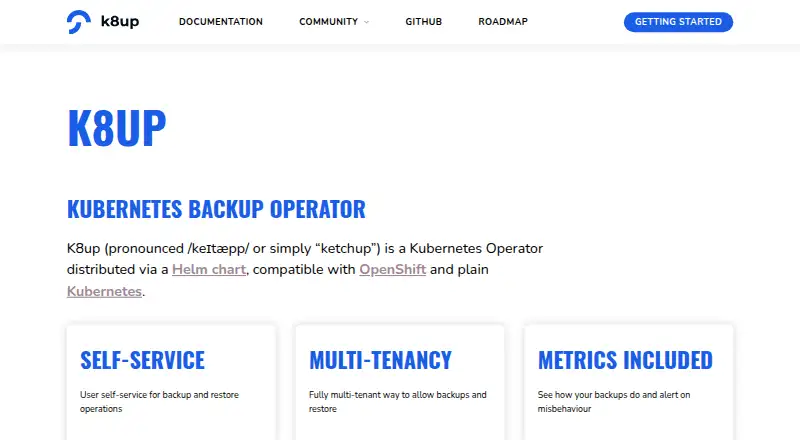
What K8up is
K8up is an open-source Kubernetes Operator for managing backups and restores, distributed as a Helm chart for OpenShift and plain Kubernetes. It provides self-service operations, including scheduled and on-demand backups of persistent volume claims marked ReadWriteMany or ReadWriteOnce, or selected by label. Application-aware backups can include output from tools that write to stdout. Built on Restic, K8up supports S3, SFTP, REST, local storage, and other targets. It can schedule longer-interval archives, check repository integrity, prune older backups, and restore through the K8up CLI. Prometheus metrics cover backup behavior, with operator and backup-job metrics sent to a Prometheus Pushgateway. The project describes itself as a CNCF Sandbox project that has been stable and production ready since 2019. K8up is free and open source, with community help available through CNCF Slack and GitHub Discussions. Official support is for recent stable Kubernetes versions with API server WebSocket support, version 1.31 or later. Linux x64 is supported; arm64 images are best-effort and receive no further testing or support.
Good
- Supports scheduled and on-demand backups
- Can select persistent volumes by label
- Works with S3, SFTP, REST, and local storage
- Includes integrity checks, pruning, and Prometheus metrics
Watch out
- Official support requires Kubernetes 1.31 or later
- Linux x64 is supported; arm64 is best-effort
- Community meetings are not currently held
Who it suits
It suits Kubernetes operators who need scheduled or on-demand backups and restores, including in multi-tenant environments. Teams should check the Kubernetes version and architecture requirements against their clusters.
Verdict
K8up combines Kubernetes backup and restore operations with multiple storage targets and monitoring metrics. Confirm the version and architecture limits before planning an installation.
The facts
Each one read from K8up's own pages, with the date it was checked.
Where it runs
- Application aware backups
- K8up can include output from tools that write to stdout in application aware backups.checked 9 Oct 2026
- Application-aware backups
- Application-aware backups can include output from any tool capable of writing to stdout.checked 9 Oct 2026
- Supported platform
- K8up v2 or later officially supports recent stable Kubernetes versions with WebSocket support in the API server, version 1.31 or later.checked 9 Oct 2026
What it does
- Architecture limit
- K8up is built, tested, and supported on Linux x64; arm64 images are provided on a best-effort basis without further testing or support.checked 9 Oct 2026
- Archival and retention
- K8up can schedule longer-interval archival, check repository integrity, and prune old backups.checked 9 Oct 2026
- Backup and restore
- K8up supports scheduled and on-demand backups, archival, repository integrity checks, pruning, and restores using its CLI.checked 9 Oct 2026
- Backups
- It can back up PVCs marked ReadWriteMany or ReadWriteOnce, or PVCs selected by a specific label, and supports on-demand and scheduled backups.checked 9 Oct 2026
- Community support
- The project provides a #k8up channel in the CNCF Slack workspace and GitHub discussions; it currently has no community meetings.checked 9 Oct 2026
- Installation
- The documentation recommends installing K8up on a Kubernetes cluster with Helm and provides a CLI downloadable from GitHub Releases.checked 9 Oct 2026
- Metrics
- K8up includes metrics for monitoring backup behavior and alerting on misbehaviour.checked 9 Oct 2026
- Monitoring
- K8up exposes Prometheus metrics for monitoring backup operations, with operator metrics and backup job metrics sent to a Prometheus Pushgateway.checked 9 Oct 2026
- Multi-tenancy
- K8up supports multi-tenant backup and restore operations.checked 9 Oct 2026
- Product
- K8up is a Kubernetes Operator for backups, distributed via a Helm chart and compatible with OpenShift and plain Kubernetes.checked 9 Oct 2026
- Project and maturity
- K8up is an open source CNCF Sandbox project that its documentation describes as stable and production ready since 2019.checked 9 Oct 2026
- Project status
- K8up describes itself as a CNCF Sandbox open source project and says it has been stable and production ready since 2019.checked 9 Oct 2026
- Restore
- Backups can be restored with the K8up CLI tool.checked 9 Oct 2026
- Security
- K8up’s vulnerability reporting page directs reporters to submit issues through the repository’s GitHub Security Advisories and says receipt is typically acknowledged within 24 hours.checked 9 Oct 2026
- Security reporting
- The project asks vulnerability reporters to submit reports through the repository’s GitHub security advisories and says receipt is typically acknowledged within 24 hours.checked 9 Oct 2026
- Self-service
- K8up provides user self-service for backup and restore operations.checked 9 Oct 2026
- Sponsor
- K8up is sponsored by VSHN AG.checked 9 Oct 2026
- Storage
- K8up uses Restic and supports S3, SFTP, REST, local storage, and other targets.checked 9 Oct 2026
- Storage integrations
- Built on Restic, K8up supports S3-compatible storage such as Amazon S3 and Minio; the product page also lists S3, SFTP, Rest, and Local targets.checked 9 Oct 2026
- Support and community
- The project uses the CNCF Slack workspace in the #k8up channel and has GitHub Discussions; it says it does not currently host community meetings.checked 9 Oct 2026
The company
- Founded
- 2019checked 28 Sep 2026
Alternatives to K8up
- 1

Bacula Enterprise
AndroidWebAPILinux7.9From $90 a year - 2

Plakar
Free planOpen sourceWebAPILinuxmacOS7.8Free plan - 3
HYCU R-Cloud
WebAPILinuxSelf-hosted7.5From $1.20 a month - 4

Storware Backup & Recovery
Free planWebAPILinuxmacOS7.5Free plan - 5
Vinchin Backup & Recovery
Free planWebLinuxSelf-hostedWindows7.3Free plan - 6

Veeam Kasten for Kubernetes
Free planWebAPILinuxSelf-hosted7.1Free plan