Juniper Address Pool Manager
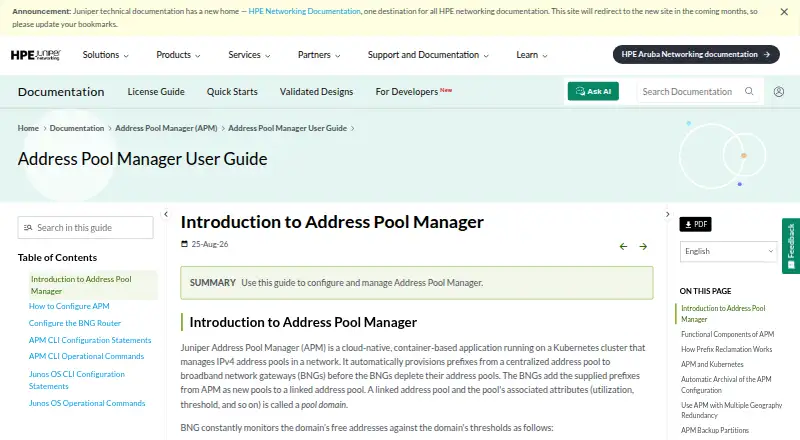
The facts below are what the maker publishes about Juniper Address Pool Manager, checked and dated. Our editors have not written about it yet.
The facts
Each one read from Juniper Address Pool Manager's own pages, with the date it was checked.
What it does
- Allocation
- APM uses just-in-time prefix allocation and subdivides prefixes to match BNG requests.checked 11 Oct 2026
- Automatic and manual operations
- Prefix reclamation can run automatically on configured alarms and schedules, or administrators can initiate it with APM commands.checked 11 Oct 2026
- Configuration archival
- APM can mirror a copy of its configuration to an external server using SCP.checked 11 Oct 2026
- Configuration interface
- APM provides a containerized CLI with a Junos OS-like structure for configuration, monitoring, statistics, and state.checked 11 Oct 2026
- Deployment
- APM is a container-based cloud-native application that runs on a Kubernetes cluster.checked 11 Oct 2026
- Gateway compatibility
- The managed gateway must be a Juniper MX Series Junos OS router or a Juniper BNG CUPS Controller.checked 11 Oct 2026
- Intended users
- Juniper describes APM as a tool for network operators and administrators managing IP prefix resources and BNG address pools.checked 11 Oct 2026
- Kubernetes options
- The installation guide lists Red Hat OpenShift Container Platform and Rancher Kubernetes Engine 2 for production clusters.checked 11 Oct 2026
- License terms
- Juniper lists APM licenses with one-year, three-year, and five-year subscription terms; the licensing guide also defines a perpetual term for Subscriber Services licenses.checked 11 Oct 2026
- Logging
- APM can export logs to an external syslog collector.checked 11 Oct 2026
- Notable limit
- APM currently supports IPv4 address families.checked 11 Oct 2026
- Prefix reclamation
- When a pool can be reclaimed, APM instructs the gateway to drain it and returns the prefix to the source partition after it is empty.checked 11 Oct 2026
- Protocol
- APM and BNGs communicate using APMi, a Juniper-defined gRPC-based protocol.checked 11 Oct 2026
- Purpose
- APM manages IPv4 address pools and automatically provisions prefixes from a centralized pool to broadband network gateways before their pools run low.checked 11 Oct 2026
- Reclamation
- APM can reclaim underused prefixes from BNG pools and redistribute them to pools that need addresses.checked 11 Oct 2026
- Redundancy
- In a multiple-geography deployment, APM uses primary and standby database instances, and its operator coordinates service roles and health reporting across clusters.checked 11 Oct 2026
- Release limitation
- The APM 3.4.0 release notes list an issue where deleting an entity-match entry may not completely clean up the show apm entity output.checked 11 Oct 2026
- Security
- Juniper recommends using a secure connection between APM and the BNG, and the setup process collects keys and certificates to secure external interfaces.checked 11 Oct 2026
- Support
- Juniper says technical product support is available through its Technical Assistance Center (JTAC).checked 11 Oct 2026
- Supported Kubernetes distributions
- The APM 3.6.0 installation requirements list Red Hat OpenShift Container Platform 4.18.31 or 4.20.18.checked 11 Oct 2026
The company
- Founded
- 1996checked 28 Sep 2026
- Headquarters
- Sunnyvale, California, USAchecked 28 Sep 2026
Alternatives to Juniper Address Pool Manager
- 1
GestióIP
Free planOpen sourceWebAPILinuxSelf-hosted8.2From $400 a year - 2
ManageEngine OpUtils
Free planAndroidiOSWebAPI8.2From $138 a year - 3
Subnetly
Free planiOSWebAPILinux7.9From $49 a month - 4

NetBox
Free planOpen sourceWebAPILinuxSelf-hosted7.6Free plan - 5

Danbyte
Free planOpen sourceWebAPILinuxSelf-hosted7.4Free plan - 6

Obelinf
Free planWebAPI7.4From $99 a month